
What Are Brass Cable Glands?
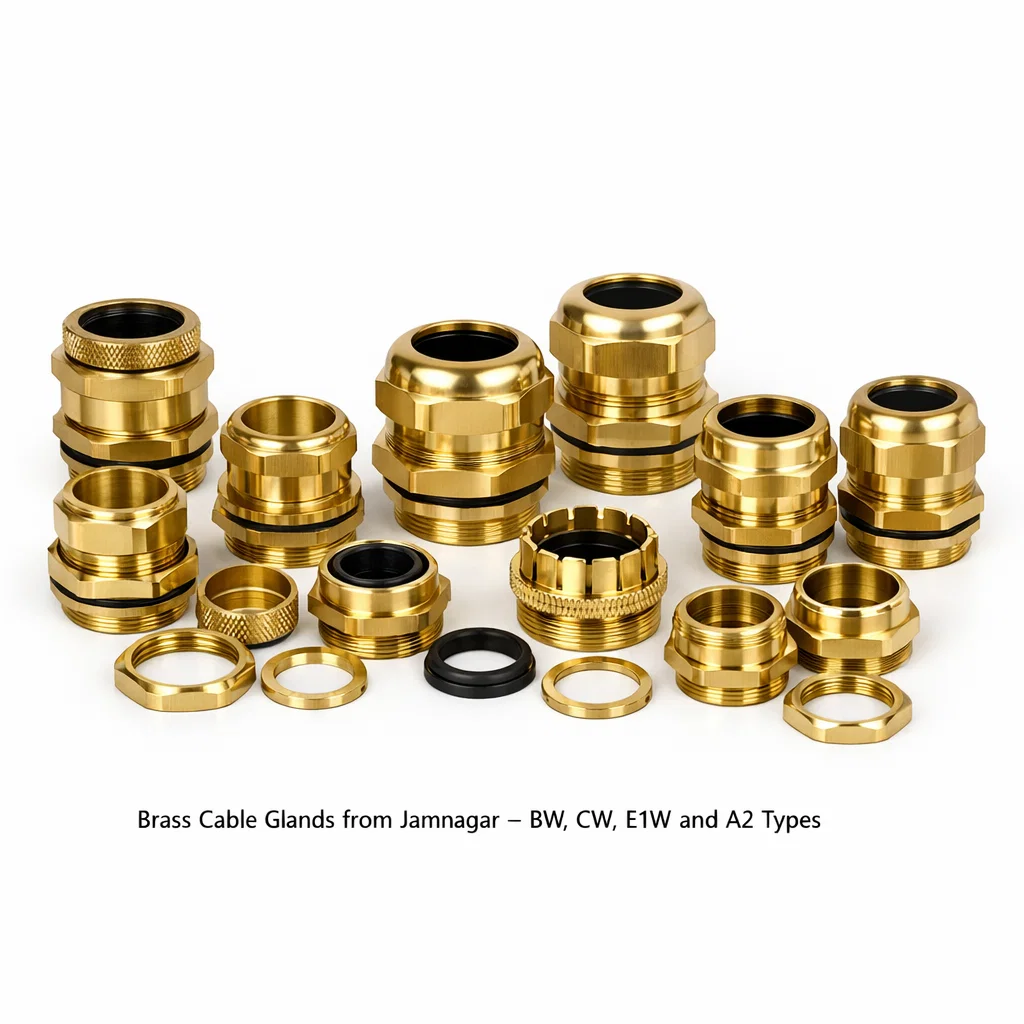
A brass cable gland (also known as a cable fitting, cable connector, or cord grip) is a mechanical device used to attach and secure the end of an electrical cable to the equipment it connects to. Cable glands perform multiple critical functions simultaneously: they provide strain relief — preventing tension on the cable from reaching the electrical connections inside the enclosure; they create a seal — keeping out moisture, dust, and gases; they maintain the integrity of the enclosure’s IP (Ingress Protection) rating; and in hazardous area installations, they provide explosion protection by preventing the propagation of flame through the cable entry point.
Brass cable glands are the industry standard for electrical cable management in industrial, commercial, marine, oil and gas, and hazardous area installations worldwide. Jamnagar, India — the brass manufacturing capital of the world — is the global center for brass cable gland production. Jamnagar Brass Components is among the leading manufacturers of BW, CW, E1W, and A2 type brass cable glands for export to the USA, UK, Europe, Australia, Middle East, and worldwide.
Brass Cable Gland Types – Comprehensive Guide
BW Type Brass Cable Glands
BW (Braided Wire) type cable glands are designed for use with armoured cables that have a steel wire or brass wire armour braid. The BW gland provides mechanical grip and electrical continuity between the cable armour and the equipment enclosure earth (ground) conductor. BW glands are the most widely specified type in industrial and commercial electrical installations worldwide. They consist of a brass body, a brass compression nut, a neoprene or EPDM sealing ring, a locknut, and an earth (ground) tag. BW glands are rated for IP68 sealing (to a specified depth and duration) when correctly installed.
Our BW brass cable glands comply with BS EN 50262 and BS 6121 Part 1 and are available in metric thread (M16 to M63) and NPT thread (½” to 2″) in standard and reduced variants. Common applications include motor termination boxes, distribution boards, control panels, junction boxes, and switchgear in industrial plants, water treatment facilities, power generation, and commercial buildings.
CW Type Brass Cable Glands
CW (Cable Wire) type cable glands are designed for use with steel wire armoured (SWA) cables and provide an enhanced mechanical grip on the cable armour using a cone and cone-lock mechanism. The CW gland offers superior pull-out resistance and is preferred in installations where cables are subject to vibration, mechanical stress, or frequent movement. CW glands maintain the armour-to-earth electrical continuity required by wiring regulations and provide IP68 sealing.
Our CW type brass glands conform to BS 6121 Part 1 and are available in metric (M16–M63) and PG thread sizes. Typical applications include cable entries on heavy industrial machinery, conveyors, pumps and motors in challenging environments, cable management in mining, oil and gas, marine, and offshore applications.
E1W Type Brass Cable Glands (Outdoor / Weather Resistant)
E1W type cable glands are the outdoor and weather-resistant version of the standard BW/CW type glands, featuring an additional weather seal — typically a EPDM outer sealing ring or weather seal washer — that provides resistance to rainwater ingress, UV exposure, and temperature extremes. E1W glands are specifically designed for cable entries on equipment installed outdoors or in exposed, wet, or damp conditions. The additional outer seal ensures IP66 or IP68 rating is maintained even when exposed to water spray, heavy rain, or temporary immersion.
E1W cable glands conform to BS EN 50262 (weather-resistant grade) and are widely used in outdoor distribution substations, solar PV installations, wind turbines, external lighting columns, outdoor motor control centers (MCCs), and cable entries on outdoor process plant equipment. Available in metric (M16–M63) and NPT thread sizes.
A2 Type Brass Cable Glands (Hazardous Area – ATEX / IECEx)
A2 type brass cable glands are certified explosion-proof cable glands designed for use in hazardous areas where flammable gases, vapors, or dusts may be present. The A2 gland provides flameproof (Ex d) and increased safety (Ex e) entries conforming to IEC 60079-0 and IEC 60079-1 (Ex d) or IEC 60079-7 (Ex e). They are ATEX certified (II 2 G Ex d or II 2 G Ex e) for use in Zone 1 and Zone 2 (gas) hazardous areas, and IECEx certified for global hazardous area applications.
A2 cable glands are manufactured with tighter tolerances and more stringent quality requirements than standard industrial glands, with every batch subject to dimensional verification, pull-out force testing, and IP verification. They are constructed with flame-path components that prevent ignition of external hazardous atmospheres even under internal arcing or explosion conditions. Our A2 glands conform to ATEX Directive 2014/34/EU, IECEx standards, and NEC 500/505 (US National Electrical Code) requirements for Class I, Division 1 and Zone 1 locations.
Additional Cable Gland Types Available
In addition to BW, CW, E1W, and A2 types, we manufacture a wide range of specialized cable glands including: EMC (Electromagnetic Compatibility) cable glands for shielded cable termination in data, instrumentation, and control applications; marine cable glands conforming to IEC 60092 for shipboard electrical installations; stainless steel cable glands for aggressive chemical environments; nylon/plastic cable glands for lightweight or anti-corrosive applications; and multiple cable transit (MCT) systems for firewall cable penetrations.
Brass Cable Gland Sizes and Thread Standards
Our brass cable glands are available in all standard thread sizes and forms. The table below provides a quick reference guide to cable gland thread sizes and their typical cable diameter ranges.
| Thread Size (Metric) | Equivalent NPT (US) | PG Thread | Typical Cable OD Range | Common Application |
|---|---|---|---|---|
| M16 × 1.5 | ½” NPT | PG9 / PG11 | 4–10 mm | Instrument cables, control wiring |
| M20 × 1.5 | ½” NPT | PG13.5 | 6–12 mm | Standard control cables, power cables |
| M25 × 1.5 | ¾” NPT | PG16 / PG21 | 10–16 mm | Medium power cables, SWA up to 10mm² |
| M32 × 1.5 | 1″ NPT | PG21 / PG29 | 15–21 mm | SWA power cables, motor feeders |
| M40 × 1.5 | 1¼” NPT | PG29 / PG36 | 19–28 mm | Medium armoured cables, industrial feeders |
| M50 × 1.5 | 1½” NPT | PG36 / PG42 | 27–35 mm | Heavy armoured cables, large power cables |
| M63 × 1.5 | 2″ NPT | PG48 | 34–44 mm | Large SWA cables, VFD cables |
Brass Material Grades for Cable Glands
| Grade | US Standard | UK/EU Standard | DIN/ISO | Composition | Notes |
|---|---|---|---|---|---|
| C36000 (Standard) | ASTM B16 / B453 | CW603N (BS EN 12164) | CuZn36Pb3 | Cu 60–63%, Pb 2.5–3.7%, Zn Rem. | Standard machining grade, most cable glands |
| C37700 (Forging Brass) | ASTM B283 / B124 | CW614N (BS EN 12420) | CuZn38Pb2 | Cu 58–61%, Pb 1.5–2.5%, Zn Rem. | Forged gland bodies |
| CW602N (DZR) | Equiv. ASTM B283 | CW602N (BS EN 12165) | CuZn36Pb2As | Cu 61–63%, As 0.02–0.06% | Marine/corrosive environment |
| Nickel Plated Brass | ASTM B689 | EN 12540 | — | Brass substrate + Ni 5–15 µm | Corrosion enhanced, EMC glands |
| C87850 (Lead Free) | ASTM B763 | — | CuZn21Si3P | Cu 75–77%, Si 2.7–3.4%, Pb ≤0.09% | RoHS/lead-free required applications |
Cable Gland Finishes and Coatings
Brass cable glands are available in multiple surface finish options depending on installation environment and customer preference. Natural brass (as machined or polished) is the standard finish for general industrial use. Nickel electroplating provides enhanced corrosion resistance and is standard on EMC/shielded cable glands and marine-grade glands. Chrome plating provides bright decorative finish for architectural and commercial applications. Zinc passivation (yellow or clear) enhances corrosion resistance at minimal cost. Hot-dip tinning is available for maximum corrosion protection in highly aggressive environments.
Standards and Certifications for Brass Cable Glands
Our brass cable glands are manufactured and tested to the following key international standards: BS EN 50262 (Cable glands for electrical installations), BS 6121 Parts 1–5 (Mechanical cable glands), IEC 60079-0 (General requirements for explosive atmospheres), IEC 60079-1 (Ex d flameproof enclosures), IEC 60079-7 (Ex e increased safety), ATEX Directive 2014/34/EU (Equipment for explosive atmospheres), IECEx (International certification for explosion-proof equipment), NEC 500/505 (US National Electrical Code Class I/II Divisions and Zones), UL Standard 514B (Conduit, tubing, and cable fittings – US), IEC 60529 (IP protection ratings — IP54, IP65, IP66, IP67, IP68), and IEC 60092-303 (Marine cable installations).
Why Jamnagar Is the World’s Cable Gland Capital
Jamnagar, Gujarat, India produces an estimated 70–80% of the world’s brass cable glands. The city’s unique advantages — massive concentration of brass processing infrastructure, skilled precision machining workforce, abundant raw material supply from Jamnagar’s own brass mills, decades of manufacturing expertise, and highly competitive cost structure — make it the unrivaled global hub for cable gland production. Major electrical brands across the USA, UK, Europe, Australia, and the Middle East source their cable glands from Jamnagar manufacturers, often under private label arrangements.
Why Choose Jamnagar Brass Components for Cable Glands?
- Specialist Cable Gland Manufacturer: Cable glands are among our core product lines with decades of production experience. We have dedicated machining, assembly, and testing lines for cable gland manufacturing.
- Comprehensive Type Range: BW, CW, E1W, A2, EMC, marine, reduced, increased, single and double seal, armour lock types — all available from one source.
- Full Certification: CE marking, ATEX certification, IECEx certification, and UL-listed options available. All certifications maintained current and available for customer documentation.
- Rigorous Quality Control: 100% dimensional inspection of critical features (thread form, sealing ring groove, armour grip), IP rating verification on sample basis, pull-out force testing, and visual inspection for every production batch.
- Competitive Pricing: As a Jamnagar-based manufacturer, we offer the most competitive pricing on brass cable glands — often 30–50% below European or US equivalent branded products.
- Private Label Capability: We supply cable glands under customer brand names with custom part numbering, packaging, and documentation. Trusted private-label partner for major electrical brands worldwide.
- Fast Delivery: Standard catalog cable glands are held in finished goods inventory for fast order fulfillment. Minimum order quantities from 1,000 pieces per type/size.
- US/NPT Thread Specialization: Dedicated production of NPT-threaded cable glands for the North American market — a specialty often not offered by smaller Jamnagar manufacturers.
Brass Cable Glands – Frequently Asked Questions
Q1: What is the difference between BW and CW type cable glands?
BW (Braided Wire) cable glands grip the cable armour using a cone that is compressed against the armour braid by tightening the outer nut. CW (Cable Wire) glands use a more positive armour clamping mechanism with an inner cone and outer cone-lock, providing higher pull-out force and better retention in applications subject to vibration or cable movement. CW glands are preferred in demanding industrial and marine environments; BW glands are more commonly used in standard commercial and industrial panel wiring.
Q2: What makes an E1W cable gland different from a standard BW gland?
An E1W gland adds a secondary outer seal (weather seal) compared to the standard BW type. This outer seal prevents water ingress when the gland is installed in outdoor, wet, or exposed positions. The outer weather seal is typically made from EPDM rubber and fits over the cable outer sheath between the gland body and the lock nut, ensuring IP66/IP68 sealing is maintained in rain, spray, and temporary submersion conditions.
Q3: Are A2 type cable glands suitable for oil and gas applications in the USA?
Yes. A2 type ATEX/IECEx certified cable glands are used extensively in oil and gas production, refining, and petrochemical facilities worldwide, including in North America. For the US market specifically, cable glands used in hazardous locations must comply with the National Electrical Code (NEC) Articles 500–502 (Class/Division system) or Article 505 (Zone system). We supply A2 glands with both ATEX/IECEx certification (for international/Zone use) and UL/FM approved versions for NEC 500 Class I Division 1 compliance.
Q4: What IP rating do your brass cable glands achieve?
Our standard brass cable glands are rated IP68 (dust-tight and protected against continuous immersion in water — tested at 10 meters for 30 minutes) when correctly installed per installation instructions. E1W types are additionally rated for outdoor weathering (IP66 per the weather seal requirements of BS EN 50262). IP54 and IP65 rated lighter-duty versions are also available for specific applications.
Q5: Can I get NPT thread cable glands for the North American market?
Yes. We specifically manufacture brass cable glands with NPT (National Pipe Taper) threads in ½” NPT, ¾” NPT, 1″ NPT, 1¼” NPT, 1½” NPT, and 2″ NPT sizes for the North American market. NPT threaded cable glands are also widely used in Middle East projects following US electrical codes. All standard BW, CW, E1W, and A2 types are available in NPT thread sizes.
Q6: Are your cable glands RoHS and REACH compliant?
Standard brass cable glands made from C36000 (containing lead) are generally exempt from RoHS restrictions for electrical/electronic equipment cables and cable fittings under Annex III exemptions. However, for applications where RoHS compliance is strictly required (particularly consumer electronics), we can supply cable glands in lead-free brass alloys (C87850, bismuth brass) with formal RoHS compliance declarations. REACH SVHC declarations are available for all our standard cable glands on request.
Q7: What is the minimum order quantity (MOQ) for brass cable glands?
Standard catalog cable glands are available from 1,000 pieces per type/size. For popular sizes (M20, M25, M32 in BW type), we hold stock and can fulfill smaller trial orders from 250 pieces. Custom cable glands (non-standard sizes, special configurations, unique certifications) typically have MOQs of 2,000–5,000 pieces due to setup and certification costs. Please contact us to discuss your specific requirements.
Q8: How are cable glands packaged for export?
Standard cable glands are individually bagged in polyethylene bags (with or without part number labels), bulk-packed in boxes of 25, 50, or 100 pieces depending on size, and packed in export cartons with full labeling (part number, description, quantity, gross/net weight, country of origin). We can accommodate custom packaging requirements including blister packs, branded boxes, and retail-ready packaging for customer-branded products.
Q9: Can you supply cable glands with pre-fitted sealing washers and locknuts?
Yes. Our complete cable gland assemblies come with all necessary components as a kit: gland body, inner seal (neoprene or EPDM), compression ring, outer seal (for E1W type), locknut, and earth tag (for BW/CW types). Kits are pre-assembled or packed in bags for customer assembly. We also supply loose spares (sealing rings, locknuts, earth tags) separately for maintenance and replacement.
Q10: Are shrouded (insulated) versions of brass cable glands available?
Yes. PVC or nylon shrouds (insulating gland shrouds) are available for BW, CW, and E1W type cable glands to prevent inadvertent contact with energized metallic parts of the gland body in electrically exposed or touch-sensitive installations. We supply shrouds as a standard accessory that fits over the external body of the gland after installation.
Q11: How do I select the correct cable gland for my installation?
Cable gland selection depends on: (1) cable construction (armoured/unarmoured, braid/SWA, overall diameter), (2) environmental conditions (indoor/outdoor, IP requirements, temperature range), (3) hazardous area classification (Zone 0/1/2, Division 1/2, ATEX/IECEx/NEC), (4) entry thread requirement (metric/NPT/PG), and (5) any special requirements (EMC screening, marine, high temperature). Our technical team is happy to assist with cable gland selection for your specific application — please provide cable specifications and environmental/hazardous area classification.
Q12: Do your A2 glands carry current ATEX certificate numbers?
Yes. Our A2 type cable glands carry current ATEX certificates issued by a notified body under the ATEX Directive 2014/34/EU. Certificate numbers, Ex marking (Ex d IIC, Ex e II), temperature class, and full product documentation are available to customers. IECEx certificates for international use are also available. We keep our certifications current and can provide copies of all certification documentation with shipments.
Q13: Can cable glands be used with unarmoured cables?
Yes. For unarmoured (plain) cables, we supply single compression cable glands (often called Type A or Type E glands) that grip and seal only on the outer cable sheath — without an armour clamping mechanism. These are suitable for SY, CY, flexible, and plain PVC-jacketed cables. For armoured cables (SWA, STA, wire braid), BW or CW type double-compression glands are required to provide both armour bonding and cable seal.
Request a Quote for Brass Cable Glands from Jamnagar
Jamnagar Brass Components is your ideal supply partner for BW, CW, E1W, and A2 type brass cable glands for distribution, project supply, and OEM applications. Our combination of comprehensive type range, full certifications, competitive pricing, and proven export capability makes us a preferred sourcing partner for electrical distributors, EPC contractors, panel builders, and OEM equipment manufacturers in the USA, Canada, UK, Europe, Australia, UAE, and beyond.
Contact us today with your cable gland requirements — type, thread size, quantity, certifications required, and target pricing — and our sales team will respond with a competitive quotation and samples within 48–72 hours.