
What Are Aluminum Manifolds?
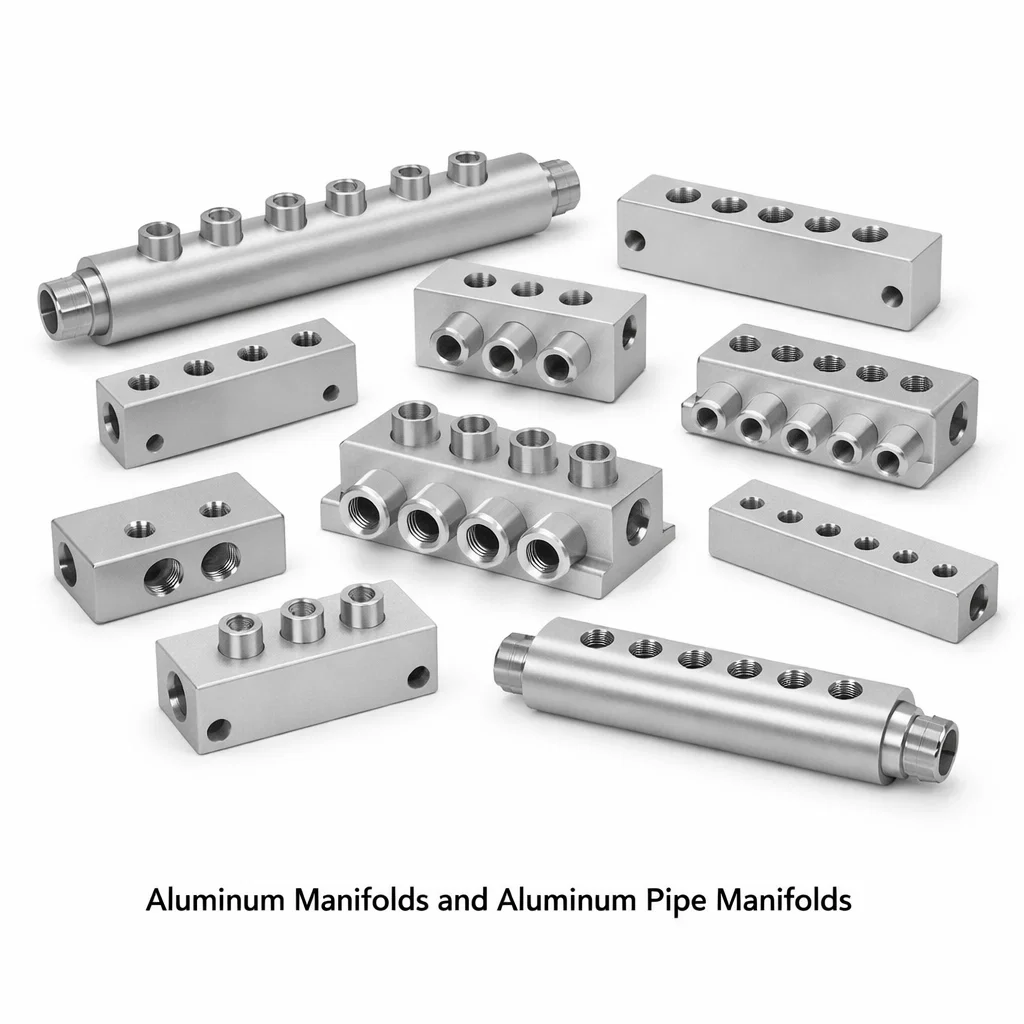
An aluminum manifold is a precision-engineered fluid distribution block or header manufactured from aluminum alloy, designed to distribute or collect fluids (liquids or gases) from a single inlet to multiple outlets — or vice versa. Aluminum manifolds are widely used in plumbing, HVAC, hydraulic, pneumatic, automotive, and industrial systems as a central hub for fluid or gas management, replacing multiple individual pipes, fittings, and valves with a single integrated component. The result is a cleaner, more compact, more reliable, and often more cost-effective system layout.
Jamnagar Brass Components manufactures high-quality Aluminum Manifolds and Aluminum Pipe Manifolds for customers in the USA, Canada, UK, Europe, and worldwide. Our aluminum manifolds are machined from solid aluminum bar, extruded profiles, or aluminum die castings to customer drawings and specifications, offering an excellent combination of light weight, corrosion resistance, thermal performance, and cost efficiency.
Types of Aluminum Manifolds We Manufacture
Aluminum Pipe Manifolds (Multi-Port Distribution Manifolds)
The most common type, aluminum pipe manifolds feature a central tube or block with multiple outlet ports (typically 2 to 12 ports) along the body. Used extensively in radiant heating and cooling systems, these manifolds distribute hot or chilled water to individual circuits (zones) from a central boiler or chiller. Available in 1″ to 3″ main pipe sizes with ½” or ¾” branch connections, in BSP, NPT, or metric thread forms.
Aluminum Hydraulic Manifolds
Precision-machined aluminum hydraulic manifold blocks integrate multiple hydraulic circuits, valves, and orifices into a single compact body, replacing complex tubing and fitting assemblies. These manifolds are machined from aluminum billet (typically 6061-T6 or 7075-T6) to tight tolerances, with cross-drillings, valve cavities, and port connections per customer CAD drawings. Suitable for pressures up to 250 bar (3,600 psi) depending on alloy and wall thickness.
Aluminum Pneumatic Manifolds
Aluminum pneumatic manifolds distribute compressed air to multiple actuators, cylinders, or valves from a single feed port. Our manifolds are manufactured from 6061-T6 or 6063-T5 aluminum with anodized or clear-coated finish for corrosion resistance. Thread options include G (BSP), NPT, BSPT, and metric (M5, M6, 1/8″, 1/4″, 3/8″) in standard solenoid valve mounting configurations (ISO 5599, NAMUR, etc.).
Aluminum HVAC Manifolds
In HVAC applications, aluminum manifolds are used for refrigerant distribution (multi-split systems), chilled water distribution headers, and air handling unit connections. Their light weight versus steel or copper makes aluminum manifolds preferred for rooftop and suspended HVAC installations where weight is a constraint.
Aluminum Radiant Heating Manifolds
Underfloor (radiant) heating systems rely on aluminum manifolds to distribute hot water from the boiler to individual floor heating loops. Our radiant manifolds are available in 2-port to 12-port configurations, with flow meters, zone valves, and balancing valves integrated as required. Suitable for PEX, PEX-AL-PEX, multilayer, and copper tubing systems.
Aluminum Automotive Manifolds
Aluminum manifolds for automotive applications include coolant distribution manifolds, fuel rail manifolds, air intake manifolds (aftermarket/specialty), and transmission oil distribution manifolds. 6061-T6 and 7075-T6 aluminum alloys are commonly used for their strength-to-weight ratio and compatibility with automotive fluids.
Custom Aluminum Manifold Blocks (Ported Blocks)
We produce custom aluminum manifold blocks to customer 3D models and engineering drawings. These can include any combination of drilled passages, tapped ports, O-ring grooves, valve cavities, and face sealing surfaces. Custom manifold blocks are widely used in semiconductor equipment, medical devices, laboratory instruments, and industrial automation systems.
Aluminum Alloy Grades for Manifolds – Material Selection Guide
Selecting the correct aluminum alloy for your manifold application is critical for performance, machinability, and corrosion resistance. The table below provides an overview of the most commonly specified aluminum alloys for manifold manufacturing along with their international equivalents.
| Alloy | US Standard | European Equiv. | ISO/DIN Equiv. | Temper | UTS (MPa) | Best Use |
|---|---|---|---|---|---|---|
| 6061 | ASTM B221 / B209 | EN AW-6061 | AlMg1SiCu | T6 | 310 | General hydraulic/pneumatic manifolds, HVAC |
| 6063 | ASTM B221 | EN AW-6063 | AlMg0.7Si | T5/T6 | 215 | Extrusions, pipe manifolds, architectural |
| 6082 | — | EN AW-6082 | AlSi1MgMn | T6 | 310 | European structural manifolds, medium duty |
| 7075 | ASTM B209 / B211 | EN AW-7075 | AlZn5.5MgCu | T6 | 503 | High-pressure hydraulic manifolds, aerospace |
| 2024 | ASTM B209 | EN AW-2024 | AlCu4Mg1 | T3/T4 | 440 | Aerospace, high-strength manifold blocks |
| A380 (Die Cast) | ASTM B85 | EN AC-46100 | AlSi8Cu3 | F | 317 | Die-cast manifold bodies, HVAC, automotive |
| A356 (Sand/PM Cast) | ASTM B26 | EN AC-42100 | AlSi7Mg0.3 | T6 | 228 | Cast manifolds, medium pressure |
Manufacturing Processes for Aluminum Manifolds
We offer multiple manufacturing routes for aluminum manifolds depending on design complexity, production volume, and application requirements. CNC machined manifolds from solid billet provide the highest precision and are ideal for complex internal passages and tight tolerances. Extruded aluminum profiles offer a cost-effective solution for simple pipe-type manifolds in medium to high volumes. Die-cast aluminum manifolds are suitable for high-volume production of complex shapes where draft angles and casting design rules can be accommodated.
All machined surfaces are deburred and cleaned, with optional surface treatments including hard anodizing (Type III), clear anodizing (Type II), chromate conversion coating (Alodine/Iridite — MIL-DTL-5541), powder coating, or paint for additional corrosion protection.
Key Advantages of Aluminum Manifolds
- Lightweight: Aluminum is approximately one-third the weight of steel and one-third the weight of brass — critical for reducing system weight in automotive, aerospace, and portable equipment applications.
- Excellent Corrosion Resistance: The natural oxide layer on aluminum provides good corrosion resistance, enhanced further by anodizing or chromate conversion coatings.
- High Thermal Conductivity: Aluminum’s excellent thermal conductivity (approximately 150–200 W/m·K) makes it ideal for heat exchanger manifolds, cooling plates, and thermal management applications.
- Cost Effective: Compared to stainless steel or titanium manifolds, aluminum manifolds offer significant cost savings, especially at high volumes.
- Machinability: Aluminum alloys (particularly 6061-T6 and 7075-T6) machine readily at high speeds, enabling complex manifold geometries at competitive cycle times.
- Recyclability: Aluminum is 100% recyclable without loss of properties, aligning with sustainability requirements in many OEM supply chains.
Why Choose Jamnagar Brass Components for Aluminum Manifolds?
While our name says “Brass Components,” we have extensive capabilities in aluminum precision machining and have been supplying aluminum manifolds to customers globally for over two decades. Here is why customers in the USA and worldwide choose us:
- Precision CNC Machining: 5-axis and 3+2 axis CNC machining centers for complex manifold geometries with intricate internal drillings and multiple face operations.
- Leak Testing: All manifolds pressure tested with air-under-water or hydraulic pressure testing to customer specifications before shipment.
- Material Traceability: Certified aluminum billets with EN 10204 Type 3.1 certificates. Chemical composition and mechanical properties verified before machining.
- Flexible Volume Range: Prototypes and samples to full production runs (1 piece to 100,000+ pieces per year) at competitive pricing.
- Competitive Lead Times: Custom manifolds: 4–8 weeks from drawing approval. Repeat orders from established tooling: 2–4 weeks.
- Engineering Support: Our technical team provides DFM (Design for Manufacturability) review, helping optimize your manifold design for reduced machining time and cost without compromising function.
- One-Stop Shop: We can supply manifolds with all secondary operations including tapping, reaming, O-ring groove machining, surface treatment, assembly of fittings/valves, and leak testing — reducing your supply chain complexity.
Frequently Asked Questions – Aluminum Manifolds
Q1: What is the maximum working pressure for aluminum manifolds?
The maximum working pressure depends on the alloy, wall thickness, and design. Aluminum 6061-T6 manifolds are typically rated for 100–250 bar (1,450–3,625 psi) in hydraulic service depending on port size and body dimensions. For higher pressures, 7075-T6 aluminum is used. We calculate pressure ratings based on ASME standards and perform burst testing on new designs upon request.
Q2: Can you machine aluminum manifolds to our proprietary CAD drawings?
Absolutely. Custom manifolds to customer-supplied 3D CAD models (STEP, IGES, SolidWorks, CATIA, Pro-E) or 2D drawings (PDF, DXF, DWG) are our core business. We provide DFM feedback, a detailed quotation, and lead time within 72 hours of receiving your drawings.
Q3: What thread standards are available on aluminum manifolds?
We machine all standard thread forms including NPT (American National Pipe Taper — ANSI/ASME B1.20.1), NPTF, BSP/BSPP (G thread — ISO 228), BSPT (R thread — ISO 7), metric (M series — ISO 965), SAE-ORB (O-ring Boss — SAE J1926), and ORFS (O-ring Face Seal — SAE J1453). Custom or proprietary thread forms are also available on request.
Q4: Is anodizing available for aluminum manifolds?
Yes. We offer Type II (clear) anodizing, Type III hard anodizing (for wear resistance up to 25–50 microns), colored anodizing (black, red, blue, gold, etc.), and chromate conversion coating (clear or yellow Alodine). Post-anodizing masking can be applied to maintain critical thread dimensions and sealing surfaces.
Q5: What fluids are compatible with aluminum manifolds?
Aluminum is compatible with most hydraulic oils (mineral, synthetic, biodegradable), compressed air, nitrogen, many refrigerants (R410a, R32, R134a), water/glycol mixtures, and many industrial fluids. Aluminum is NOT recommended for use with strong acids, strong alkalis, mercury, or many industrial solvents. For aggressive media, we can advise on appropriate alloy selection or alternative materials (stainless steel or brass) for your application.
Q6: Can you supply aluminum manifolds for radiant floor heating systems?
Yes. Aluminum radiant floor heating manifolds are one of our standard product ranges. We supply 2-port to 12-port manifolds with integrated flow meters, drain/fill valves, air vents, and zone actuator mounts. Compatible with PEX, PEX-AL-PEX, multilayer pipe, and copper tubing systems in both 1/2″ and 3/4″ outlet sizes. Available pre-assembled or as manifold bodies for your assembly line.
Q7: How are internal drillings sealed in aluminum manifold blocks?
Access holes created during cross-drilling are typically sealed with stainless steel or aluminum hex socket plugs with PTFE or anaerobic sealant, aluminum press-in plugs, or custom machined end plugs. We machine and assemble all plugging as part of the manifold machining process, with leak testing performed after assembly.
Q8: What is the typical lead time for custom aluminum manifolds?
For new custom designs, we target 4–8 weeks from final drawing approval to shipment. This includes material procurement, programming, first article machining, inspection, any required surface treatment, and shipping preparation. Repeat orders typically ship in 2–4 weeks from order confirmation.
Q9: Do you perform leak testing on all aluminum manifolds before shipment?
Yes. All aluminum manifolds undergo pressure leak testing at a minimum 1.5× the rated working pressure (air-under-water method) before packing and shipment. For higher-pressure hydraulic manifolds, hydraulic pressure testing at customer-specified test pressures is performed with test records provided in the shipment documentation.
Q10: Can you supply aluminum manifolds with integrated fittings and valves assembled?
Yes. We offer manifold assembly services including installation of threaded pipe fittings (brass, stainless, aluminum), ball valves, flow meters, pressure gauges, drain valves, and air vents. Complete assembled manifold systems are packed and shipped ready for installation, reducing on-site assembly time and complexity for your customers.
Q11: Are aluminum manifolds suitable for potable water use?
Aluminum can leach traces of aluminum ions into water, which may be a concern for potable water applications in some jurisdictions. For radiant heating systems (closed loop, non-potable), aluminum manifolds are standard. For potable water distribution, brass or stainless steel manifolds are generally preferred. We can advise on the most appropriate material for your application.
Q12: What certifications do you hold for aluminum manifold manufacturing?
We operate under ISO 9001:2015 certification for our quality management system. Material test certificates conform to EN 10204 (Type 3.1). We can provide dimensional inspection reports (CMM), pressure test certificates, and surface treatment certificates for all batches. For specific industry certifications (PED, ATEX, ASME, etc.), we work with our customers and accredited third-party certification bodies to obtain the necessary approvals.
Q13: What is the difference between an aluminum pipe manifold and an aluminum block manifold?
An aluminum pipe manifold (or header manifold) is typically a cylindrical tube or pipe with multiple branch ports welded, brazed, or machined along its length — resembling a pipe with outlets. It is commonly used in HVAC, plumbing, and radiant heating for simple distribution duties. An aluminum block manifold is a solid rectangular or complex-shaped billet with internal drilled passages, valve cavities, and multiple port connections — used in hydraulic, pneumatic, and custom fluid control applications. Block manifolds are far more complex and costly to manufacture but offer much greater integration of fluid circuit functions.
Request a Quote for Aluminum Manifolds
Whether you need standard aluminum pipe manifolds for a radiant heating project or complex custom aluminum hydraulic manifold blocks for an industrial OEM application, Jamnagar Brass Components has the capabilities, experience, and capacity to deliver. Contact our team today with your drawings and specifications for a competitive quotation.