
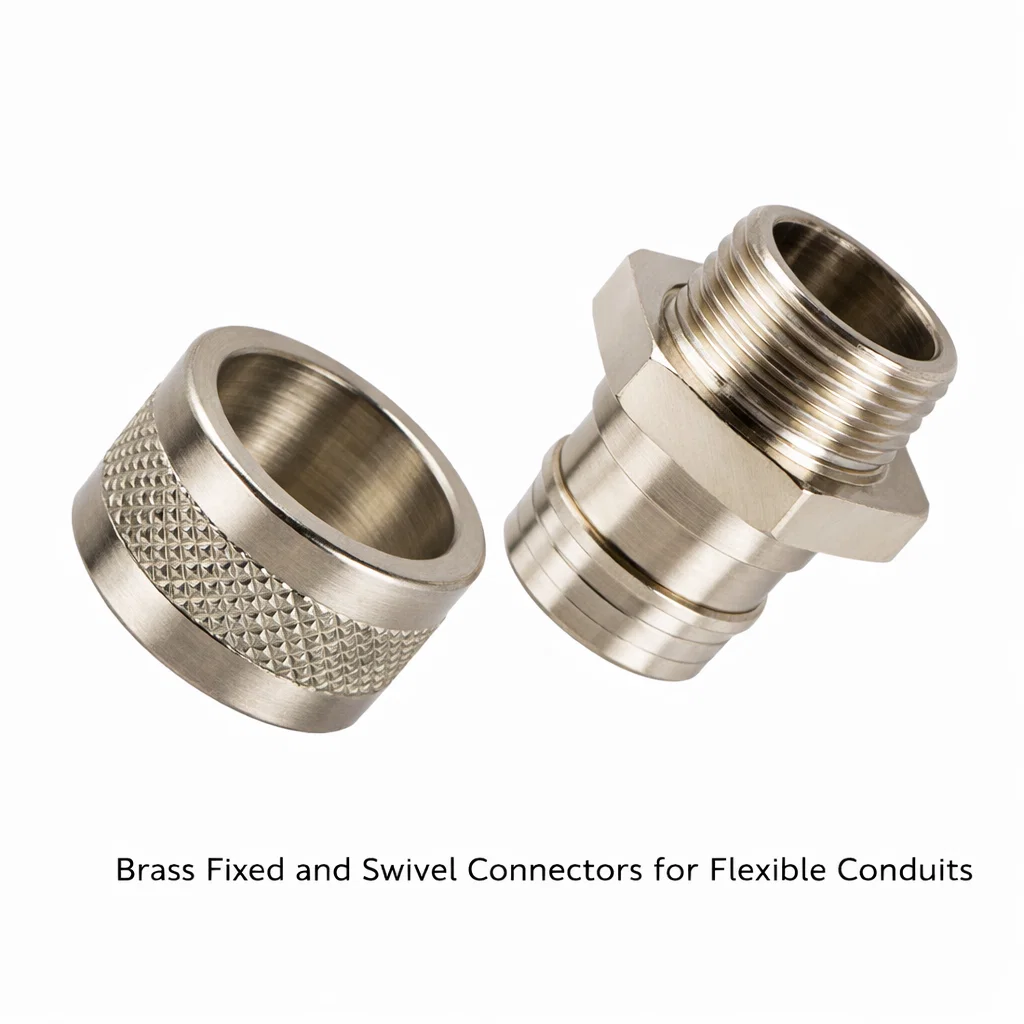
Brass conduit fittings are specialized connectors used to terminate and connect flexible metal conduit (FMC), flexible metallic liquid-tight conduit (LFMC), and non-metallic flexible conduit to electrical enclosures, junction boxes, motor terminal boxes, and switchgear. Jamnagar Brass Components is a leading manufacturer and exporter of brass conduit fittings—including male and female brass fixed conduit connectors, brass swivel flexible conduit connectors, and non-preferred (NP) thread type fittings—supplying to electrical contractors, panel builders, and OEMs across the USA, Canada, the UK, Europe, and Australia.
What Are Brass Conduit Fittings?
Brass conduit fittings are threaded or compression-style fittings that provide a secure, liquid-tight or standard mechanical connection between flexible conduit systems and electrical enclosures or rigid conduit. They protect wiring from mechanical damage, moisture ingress, and vibration while ensuring continuous electrical continuity of the conduit system for grounding purposes.
In the United States, flexible conduit fittings must comply with UL 514B (Fittings for Conduit and Outlet Boxes), NEC Article 350 (Liquidtight Flexible Metal Conduit), and NEC Article 356 (Liquidtight Flexible Nonmetallic Conduit). Our brass conduit fittings meet these requirements and are suitable for Class I, II, and III hazardous locations when specified.
Types of Brass Conduit Fittings
Male Brass Fixed Conduit Connectors
Male fixed conduit connectors have a fixed (non-rotating) male threaded entry that screws into the knockout of a panel or enclosure. The conduit is clamped to the fitting body via a locknut or compression nut. Fixed connectors are used where the conduit installation direction is predetermined and no rotational adjustment is needed after installation. Available in straight, 45°, and 90° elbow configurations.
Female Brass Fixed Conduit Connectors
Female fixed conduit connectors feature a female threaded entry, accepting a male conduit thread or male locknut stud. They are used when connecting to male-threaded conduit, Brenner-type fittings, or male studs on enclosures and motor terminal boxes. Like male types, these are non-swiveling and provide a rigid, secure installation.
Male Brass Swivel Flexible Conduit Connectors
Swivel connectors incorporate a rotating (swivel) joint between the conduit-attachment body and the panel-entry thread. This 360° rotational capability allows the panel entry thread to be tightened without torquing or stressing the flexible conduit, making installation significantly easier in tight or congested cable management zones. Particularly popular in motor connection applications, machine tool wiring, and panel building in the USA.
Female Brass Swivel Flexible Conduit Connectors
Female swivel connectors combine a rotating female panel-entry thread with the conduit-attachment body. Ideal for retrofit installations where the exact orientation of the conduit entry cannot be determined in advance. The swivel action prevents conduit strain and ensures leak-free, vibration-resistant connections.
Non-Preferred (NP) Thread Brass Conduit Connectors
Non-Preferred (NP) thread brass conduit fittings are manufactured with thread forms that are outside the standard preferred series—typically metric or special-pitch threads used in European or specialist electrical equipment imported into the USA. Common NP thread forms include M16×1.5, M20×1.5, M25×1.5, M32×1.5, and M40×1.5. These are critical for connecting European-standard electrical enclosures and motors to US-standard flexible conduit systems.
Key Features and Benefits
- Superior Corrosion Resistance: Brass construction withstands moisture, oils, mild chemicals, and industrial environments far better than zinc or iron alternatives.
- Full IP-Rated Sealing: Available with IP66 / IP68 rated sealing rings and compression nuts for liquid-tight installations.
- EMI/RFI Shielding: Brass conduit fittings maintain electrical continuity of the conduit system, providing EMI/RFI shielding critical for VFD (Variable Frequency Drive) and servo motor installations.
- Vibration Resistance: Swivel types and locking-nut designs prevent loosening in high-vibration environments (pumps, compressors, motors).
- Temperature Range: Suitable from –40°C to +130°C for standard brass; high-temperature variants available.
- UL 514B Compliant: Listed fittings available for NEC-regulated installations in the USA.
- ATEX/IECEx Compatible: Available in explosion-proof versions for Zone 1/Zone 2 hazardous areas.
Applications of Brass Conduit Fittings
- Motor connection wiring in manufacturing plants (CNC machines, conveyors, pumps)
- Industrial panel building and switchgear wiring
- HVAC equipment wiring
- Robotics and automation systems
- Food processing and pharmaceutical plants (stainless-steel options also available)
- Oil and gas processing facilities
- Marine and offshore electrical systems
- Solar inverter and wind turbine electrical installations
- Data center power infrastructure
- Commercial construction MEP (Mechanical, Electrical, Plumbing) wiring
Material Grades and International Equivalents
| Property | CW614N (EN) | C36000 (ASTM/USA) | CZ121 (BS/UK) | IS 319 (India) |
|---|---|---|---|---|
| Common Name | Free-Cutting Brass | Free-Cutting Brass 360 | Free-Machining Brass | Free-Cutting Brass |
| Cu (%) | 57–59 | 60–63 | 57–59 | 60–63 |
| Zn (%) | 39–42 | 35–37 | 38–42 | 35–38 |
| Pb (%) | 2.5–3.5 | 2.5–3.7 | 2.5–3.5 | 2.5–3.5 |
| Tensile Strength (MPa) | 380–490 | 340–470 | 370–480 | 370–480 |
| Applicable Standards | EN 12164 / EN 12165 | ASTM B16 / ASTM B453 | BS 2874 | IS 319 / IS 291 |
Lead-free (RoHS) option: C69300 (ECO Brass®) / CW511L available for environmentally sensitive installations. Nickel-plated and chrome-plated finishes available on request.
Thread Standards Available
| Thread Type | Standard | Common Sizes | Region / Application |
|---|---|---|---|
| NPT (National Pipe Taper) | ANSI/ASME B1.20.1 | 1/2″, 3/4″, 1″, 1-1/4″, 1-1/2″, 2″ | USA / North America |
| BSPP / G Thread (Parallel) | BS EN ISO 228 | G1/2, G3/4, G1, G1-1/4, G1-1/2, G2 | UK / Europe / Australia |
| BSPT (Tapered) | BS 21 / ISO 7-1 | R1/2, R3/4, R1, R1-1/4 | UK / India |
| Metric (NP – Non-Preferred) | ISO 261 / DIN 13 | M16×1.5, M20×1.5, M25×1.5, M32×1.5, M40×1.5 | Europe / Global OEM |
| PG Thread | DIN 40430 | PG7, PG9, PG11, PG13.5, PG16, PG21, PG29 | German-standard panels |
Dimensional Range
| Conduit Trade Size | NPT Thread | Metric Thread (NP) | Cable OD Range (mm) | IP Rating |
|---|---|---|---|---|
| 3/8″ | 3/8″ NPT | M16×1.5 | 4–8 | IP65 |
| 1/2″ | 1/2″ NPT | M20×1.5 | 7–13 | IP66 |
| 3/4″ | 3/4″ NPT | M25×1.5 | 11–17 | IP66 |
| 1″ | 1″ NPT | M32×1.5 | 15–21 | IP66 |
| 1-1/4″ | 1-1/4″ NPT | M40×1.5 | 19–28 | IP67 |
| 1-1/2″ | 1-1/2″ NPT | M50×1.5 | 25–35 | IP68 |
| 2″ | 2″ NPT | M63×1.5 | 32–44 | IP68 |
Metric Thread (NP) Reference Table
| Thread Size | Pitch (mm) | Thread Standard | Application |
|---|---|---|---|
| M16×1.5 | 1.5 | ISO 261 / DIN 13 | Small conduit entries, junction boxes |
| M20×1.5 | 1.5 | ISO 261 / DIN 13 | Standard conduit, cable gland entries |
| M25×1.5 | 1.5 | ISO 261 / DIN 13 | Medium conduit, switchgear panels |
| M32×1.5 | 1.5 | ISO 261 / DIN 13 | Large conduit, industrial panels |
| M40×1.5 | 1.5 | ISO 261 / DIN 13 | Heavy conduit, motor terminal boxes |
| M50×1.5 | 1.5 | ISO 261 / DIN 13 | Extra-large conduit, enclosure entries |
| M63×1.5 | 1.5 | ISO 261 / DIN 13 | Heavy-duty conduit, large cable runs |
| M75×1.5 | 1.5 | ISO 261 / DIN 13 | Extra heavy-duty, large diameter conduit |
Related Products
- Brass Cable Glands (BW, CW, E1W, A2, A4 Types – UL/IEC)
- Brass Conduit Locknuts and Bushings
- Brass Reducing Bushings for Conduit
- Brass Conduit Couplings (Straight and Elbow)
- Brass Flexible Conduit Adaptors
- Stainless Steel Conduit Fittings (316 SS)
- Plastic / Nylon Conduit Fittings
- Brass Pipe Nipples and Hex Nipples
Why Choose Jamnagar Brass Components for Brass Conduit Fittings?
- Specialist Manufacturer: We manufacture brass conduit fittings exclusively in Jamnagar, the global hub for precision brass components, with 100% in-house production.
- Complete Range Under One Roof: Male, female, fixed, swivel, straight, 45°, 90°, metric NP, NPT, PG—all available from a single source, reducing procurement complexity.
- Custom Engineering: Unique thread combinations, non-standard sizes, special materials (nickel-plated, stainless steel insert), or OEM-branded packaging—all executed in-house.
- UL and IEC Compliance: Products designed and tested to meet UL 514B, IEC 60670, and IP66/IP68 sealing requirements for the North American and global markets.
- Competitive Pricing: Direct factory pricing with no middlemen—typically 25–40% lower than European or North American stocking distributors.
- ISO 9001:2015 Quality: Every batch undergoes dimensional, thread gauge, pull-out force, and pressure (IP) testing before dispatch.
- Proven Export Track Record: Trusted by leading US electrical contractors, panel builders, and motor OEMs for consistent quality and on-time delivery.
- Dedicated Technical Support: Our applications engineers assist with thread selection, IP rating requirements, and custom design for your specific installation needs.
Frequently Asked Questions (FAQs) – Brass Conduit Fittings
Q1. What is the difference between a fixed and a swivel brass conduit connector?
A fixed conduit connector has a rigid, non-rotating body—once tightened, the panel-entry thread and the conduit-attachment section are locked in the same position. A swivel conduit connector has a rotating joint that allows the panel-entry thread to turn independently of the conduit-attachment body, making it easier to tighten without twisting the conduit and useful in confined spaces or retrofit applications.
Q2. What does NP mean in brass conduit fittings?
NP stands for “Non-Preferred” thread. In the context of conduit fittings, NP thread fittings use metric thread forms (e.g., M20×1.5, M25×1.5) that are not part of the standard preferred NPT (National Pipe Taper) series used in North America. NP metric thread fittings are commonly required when connecting European or Asian-manufactured enclosures and electrical equipment to US-standard flexible conduit systems.
Q3. Are your brass conduit fittings UL listed?
Our standard brass conduit fittings are manufactured and dimensionally tested to meet UL 514B requirements. UL-listed (file number) variants are available for projects requiring formal UL listing. Please contact us with your project specifications for UL-listed conduit fittings.
Q4. What IP rating are your brass conduit fittings?
Our brass conduit fittings are available in IP65, IP66, IP67, and IP68 ratings depending on the seal type and clamping mechanism. IP66 is standard for most industrial applications; IP68 variants are available for submersible or outdoor installations with prolonged water exposure.
Q5. Can brass conduit fittings be used for grounding/bonding?
Yes. Brass conduit fittings provide electrical continuity of the conduit system for equipment grounding purposes per NEC Article 250. For enhanced grounding, we also supply brass grounding bushings and bonding locknuts that can be used in conjunction with conduit fittings.
Q6. What sizes of brass conduit fittings do you supply?
We supply brass conduit fittings from 3/8″ through 2″ in NPT thread, and from M16×1.5 through M63×1.5 in metric (NP) thread. PG thread sizes from PG7 to PG29 are also available.
Q7. Do you supply brass conduit fittings for hazardous locations?
Yes. We manufacture ATEX Zone 1 and Zone 2, IECEx, and Class I/II/III Division 1 and Division 2 rated brass conduit fittings for use in explosive atmospheres. Please specify the hazardous area classification when requesting a quote.
Q8. What is the difference between an NPT and a metric (NP) thread in conduit fittings?
NPT (National Pipe Taper) is the standard tapered thread used in North American conduit and pipe fittings (ANSI/ASME B1.20.1). Metric NP threads (e.g., M20×1.5) are straight metric threads commonly used in European and Asian electrical equipment. They are not interchangeable. Using the wrong thread form can result in cross-threading, leaks, or unsafe mechanical connections.
Q9. Can I get brass conduit fittings with nickel plating?
Yes. Nickel-plated brass conduit fittings offer superior corrosion resistance for marine, coastal, offshore, and food-processing environments where standard brass may be insufficient. Chrome plating and tin plating are also available.
Q10. What is the minimum order quantity (MOQ) for brass conduit fittings?
For standard sizes (1/2″ or 3/4″ NPT, natural brass), the MOQ is 500 pieces per size per type. For custom thread forms, special configurations, or plated finishes, MOQ is 1,000 pieces. Samples are available prior to bulk orders.
Q11. Do you export brass conduit fittings to the USA?
Yes. The USA is our largest export market for conduit fittings. We ship to distributors, electrical contractors, and OEM manufacturers across all 50 states. We supply complete export documentation and can arrange delivery DDP (Delivered Duty Paid) to US warehouses.
Q12. How are brass conduit fittings different from brass cable glands?
Brass cable glands are used to terminate individual cables into enclosures, providing strain relief, sealing, and armour clamping. Brass conduit fittings are used to connect flexible or rigid conduit—the protective conduit tube itself—to enclosures. While both achieve IP-rated sealing, their mechanical clamping mechanisms and dimensional standards are different.
Q13. What surface finishes are available?
Available finishes include: Natural Brass (mill finish), Nickel Plating, Chrome Plating, Tin Plating, and Zinc Plating. Custom powder-coated versions are available for outdoor installations.
Q14. Can you supply 90° elbow brass conduit connectors?
Yes. We manufacture straight, 45°, and 90° elbow brass conduit connectors in both fixed and swivel types, in NPT and metric NP thread forms. Elbow types are especially useful for connecting conduit to panels where space constraints prevent straight-line conduit runs.