
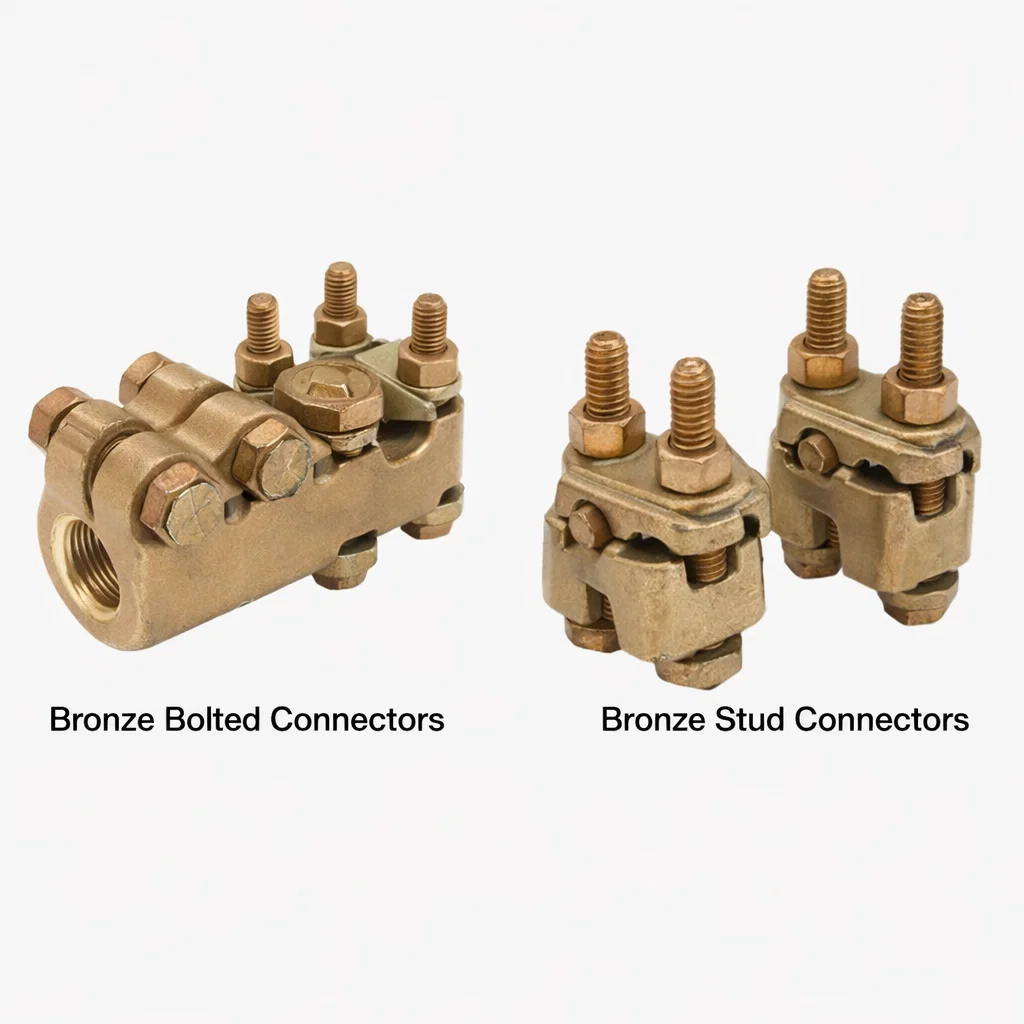
Bronze bolted connectors and bronze stud connectors are critical electrical components used for high-current, permanent, and maintenance-friendly grounding, bonding, and power distribution connections. Manufactured from premium silicon bronze, phosphor bronze, and aluminum bronze alloys, these connectors are supplied by Jamnagar Brass Components to utilities, electrical contractors, data centers, substations, and industrial facilities across the USA, Canada, Europe, the Middle East, and Australia.
What Are Bronze Bolted Connectors?
Bronze bolted connectors are two-part or multi-part connectors that mechanically clamp conductors (cables, busbars, or rods) together using bolts, nuts, and washers. The bolted clamping mechanism provides a gas-tight, vibration-resistant, highly conductive joint that does not require special tooling—unlike compression connectors that need hydraulic crimping tools.
In the USA, bronze bolted connectors are widely specified in grounding systems, equipotential bonding, lightning protection, telecommunications earthing, and power utility distribution networks per IEEE 80 (Guide for Safety in AC Substation Grounding), IEEE 837, ANSI C119, and NEC Article 250 requirements.
What Are Bronze Stud Connectors?
Bronze stud connectors consist of a pre-threaded bronze stud permanently attached (cast, pressed, or welded) to a flat connector body or busbar section. Cables, lugs, or bus links are secured to the stud using nuts and washers. Stud connectors are used in switchgear, motor control centers, transformer terminals, grounding buses, and power distribution boards where multiple conductors must be terminated to a single point.
The bronze material ensures superior corrosion resistance compared to aluminum or tinned copper alternatives, making them ideal for outdoor, coastal, marine, and industrial environments where exposure to humidity, salt air, and chemicals is a concern.
Types of Bronze Bolted Connectors
Two-Bolt Parallel Groove (PG) Connectors
Two-bolt PG connectors are the most widely used bronze bolted connectors in the USA for connecting two parallel conductors side-by-side. Used for main conductor splices, tap connections, and T-connections on overhead distribution lines, underground cables, and grounding conductor joints. Available for conductor sizes from #6 AWG through 1000 kcmil.
H-Tap / C-Tap Bronze Bolted Connectors
H-tap connectors allow a tap conductor to be connected to a through (main) conductor without cutting the main conductor. C-tap connectors are similar but with a C-shaped body profile. Both types are extensively used for service entrance connections, secondary distribution, and grounding tap connections in North American electrical utilities.
Single-Bolt Grounding Clamps
Single-bolt bronze connectors are used for grounding connections to rods, pipes, structures, and cable trays. The single-bolt design allows rapid installation and field adjustment. Commonly used in temporary and permanent grounding applications at construction sites, substations, and industrial plants.
Multi-Tap Bronze Bolted Connectors (4-Port, 6-Port)
Multi-tap connectors provide a central compression or bolted terminal block that accepts multiple conductors simultaneously. Four-port and six-port bronze multi-tap connectors are used in panelboards, metering centers, and distribution transformers where multiple branch circuit conductors must be bonded to a single ground point.
Types of Bronze Stud Connectors
Single Stud Bronze Connectors
Single-stud connectors have one threaded bronze stud for a single cable termination. The connector body can be flat (busbar mounting), curved (pipe or rod clamping), or right-angle (for panel mounting). Used in motor terminal boxes, switchgear, and distribution boards for individual cable terminations.
Double / Multi-Stud Bronze Connectors
Double-stud and multi-stud bronze connectors allow multiple cables to be terminated at the same connector body, eliminating the need for separate bus link bars. Widely used in transformer secondary terminal boxes, generator output terminals, and UPS output connections in data centers and hospitals.
Bronze Split-Bolt (Parallel-Groove) Stud Connectors
Split-bolt connectors consist of a U-shaped bolt body that clamps the conductor against a fixed saddle. The bronze split-bolt is a classic US utility connector used for conductor splicing and tapping in pole-mounted and underground electrical distribution systems. Compliant with ASTM B283 and UL 467.
Material Grades and International Equivalents
| Alloy | USA / ASTM | EN / European | UK / BS | IS (India) | Key Properties |
|---|---|---|---|---|---|
| Silicon Bronze | C65100 / C65500 (ASTM B98) | CW116C / CuSi3Mn1 | BS 2875 CS101 | IS 7814 | High strength, excellent corrosion resistance, good weldability |
| Phosphor Bronze | C51000 / C54400 (ASTM B139) | CW451K / CuSn4 | BS 2874 PB102 | IS 7811 | High fatigue strength, excellent spring properties, good conductivity |
| Aluminum Bronze | C61300 / C63000 (ASTM B150) | CW307G / CuAl10Fe3 | BS 2874 CA104 | IS 7816 | Very high strength, excellent marine corrosion resistance |
| Leaded Bronze | C83600 (ASTM B62) | CC490K / CuSn5Pb5Zn5 | BS 1400 LB2 | IS 318 | Good machinability, bearing properties |
| Property | Silicon Bronze C65500 | Phosphor Bronze C51000 | Aluminum Bronze C63000 |
|---|---|---|---|
| Cu (%) | 94–96 | 93–96 | 78–83 |
| Si / Sn / Al (%) | 2.8–3.8 Si | 4.2–5.8 Sn | 9.0–11.0 Al |
| Tensile Strength (MPa) | 480–650 | 380–520 | 580–760 |
| Electrical Conductivity (% IACS) | 7–11 | 15–20 | 7–12 |
| Hardness (HRB) | 70–90 | 60–85 | 85–100 |
| Max Service Temp (°C) | 200 | 150 | 250 |
| UL 467 / IEEE 837 Suitability | Yes | Yes | Yes |
Standards and Certifications
- UL 467: Standard for Grounding and Bonding Equipment (USA)
- IEEE 837: Qualifying Permanent Connections Used in Substation Grounding
- ANSI C119.4: Electric Connectors for Use Between Aluminum or Aluminum-Copper Overhead Conductors
- ASTM B283: Standard Specification for Copper and Copper-Alloy Die Forgings
- NEMA CC1: Electric Power Connectors for Substations
- IEEE 80: Guide for Safety in AC Substation Grounding
- NEC Article 250: Grounding and Bonding requirements
- IEC 61238-1: International standard for compression and mechanical connectors
Dimensional Specifications
| Connector Type | Conductor Range (AWG/kcmil) | Bolt Size | Material | Standard |
|---|---|---|---|---|
| Two-Bolt PG Connector | #6 AWG – 1000 kcmil | 1/2″-13 UNC | Silicon Bronze C65500 | UL 467 / IEEE 837 |
| H-Tap Connector (Main) | #2 – 750 kcmil | 3/8″-16 UNC | Silicon Bronze C65500 | ANSI C119.4 |
| Single-Bolt Grounding Clamp | #6 AWG – 4/0 AWG | 5/16″-18 UNC | Bronze C65100 | UL 467 |
| Split-Bolt Connector | #8 AWG – 750 kcmil | Custom | Silicon Bronze | ASTM B283 |
| Multi-Tap (4-Port) | #14 – 350 kcmil | 1/4″-20 UNC | Bronze C65500 | UL 467 |
| Stud Connector (Single) | Custom | M8–M24 / 3/8″–1″ | Silicon / Phosphor Bronze | IEC 61238-1 |
Applications
- Electric Utility Distribution: Transformer connections, secondary distribution taps, underground cable splices, service entrance connections throughout the USA grid.
- Substation Grounding: IEEE 80 / IEEE 837 compliant grounding grid connections, equipment ground bonds, and neutral conductor connections in high-voltage substations.
- Lightning Protection Systems: Down-conductor connections, earth electrode terminations, and bonding connections per NFPA 780 and UL 96.
- Data Centers: High-current busbar stud terminations, battery bank connections, UPS output terminals, and PDU grounding in Tier III/IV data centers.
- Marine and Offshore: Bonding of fuel systems, hull cathodic protection connections, and deck equipment grounding on vessels and offshore platforms.
- Solar / Renewable Energy: Array grounding connections, inverter bonding, and combiner box grounding in large utility-scale solar and wind projects.
- Industrial Plants: Motor frame grounding, transformer secondary bonding, cable tray grounding, and static bonding in chemical, petroleum, and food processing plants.
- Telecommunications: TELCO grounding buses, tower footing connections, and equipment bonding in central offices and cell sites.
Related Products
- Brass Earthing Tags and Ground Clamps
- Bronze Pipe Fittings (Elbows, Tees, Couplings)
- Copper Compression Lugs and Terminal Connectors
- Bronze Busbar Links and Equipotential Bonding Conductors
- Brass / Bronze Grounding Rods and Driving Heads
- Bronze Exothermic Weld Connections (Cadweld® Equivalent)
- Bronze Cable Glands (IP66/IP68)
- Copper-Bonded Ground Rods and Electrodes
Why Choose Jamnagar Brass Components for Bronze Bolted and Stud Connectors?
- Specialist Bronze Expertise: Deep material knowledge of silicon bronze, phosphor bronze, and aluminum bronze ensures correct alloy selection for your specific application—corrosion resistance, conductivity, and mechanical strength perfectly matched.
- IEEE 837 and UL 467 Design: Our bronze bolted connectors are designed to withstand the mechanical load, fault current, and corrosion testing regimes of IEEE 837 and UL 467—critical qualifications for utility substation and grounding applications in the USA.
- Complete Size Range: Standard connector sizes from #6 AWG through 1000 kcmil available from stock. Custom connectors for special conductor sizes, configurations, or current ratings manufactured to order.
- Precision Forging and Machining: Die-forged bronze bodies provide superior density and mechanical properties versus cast alternatives. CNC machined interfaces ensure precise fit and reproducible electrical performance.
- Competitive Pricing: Factory-direct pricing from Jamnagar is typically 25–45% below equivalent US-made or European-made connectors.
- Custom Bolt Hardware: Complete connector assemblies supplied with matching bronze or stainless steel bolts, nuts, washers, and spring washers—fully assembled and ready to install.
- ISO 9001:2015 and Export Expertise: All connectors supplied with material certificates, dimensional reports, and full export documentation for seamless US Customs clearance.
- Rapid Prototype and Sample Service: Prototype connectors for engineering evaluation available within 2–3 weeks. OEM long-term supply agreements welcomed.
Frequently Asked Questions – Bronze Bolted Connectors & Bronze Stud Connectors
Q1. What is the difference between a bronze bolted connector and a compression connector?
A bronze bolted connector is secured mechanically using bolts and nuts, requiring only standard hand tools (wrenches) for installation. A compression connector is crimped onto the conductor using a hydraulic or mechanical crimping tool, creating a cold-weld joint. Bolted connectors are preferred where maintenance access or future re-entry is required; compression connectors are preferred for permanent, tamper-resistant connections in utility-grade applications.
Q2. Why is silicon bronze preferred for bolted electrical connectors?
Silicon bronze (C65500) offers an excellent combination of: high mechanical strength (supports bolt torque without stripping), corrosion resistance superior to brass in marine and outdoor environments, good electrical conductivity (~7–11% IACS, suitable for ground and bonding applications), and compatibility with both copper and aluminum conductors without bimetallic corrosion issues when used with proper anti-oxidant compound.
Q3. Are your bronze bolted connectors UL 467 listed?
Our bronze bolted connectors are designed and dimensionally tested to comply with UL 467 requirements. UL 467 Listed products (bearing the UL mark) are available for projects requiring formal listing. Please specify UL 467 listing when requesting a quotation.
Q4. What conductor sizes do your bronze bolted connectors accommodate?
We supply bronze bolted connectors for conductor sizes ranging from #8 AWG through 1000 kcmil (for PG and H-tap types) and custom configurations for busbar and cable combinations up to 3000 kcmil equivalent cross-sections. Metric sizes from 6 mm² through 630 mm² are also available.
Q5. Can bronze stud connectors be used outdoors?
Yes. Bronze stud connectors, particularly those made from silicon bronze (C65500) or aluminum bronze (C63000), are highly suitable for outdoor, coastal, marine, and exposed industrial environments. They resist salt spray, humidity, and mild industrial chemicals without requiring protective coatings in most applications.
Q6. What is a parallel groove (PG) connector?
A parallel groove (PG) connector, also known as a two-bolt connector, has parallel U-shaped grooves machined into the connector body that grip the conductors when bolts are tightened. The two conductors run parallel to each other through the connector, making it ideal for cable splices, tap connections, and bonding jumpers in both overhead and underground electrical distribution.
Q7. Are bronze connectors compatible with aluminum conductors?
Bronze bolted connectors can be used with aluminum conductors provided the proper anti-oxidation compound (Penetrox or equivalent) is applied to the aluminum conductor and aluminum-compatible coatings or bi-metal pads are used at the contact interface. For frequent connections between bronze and aluminum, we recommend using connectors specifically rated for Al/Cu service to prevent galvanic corrosion.
Q8. What bronze alloy is best for marine electrical connectors?
For marine and saltwater environments, aluminum bronze (C63000 / C61300) is the superior choice due to its exceptional resistance to salt water corrosion, biofouling, and crevice corrosion. Silicon bronze (C65500) is also excellent and more cost-effective for most marine installations.
Q9. What is the minimum order quantity for bronze bolted connectors?
MOQ for standard bronze bolted connectors (PG type, 2/0–4/0 AWG) is 100 pieces per part number. For custom configurations, special conductor ranges, or OEM parts, MOQ is 500 pieces. Sample quantities (10–25 pcs) are available for engineering evaluation prior to bulk ordering.
Q10. Do you supply bronze stud connectors for busbar systems?
Yes. We manufacture bronze stud connectors specifically designed for copper and aluminum busbar systems in switchgear, MCC panels, transformer bays, and generator sets. These include flat-body stud connectors (bolted to busbars), right-angle stud connectors, and T-type stud connectors for cable tap connections off busbars.
Q11. What torque specifications apply to bronze bolted connectors?
Torque values depend on bolt size and conductor material. Typical values: 3/8″-16 UNC bolt – 200 in-lbs (for copper); 1/2″-13 UNC bolt – 300 in-lbs (for copper). Specific torque specs are provided on our product data sheets. Always use a calibrated torque wrench to ensure proper clamping without stripping the bronze threads.
Q12. How do bronze stud connectors differ from brass stud connectors?
Bronze stud connectors are made from copper-tin, copper-silicon, or copper-aluminum alloys (bronzes), offering superior strength, fatigue resistance, and corrosion resistance compared to brass (copper-zinc alloy) stud connectors. Bronze is preferred for high-current, outdoor, and marine electrical applications; brass is commonly used for lower-stress indoor panel and plumbing applications.
Q13. Can you supply bronze connectors that meet IEEE 837?
Yes. IEEE 837 (Qualifying Permanent Connections Used in Substation Grounding) requires connectors to pass current-cycling tests (100 cycles of rated fault current), pull-out force tests, and corrosion exposure tests. Our silicon bronze bolted connectors are designed to meet IEEE 837 Class B requirements and can be supplied with test reports. Please specify IEEE 837 compliance when ordering for substation grounding applications.
Q14. Do you offer custom bronze stud connector designs?
Absolutely. We offer complete custom design and manufacturing of bronze stud connectors including: custom stud heights, thread forms (UNC, UNF, metric), special body profiles (L-shape, T-shape, flat, curved), integrated mounting holes, and special surface treatments (silver plating, tin plating, nickel plating). Minimum quantities apply; tooling charges may apply for new designs.