

Comprehensive Overview of Copper Cable Terminals (Crimping Lugs): The Foundation of Secure Power Connections
We are a premier manufacturer and global exporter of high-performance Copper Cable Terminals, also known as Crimping Lugs, from India, specializing in the critical interface between electrical cables and equipment. For decades, we have been the cornerstone for industries requiring absolute reliability in power distribution, providing the essential link that ensures safety, efficiency, and longevity in electrical systems. Our state-of-the-art manufacturing facility is dedicated to producing superior-quality copper lugs, terminals, and connectors utilizing advanced hot forging, precision machining, and electroplating technologies. With profound expertise in high-current electrical connectivity, we serve a vast spectrum of critical industries including electrical power generation and distribution, renewable energy plants (solar and wind), industrial machinery and manufacturing plants, construction and building infrastructure, railway electrification and rolling stock, shipbuilding and marine engineering, telecommunications infrastructure, and oil & gas exploration and refining. Our technical mastery encompasses a range of premium copper materials, including Electrolytic Tough Pitch Copper C11000 for unmatched conductivity, Oxygen-Free Copper C10100/C10200 for superior performance in high-temperature/vacuum environments, Tin-Plated Copper for robust corrosion resistance, and Bare Copper for cost-effective, non-corrosive indoor applications. We manufacture copper cable terminals in an exhaustive size range, from fine 1.5 mm² for control wiring to massive 1000 mm² for heavy-duty power circuits, all engineered to deliver minimal voltage drop, maximum current carrying capacity, and unwavering mechanical strength in the most demanding applications.
Our advanced manufacturing capabilities for copper cable terminals integrate a suite of sophisticated processes, including computer-aided design and finite element analysis (FEA) for optimizing current flow and mechanical stress distribution, hot forging and die pressing to create a dense, non-porous grain structure that guarantees superior electrical and mechanical properties, precision deep drilling and boring for consistent cable barrel dimensions, CNC machining for complex profiles, exact tolerances, and specific tongue geometries, high-quality electroplating with pure matte tin for superior environmental protection, hydraulic crimping and swaging for value-added assembly services, and laser or dot-peen marking for permanent rating, size, and batch identification. Our engineering team possesses deep expertise in current carrying capacity (ampacity) calculations, heat dissipation and thermal management, corrosion mitigation strategies, crimping technology and force optimization, and strict adherence to international standards such as UL 486A-B, IEC 61238-1 for compression and mechanical connections, ASTM B105, and DIN 46235, ensuring every copper cable terminal meets the most stringent demands of global safety and performance benchmarks. Our ISO 9001:2015 and IATF 16949 certified quality management systems govern our production, and we maintain complete raw material traceability with mill certificates, detailed process control records, comprehensive dimensional inspection reports, conductivity test results, and plating thickness verification, providing our worldwide clientele with absolute confidence in component quality, reliability, and performance.
Copper Cable Terminals (Crimping Lugs) – The Critical Conduit for High-Current Power Transmission
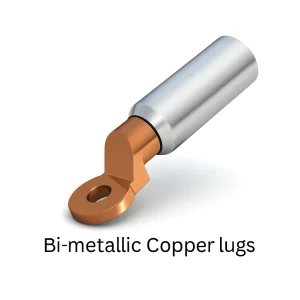
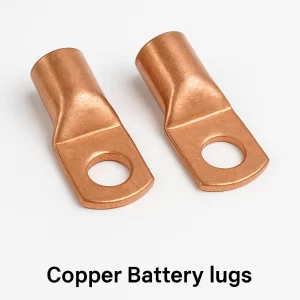
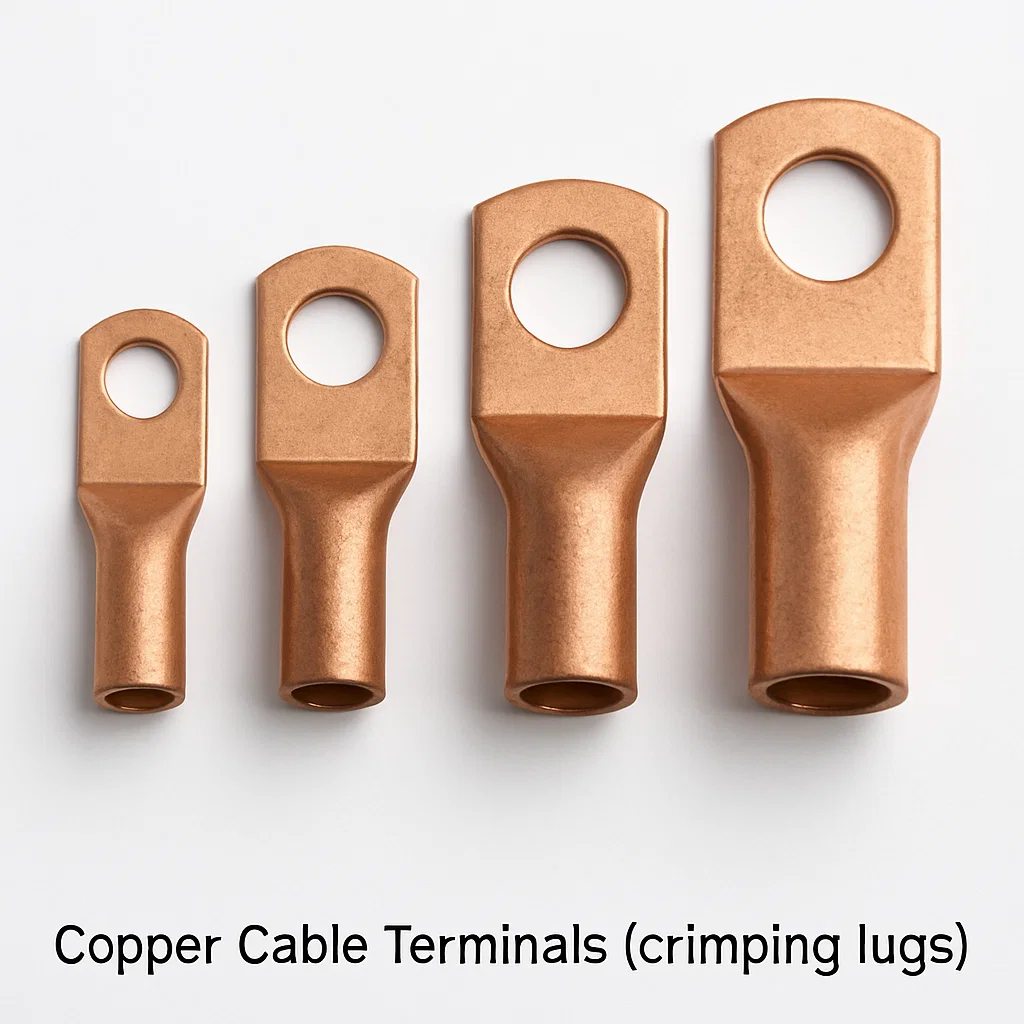
Copper Cable Terminals, universally known as Crimping Lugs, are fundamental components designed to terminate electrical cables and create a secure, low-resistance, and permanent connection to equipment terminals, busbars, or other cables. They serve as the crucial, engineered interface that ensures electrical power is transmitted from the source to the load with maximum efficiency, minimal energy loss, and absolute safety. A substandard or improperly selected lug can lead to catastrophic failures, including voltage drop, excessive heating, energy waste, connection loosening, and ultimately, fire hazards. The fundamental anatomy includes a cable barrel (for crimping or soldering to the conductor) and a connection tongue (with a ring, fork, pin, or stud-style geometry for bolting). The exceptional electrical and thermal conductivity of copper, combined with its inherent ductility, makes it the undisputed material of choice for these critical high-current components, ensuring they can handle massive inrush currents and continuous loads without compromising performance or integrity.
Extended Applications of Copper Cable Terminals (Crimping Lugs):
-
Power Generation & Distribution: Main connections in electrical substations, transformer terminals, circuit breaker panels, generator sets, and distribution boards.
-
Renewable Energy Systems: DC and AC connections in solar combiner boxes, inverter terminals, wind turbine generators, and battery storage system busbars.
-
Industrial Plants: Power connections for heavy motors, variable frequency drives (VFDs), welding equipment, furnace power supplies, and industrial control panels.
-
Construction & Infrastructure: Main power risers, earthling and grounding connections, panel board terminations, and service entrance connections in commercial and industrial buildings.
-
Railway & Mass Transit: Power connections for traction systems, overhead catenary lines, rolling stock internal wiring, and signaling power cabinets.
-
Shipbuilding & Marine: Marine-grade battery connections, power distribution on vessels, shore power inlets, and engine room wiring requiring superior corrosion resistance.
-
Telecommunications & Data Centers: Primary power and grounding connections for server racks, UPS systems, and cellular tower power cabinets.
-
Oil & Gas: Explosive atmosphere (Ex) certified equipment, drilling rig power systems, and pipeline cathodic protection systems.
Our comprehensive copper cable terminal manufacturing and service portfolio includes:
-
Application-Specific Engineering Consultation: Expert assistance in selecting the correct lug type, size, material, and plating based on current rating, cable type, environmental conditions, vibration, and applicable international standards.
-
Custom Design & Prototyping: Development of lugs for non-standard applications, including special angles, offsets, elongated holes, double-hole tongues, and lugs for DIN rail mounting.
-
Full-Range Production: Capability to manufacture all standard types—Ring Tongue (Closed End), Fork (Spade) Tongue, Pin Tongue, Stud-Type, and Palm Lugs—in a complete range of AWG, metric (mm²), and MCM cable sizes.
-
Value-Added Services: Pre-installation tin-plating, laser etching for part numbers and ratings, and supplying with matching hydraulic crimping dies.
-
Complete Kitting Solutions: Supplying lugs along with crimping tools, copper lube (anti-oxidant compound), and heat shrink tubing as a complete, ready-to-install connection solution.
Copper Material Grades and Cable Terminal Performance Specifications
Copper Alloy Specifications for High-Performance Cable Terminals
| Copper Grade | International Designation | Key Properties | Typical Terminal Applications | Applicable Standards |
|---|---|---|---|---|
| Electrolytic Copper C11000 | CW004A (EN), C1100 (JIS) | 99.9% purity, 100% IACS conductivity, excellent formability | General purpose lugs, power distribution, industrial panels | ASTM B152, EN 1652 |
| Oxygen-Free Copper C10200 | CW008A (EN) | 99.95% Cu, superior ductility, resistant to hydrogen embrittlement | High-vacuum, critical aerospace, and high-reliability military applications | ASTM B152, EN 13601 |
| Tin-Plated Copper | Base C11000 with Sn coating | Excellent corrosion resistance, good solderability, RoHS compliant | Standard for outdoor, marine, humid, and general industrial use | ASTM B545, IEC 61238-1 |
| Bare Copper | C11000 without plating | Cost-effective, high conductivity | Dry, non-corrosive indoor environments, often used for grounding | ASTM B152 |
| Silver-Plated Copper | Base C11000 with Ag coating | Lowest contact resistance, high-temperature performance | High-reliability aerospace, critical power connections, high-temperature environments | ASTM B700 |
Comparative Performance Properties of Copper Cable Terminal Materials
| Property | Bare Copper (C11000) | Tin-Plated Copper | Oxygen-Free Copper (C10200) | Silver-Plated Copper |
|---|---|---|---|---|
| Electrical Conductivity (% IACS) | 100% | 100% (Base) | 101% | 100% (Base) |
| Thermal Conductivity (W/m·K) | 394 | 394 (Base) | 391 | 394 (Base) |
| Corrosion Resistance | Poor (oxidizes easily) | Very Good | Poor (oxidizes easily) | Good (tarnishes) |
| Solderability | Good (requires flux) | Excellent | Good (requires flux) | Excellent |
| Max Operating Temperature | ~150°C | ~200°C | ~150°C | ~250°C |
| Primary Advantage | Lowest Cost | All-round performance & protection | Maximum purity for critical forming | Premium performance in high-temp/current |
Advanced Manufacturing Processes and Rigorous Quality Control
Our dedicated manufacturing facility for copper cable terminals employs world-class processes to ensure unparalleled precision, performance, and reliability:
-
Hot Forging & Die Pressing: The primary process for high-quality power lugs, creating a dense, forged grain structure that eliminates porosity and ensures superior electrical conductivity and mechanical tensile strength compared to inferior cast lugs.
-
Precision CNC Machining: For drilling the cable barrel to exact diameters, boring the terminal ring, and creating complex features like pilot holes, specific chamfers, and custom tongue profiles with tight tolerances.
-
High-Speed Stamping: For producing smaller, standard lugs in very high volumes, ensuring consistency and cost-effectiveness for large-scale projects.
-
Electroplating: Automated plating lines ensure a consistent, adherent, and pure layer of tin or silver, providing durable corrosion protection and stable contact resistance.
-
Quality Control & Testing: Every step is meticulously monitored, from raw material certification to final packaging.
Detailed Manufacturing Process Flow:
Raw Material Procurement (Copper Billets/Rod) → Incoming Material Inspection & Spectroscopic Analysis → Hot Forging in Precision Dies → Flash Trimming & Deburring → Precision Drilling & Boring of Cable Barrel → Electroplating (Tin/Silver) → Rinsing & Drying → 100% Dimensional & Visual Inspection → Electrical Conductivity Spot Testing → Laser Marking with Size & Rating → Packaging & Shipment.
Comprehensive Quality Control and Testing Protocol:
-
Dimensional Metrology: Using go/no-go gauges for ring inner diameter, vernier calipers, micrometers, and CMMs to verify all critical dimensions, including cable barrel inner diameter, wall thickness, bolt hole size, and tongue geometry.
-
Material and Plating Verification: Spectroscopic analysis to confirm copper grade and X-ray fluorescence (XRF) to verify plating thickness and composition.
-
Mechanical Strength Testing: Destructive pull-out force testing on sample crimped connections to validate that the crimp strength meets or exceeds the tensile strength of the cable itself, as per IEC 61238-1.
-
Electrical Performance Testing: Micro-ohm meter testing to ensure the resistance of the lug itself and the crimped connection are negligible and within specified limits.
-
Salt Spray Testing (ASTM B117): Regular testing of plated samples to validate corrosion resistance, ensuring lugs can withstand harsh, saline environments.
Frequently Asked Questions (FAQ)
Q1: What is the fundamental difference between a crimping lug and a soldering lug?
A crimping lug is designed to be permanently attached using a specialized tool that deforms (crimps) the lug’s barrel onto the cable, creating a cold-weld, gas-tight connection. A soldering lug typically has a hollow, cup-shaped end designed to be filled with molten solder to attach the wire. Crimping is overwhelmingly preferred for power applications due to its superior mechanical strength, reliability under vibration, and consistency. Soldering can create a brittle point and is not recommended for high-vibration environments.
Q2: Why is hot forging superior to casting for manufacturing power lugs?
Hot forging involves shaping copper under high pressure while hot, which aligns the grain structure and eliminates internal porosity. This results in a part with higher mechanical strength, better ductility, and superior electrical conductivity. Cast lugs are made by pouring molten metal into a mold, which can trap air and impurities, creating weak spots and higher resistance paths. We specialize exclusively in hot-forged lugs for critical power applications.
Q3: How do I select the correct crimping lug for my cable?
The lug must match both the conductor cross-sectional area (mm² or AWG) and the terminal stud size. The lug’s current rating must also meet or exceed the circuit’s requirements. Using an undersized lug will constrict current flow and cause dangerous overheating. We provide detailed sizing charts and technical support to ensure correct selection.
Q4: Is tin-plating necessary on copper lugs?
For any application exposed to air, yes. Bare copper oxidizes, forming a non-conductive layer of copper oxide that increases resistance and causes overheating. Tin-plating prevents this oxidation, protects against general corrosion, and provides a stable, low-resistance contact surface. It is considered standard for most industrial and outdoor applications.
Q5: Can you provide lugs pre-crimped to cables?
Absolutely. We offer value-added services where we cut, strip, and crimp lugs to your specified cable lengths, delivering a ready-to-install cable assembly, which can significantly reduce on-site labor time and ensure connection integrity.
Why Partner With Us for Your Copper Cable Terminal Needs?
-
Decades of Power Connection Expertise: With over 30 years of focused experience, we possess an unparalleled understanding of the metallurgical, electrical, and mechanical requirements for high-performance power connections.
-
Superior Hot-Forged Manufacturing: Our commitment to hot-forged technology ensures we deliver the most reliable, efficient, and safe lugs on the market, far surpassing the quality of cast alternatives.
-
Full Compliance & Global Certification: Our lugs are manufactured to meet UL, IEC, ASTM, and DIN standards, and our IATF 16949 certification makes us a qualified supplier for the automotive and heavy vehicle industries.
-
End-to-End In-House Capability: From forging and machining to plating and marking, we control the entire process, guaranteeing quality, shortening lead times, and offering highly competitive pricing.
-
Unmatched Technical & Application Support: Our engineers provide more than just products; we offer solutions for crimping tool selection, installation best practices, and application-specific failure mode analysis.
Glossary of Technical Terms
-
Crimping Lug/Terminal: A connector designed to be attached to a cable via mechanical deformation (crimping).
-
Ampacity: The maximum current a cable or connector can carry continuously without exceeding its temperature rating.
-
Ring Tongue: A lug with a fully enclosed circle for bolting, providing the most secure connection.
-
Fork (Spade) Tongue: A lug with a U-shaped opening, allowing for installation without removing the bolt.
-
Crimp Die: The specific tooling used in a crimping tool to deform the lug barrel onto the cable.
-
Gas-Tight Connection: A connection so tight that no oxygen can penetrate, preventing oxidation and maintaining stable electrical resistance over time.
-
IEC 61238-1: The international standard for testing and requirements for compression and mechanical connections for power cables.
Call to Action – Secure Your Power Connections with Uncompromising Quality
Ensure the integrity, safety, and efficiency of your power distribution systems with our high-performance, hot-forged copper cable terminals. Contact us today to find the perfect crimping solution for your application.
-
Request a Competitive Quote: Email your cable sizes, lug types, quantities, and plating requirements to sales@jambrass.com for a prompt and detailed quotation.
-
Consult Our Power Connection Experts: Call +91-22-43449300 / +91-22-43449323 to discuss high-current connection challenges, custom designs, or technical specifications.
-
Visit Our Advanced Facilities:
-
Corporate Office: 1406, 14th Floor, Dalamal Tower, Nariman Point, Mumbai – 400021, Maharashtra, India
-
Advanced Manufacturing Plant: Plot 10B, GIDC Industrial Estate, Shanker Tekari, Udyognagar, Jamnagar, Gujarat, India – 361004
-
-
Request Samples & Compliance Documentation: Contact us for physical samples, material certification, UL/ IEC compliance certificates, and test reports for your quality assurance process.