
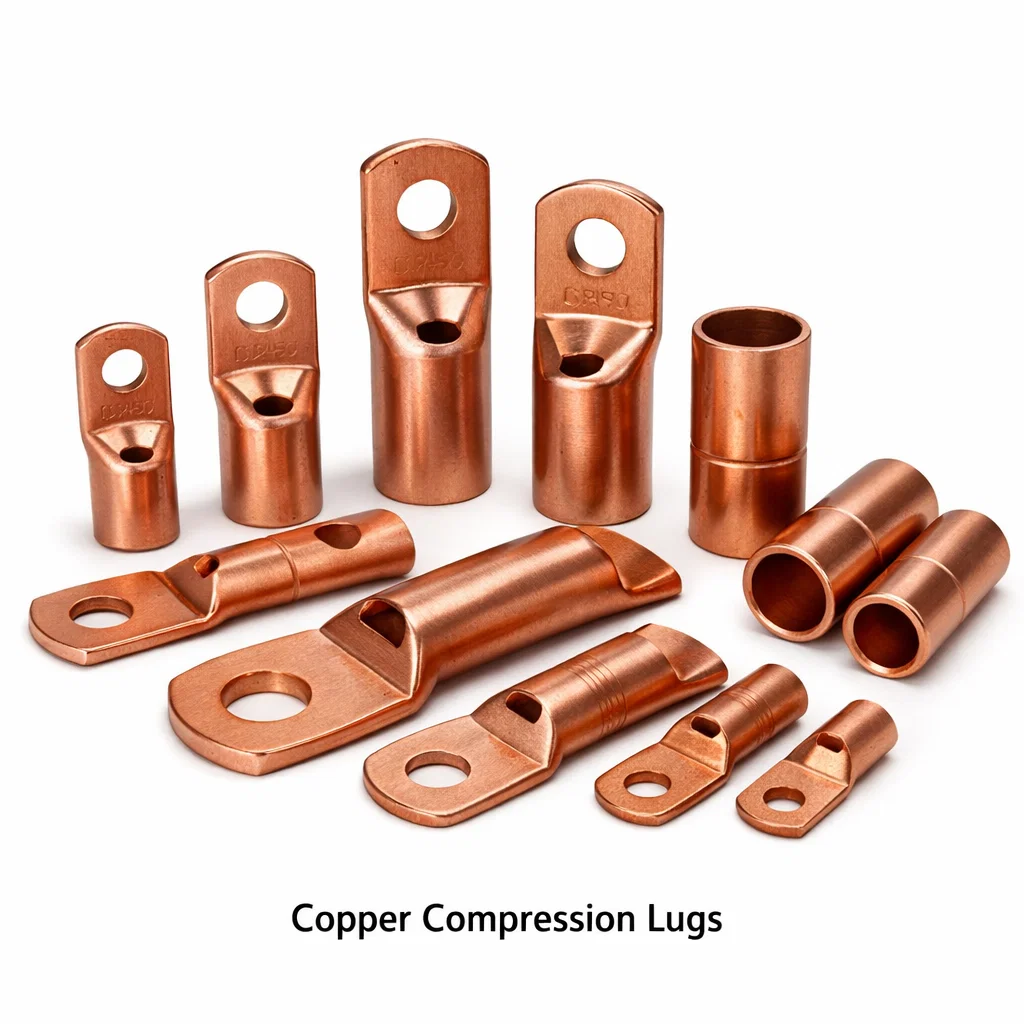
Copper compression lugs and ring terminals manufactured by Jamnagar Brass Components. C11000 ETP copper to IEC 61238-1 and UL 486A. Tin-plated barrel lugs from 16mm² to 630mm² cable sizes. For power cables, switchgear, and transformer connections. ISO 9001 certified manufacturer supplying USA and Europe.
Frequently Asked Questions — Copper Compression Lugs
Q1: What is a copper compression lug?
A copper compression lug (barrel lug or ring terminal) is an electrical connector that terminates a copper conductor (cable) to a terminal, busbar, or equipment connection point. The cable is inserted into the barrel (sleeve) and a hydraulic crimping tool compresses the barrel around the conductor, forming a gas-tight, low-resistance connection. The palm (tongue) with fixing hole is then bolted to the terminal point. Compression lugs are used for permanent, maintenance-free conductor terminations.
Q2: What copper alloy are compression lugs made from?
High-quality copper compression lugs are made from C11000 (ETP copper, 99.9% Cu, 101% IACS conductivity) drawn tube or CW004A electrolytic tough pitch copper. This ensures maximum electrical conductivity at the barrel-to-conductor and palm-to-terminal interfaces. Inferior lugs use brass or copper alloys with lower conductivity. The palm is often tin-plated (5–10 µm) to prevent oxidation and reduce contact resistance at the terminal interface.
Q3: What cable sizes are available for copper compression lugs?
Copper compression lugs are available for cable conductor cross-sections from 1.5 mm² (instrumentation and control) to 1,000 mm² (HV power cables and generator connections). Standard sizes cover 1.5, 2.5, 4, 6, 10, 16, 25, 35, 50, 70, 95, 120, 150, 185, 240, 300, 400, 500, 630, and 800 mm². Stud hole diameters of M5, M6, M8, M10, M12, and M16 are standard. Custom sizes, extended palms, and double-hole palms are available.
Q4: What standards apply to copper compression lugs?
Copper compression lugs must comply with IEC 61238-1 (compression and mechanical connectors for power cables up to 30 kV) for type testing. BS 4579 (performance requirements for mechanical and compression joints in electrical cables) applies in the UK. DIN 46235 and EN 46235 cover tinned copper lugs for European markets. For USA applications, UL 486A covers wire connectors for copper conductors. Type test certificates per IEC 61238-1 are available on request.
Q5: What crimping tools are required for copper compression lugs?
Correct hydraulic crimping tools with matching die sets are essential for quality lug installation. Dies are specific to the barrel size and cross-section. For small cables (1.5–70 mm²), ratchet hand crimping tools or hydraulic hand tools are used. For large cables (95–1,000 mm²), hydraulic pressing tools (15–60 tonne press force) with die sets calibrated to the lug manufacturer’s specification are required. Using incorrect dies or under-crimping results in high contact resistance and potential overheating.
Q6: What is the difference between a copper compression lug and a mechanical (setscrew) lug?
Compression lugs use hydraulic crimping to form a gas-tight, permanent joint with minimum contact resistance and maximum current-carrying capacity — preferred for all permanent conductor terminations. Mechanical (setscrew) lugs use one or more setscrews to clamp the conductor — easier to install and disconnect, but higher contact resistance, more susceptible to vibration loosening, and not recommended for aluminium conductors. For permanent power connections, compression lugs are the industry standard.
Q7: What is the temperature rating of copper compression lugs?
Standard tinned copper compression lugs are rated for continuous operation at 90°C conductor temperature, consistent with XLPE and EPR insulated power cables. For 105°C rated cables (some XLPE designs), lugs rated to 105°C are available. For high-temperature applications (up to 150°C), silver-plated copper lugs are specified. All temperature ratings are confirmed by type testing per IEC 61238-1 thermal cycling tests.
Q8: Are copper lugs available for solar and photovoltaic (PV) applications?
Yes. Tinned copper compression lugs and ring terminals for solar PV DC wiring (1,000 VDC and 1,500 VDC rated) are available for string combiner boxes, inverter DC input connections, and battery bank terminations. For outdoor solar installations, heavy tin plating (10–15 µm) or silver plating on the palm ensures long-term corrosion resistance in exposed outdoor service. Double-hole palm designs are available for bolted bus connections in inverter panels.
Q9: Can you supply copper lugs with pre-installed heat shrink insulation sleeves?
Yes. Copper compression lugs with pre-installed heat shrink tubing (dual-wall, adhesive-lined, waterproof) are available for outdoor, underground, and direct burial cable terminations. The heat shrink sleeve is applied after crimping and provides moisture sealing, mechanical protection, and colour coding. Heat shrink insulated lugs are available in standard insulation colours (red, black, blue, green/yellow) and any custom colour for circuit identification.
Q10: What is the minimum order and lead time for copper compression lugs?
Standard sizes (16–240 mm², M8 and M10 stud holes) are typically in stock for immediate dispatch. Non-standard sizes, bi-metallic (Al-Cu), and special configurations: 2–4 weeks. Minimum order: 50 pieces for standard sizes; 100 pieces for non-standard. Volume pricing breaks at 500, 1,000, 5,000, and 10,000 pieces. Project-specific bulk orders (above 5,000 pieces) receive dedicated production planning and volume discount pricing.
📧 Get a Free Quote Today
Contact Jamnagar Brass Components for your custom manufacturing requirements.
Our engineers respond within 24 hours with competitive pricing and full technical documentation.
🏭 Manufactured in Jamnagar, India · 📦 Exporting to USA, UK, Europe & Worldwide · ✅ ISO 9001:2015 Certified