
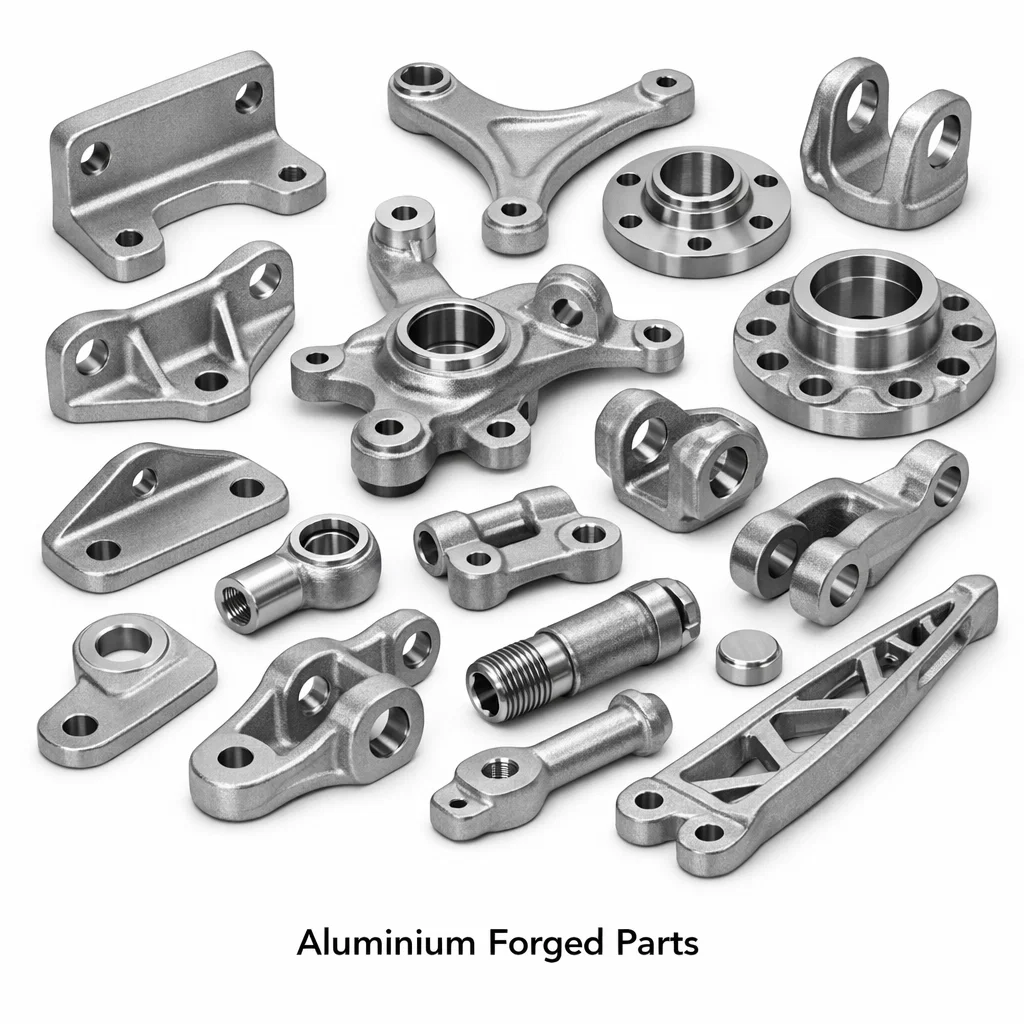
Jamnagar Brass Components manufactures precision aluminium forged parts and components for the aerospace, automotive, marine, and structural engineering industries. Forging produces parts with superior mechanical properties to castings — with a refined grain structure, higher fatigue strength, and better impact resistance — making it the preferred manufacturing route for safety-critical load-bearing aluminium components.
Aluminium Alloys for Forging
We forge from 6061-T6, the most widely used structural aluminium alloy, offering a good balance of strength, corrosion resistance, and machinability after forging. 6082-T6 is the European standard structural alloy, preferred in UK and EU markets. 2024-T3/T4 provides higher strength with excellent fatigue resistance for aerospace structural applications. 7075-T6 is our highest-strength option for demanding aerospace and motorsport applications. All alloys are available with full material traceability and mill certificates.
Forging Processes We Use
We operate closed-die (impression die) forging for production quantities of complex-shaped parts, producing near-net-shape components with minimal machining allowance. Open-die forging is used for large billets and custom shapes in smaller quantities. Ring rolling produces seamless rings and annular shapes for flanges, rings, and hubs. All forgings are heat-treated to the specified temper condition — typically T6 — after forging, followed by shot blasting and any required machining.
Components We Manufacture
Aluminium forgings we produce include aircraft structural fittings and brackets, automotive suspension arms and control arms, marine propeller hubs and structural brackets, hydraulic valve bodies and manifolds, aerospace and defence airframe components, motor sport chassis and suspension parts, and industrial flanges and pressure vessel components.
Quality and Testing
Our quality management system is certified to ISO 9001:2015. Aluminium forgings are inspected by visual, dimensional (CMM), and mechanical testing per lot. Non-destructive testing including dye penetrant inspection (DPI) and ultrasonic testing (UT) is available. Full material test certificates confirming chemical composition and mechanical properties are provided.
Why Source Aluminium Forgings from Jamnagar?
Our in-house forging, heat treatment, and CNC machining under one roof allows us to offer complete, finished aluminium forged components at competitive India-based prices. We export to buyers in the USA, UK, Germany, and Australia. Contact us to discuss your aluminium forging requirements.
Frequently Asked Questions — Aluminium Forged Parts
Q1: What is aluminium forging?
Aluminium forging is a manufacturing process where aluminium billets are heated to 400–500°C and shaped under high pressure in closed impression dies. Forging refines and aligns the aluminium grain structure, producing directional mechanical properties with significantly higher strength, fatigue resistance, and impact toughness than aluminium castings of the same alloy. Forged aluminium is widely used in aerospace, automotive, and high-performance applications requiring maximum structural reliability.
Q2: What aluminium alloys are most commonly forged?
6061-T6 (most widely forged aluminium, excellent strength and corrosion resistance, widely available billet stock), 6082-T6 (European equivalent of 6061), 7075-T6 (high-strength aerospace grade, tensile strength 503 MPa), 2024-T4 (fatigue-resistant for aerospace structural applications), 5083 H321 (marine grade, not heat-treatable, forged for marine hardware), and 7010/7050 for high-toughness aerospace applications are the principal forgeable aluminium alloys.
Q3: What are the key advantages of forged aluminium over cast aluminium?
Forged aluminium advantages: 30–50% higher tensile strength than equivalent cast alloy (6061-T6 forging: 276 MPa vs. A380 casting: 165 MPa); no internal porosity (fully dense structure); grain flow aligned with component geometry (directional strength); better fatigue and impact resistance (critical for safety components); and tighter dimensional tolerances (CT5–CT7 as-forged vs. CT8–CT10 for sand casting). Trade-off: higher tooling cost than sand casting.
Q4: What applications use aluminium precision forgings?
Aluminium forgings are used in aerospace (structural frames, brackets, bulkheads, wing ribs), automotive (wheel hubs, control arms, steering knuckles, pistons), motorsport (uprights, gear lever paddles, brake callipers), bicycles and sporting equipment (frame joints, pedal cranks), marine (deck hardware, propeller hubs, structural fittings), and military/defence (weapons components, vehicle structure, avionics housings).
Q5: What tolerances are achievable with aluminium precision forgings?
Precision aluminium forgings achieve CT4–CT6 as-forged per ISO 8062, significantly better than sand casting (CT8–CT10). After CNC machining of critical bores and surfaces, tolerances of ±0.025 mm are standard; ±0.005 mm with grinding. Draft angles of 1–3 degrees are required. Flash trimming to ±0.3 mm. GD&T flatness and parallelism of machined faces: 0.025 mm achievable. Forging dimensional repeatability is excellent over long production runs.
Q6: What is the die cost for aluminium forging tooling?
Aluminium forging die costs: small simple dies USD 2,000–5,000; medium complexity dies USD 5,000–15,000; large complex dies with multiple impressions USD 15,000–50,000. Dies are made from H13 hot work tool steel for long service life (30,000–100,000 shots). Die cost is quoted separately and amortised over production. For high-volume programs, die cost is typically recovered within 6–18 months of production start.
Q7: What heat treatment is required after aluminium forging?
Most forgeable aluminium alloys (6061, 7075, 2024) require solution heat treatment followed by artificial ageing (T6 condition) after forging to develop maximum strength. Solution treatment: 530°C for 1–4 hours, water quench. Artificial ageing: 175°C for 8–10 hours. The T6 condition develops the precipitation hardening that gives these alloys their superior strength. Some applications use the T73 (over-aged) condition for better stress corrosion cracking resistance.
Q8: Can aluminium forgings be anodised?
Yes. Aluminium forgings in 6061, 6082, and 7075 alloys can be anodised to Type II (5–25 µm, corrosion and wear protection) or Type III hard anodising (25–75 µm, maximum wear resistance) after CNC machining. 7075 and 2024 alloys require careful anodising bath control as their high copper and zinc content affects anodising quality. Hard anodised forged aluminium is widely used for aerospace bracket and fitting applications.
Q9: What industries purchase aluminium forgings from Jamnagar?
We supply aluminium forgings to aerospace component distributors and Tier 1 aerospace suppliers, automotive and motorsport OEMs and Tier 1 suppliers, bicycle and sporting goods manufacturers, marine equipment manufacturers, and defence/military equipment suppliers. Customers are primarily based in USA, UK, Europe, and Australia. Our competitive India-based forging costs offer 30–50% savings vs. equivalent US and European forging suppliers.
Q10: What is the minimum order and lead time for aluminium precision forgings?
New die forgings: minimum 50–100 pieces. First-article lead time with new die: 5–8 weeks (die manufacture: 3–5 weeks; first forgings + heat treatment + FAIR: 2–3 weeks). Production lead time for repeat orders: 4–6 weeks including forging, heat treatment, CNC machining, and inspection. Bulk orders above 5,000 pieces/year: dedicated production planning with 3–4 weeks standard lead time on blanket purchase orders.
📧 Get a Free Quote Today
Contact Jamnagar Brass Components for your custom manufacturing requirements.
Our engineers respond within 24 hours with competitive pricing and full technical documentation.
🏭 Manufactured in Jamnagar, India · 📦 Exporting to USA, UK, Europe & Worldwide · ✅ ISO 9001:2015 Certified