
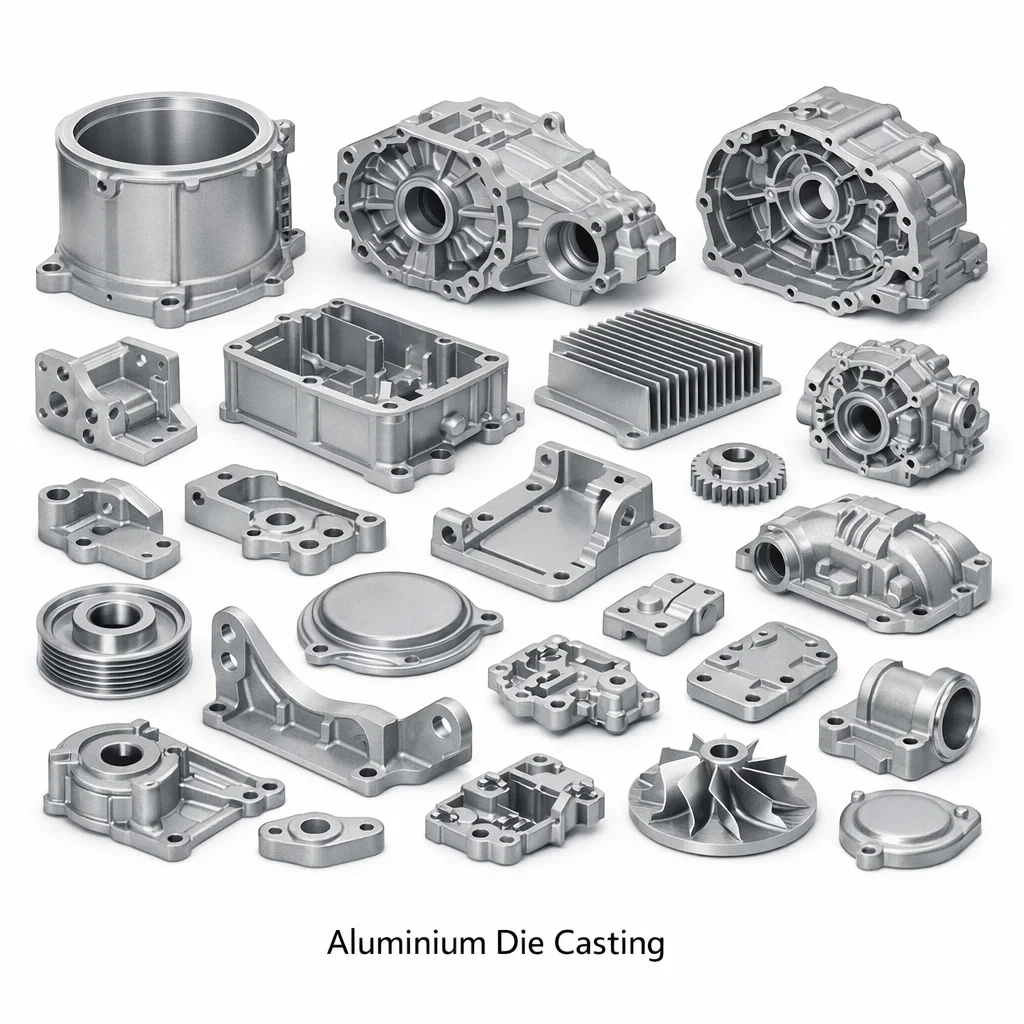
Jamnagar Brass Components manufactures aluminium die cast parts and components using high-pressure die casting (HPDC) and gravity die casting processes. Our die casting capability complements our CNC machining and forging services, providing a complete aluminium component solution for automotive, electrical, electronics, and consumer products industries.
Aluminium Die Casting Alloys
We cast with the most widely used die casting alloys for the international market. ADC12 (A383) is the standard aluminium-silicon-copper alloy for high-pressure die casting, offering excellent fluidity, good mechanical properties, and best dimensional stability for complex thin-wall castings. A380 is a common North American specification for HPDC, closely equivalent to ADC12. A413 (LM20) is a high-silicon alloy with excellent fluidity for very thin-wall and pressure-tight castings. We also cast in A360 for improved corrosion resistance in outdoor applications.
Products We Manufacture
Our aluminium die cast components include motor and gearbox housings for electric motors and power tools, heat sinks and thermal management enclosures for electronics, automotive brackets, housings, and valve bodies, LED lighting fixtures and street light housings, electrical junction boxes and enclosure bodies, instrument and control panel housings, power tool and hand tool bodies, and consumer electronics and appliance components.
Secondary Operations
After die casting, we offer in-house and sub-contracted secondary operations including CNC machining of critical dimensions (bores, threads, sealing faces), shot blasting for surface preparation, powder coating in any RAL colour, anodising (Type II) for electrical insulation and corrosion resistance, primer and wet painting, and vibration deburring and mass finishing. We supply complete, finished components ready for assembly.
Quality and Standards
Our quality management system is certified to ISO 9001:2015. Castings are inspected using CMM measurement, X-ray (where specified for porosity-critical parts), and pressure testing for hydraulic components. Full dimensional inspection reports and material test certificates are available with every production order.
Why Choose Jamnagar Brass Components for Die Casting?
Our Jamnagar facility combines die casting with CNC machining and surface treatment under one roof, reducing the number of suppliers in your supply chain. Our India-based manufacturing pricing delivers significant savings compared to UK, EU, or North American die casters while maintaining the same quality standards. Contact us for a competitive die casting quotation.
Frequently Asked Questions — Aluminium Die Cast Parts
Q1: What is aluminium die casting?
Aluminium die casting is a high-pressure manufacturing process where molten aluminium alloy is injected at high speed (10–100 m/s) and pressure (700–1,000 bar) into a steel die cavity. The die is water-cooled for rapid solidification. The process produces dimensionally accurate, complex aluminium components with excellent surface finish at high production rates — ideal for high-volume parts where tooling cost is amortised over large quantities.
Q2: What aluminium alloys are used for die casting?
ADC12 (AlSi12Cu2Fe, equivalent to EN AC-47100 / A383 USA) is the most widely used aluminium die casting alloy globally, offering excellent castability, low shrinkage, good fluidity for thin walls, and acceptable mechanical properties. A380 (AlSi8Cu3Fe) is the most common alloy in USA markets. ADC10 (A380 equivalent) offers higher strength. AlSi5 alloys are used for applications requiring higher ductility and weldability than standard ADC12.
Q3: What are the advantages of aluminium die casting over sand casting?
Die casting advantages: much tighter tolerances (CT3–CT5 vs. CT8–CT10 for sand), better surface finish (Ra 0.8–3.2 µm vs. Ra 6–25 µm), thinner walls (1.0–2.0 mm vs. 5 mm minimum for sand), faster cycle times (seconds per casting vs. minutes for sand), significantly lower per-piece cost at high volumes (above 1,000 pieces/year). Trade-offs: much higher tooling cost (USD 10,000–100,000 for die casting dies vs. USD 1,000–5,000 for sand patterns).
Q4: What wall thickness is achievable in aluminium die casting?
Aluminium die casting achieves minimum wall thickness of 0.8–1.5 mm for small thin-wall components (electronic enclosures, covers) and typically 1.5–3.0 mm for medium-sized structural castings. Maximum section thickness for quality die castings is approximately 12 mm — thicker sections have slower solidification, increased porosity risk, and longer cycle times. For thicker sections, low-pressure die casting or squeeze casting processes provide better internal quality.
Q5: What is the typical dimensional accuracy of aluminium die castings?
Aluminium die castings achieve CT4–CT5 per ISO 8062 as-cast, equivalent to ±0.1–0.3 mm on medium-sized parts. Critical features (bores, mounting faces, locating surfaces) are machined to ±0.025 mm after casting. Draft angles of 0.5–2 degrees are required for die withdrawal. Parting line and ejector pin marks are unavoidable but are located in non-critical areas. Wall thickness variation of ±0.15 mm is typical.
Q6: What surface treatments are available for aluminium die cast parts?
Surface treatments for aluminium die castings include shot blasting (standard, removes scale and improves paint adhesion), powder coating (broad colour range, durable outdoor finish), wet painting (custom colours, decorative finishes), anodising (Type II for corrosion resistance, Type III hard anodising for wear resistance), electroless nickel plating (uniform coating for complex shapes), and chromate conversion coating (Alodine, for conductivity and adhesion).
Q7: Can aluminium die castings replace zinc die castings?
Yes, for many applications. Aluminium die castings weigh approximately 65% less than zinc (density 2.7 vs. 6.6 g/cm³), are stronger, and have better elevated temperature performance. Zinc die castings produce thinner walls (0.5 mm vs. 0.8 mm minimum for aluminium) and tighter tolerances, and are preferred for very thin-wall, high-complexity decorative components (automotive trim, hardware). For structural and thermally-functional parts, aluminium die casting is preferred.
Q8: What industries use aluminium die cast parts?
Key industries include automotive (transmission housings, engine brackets, lighting bezels, heat sinks), electronics (RF enclosures, LED driver housings, heatsink-integrated housings), power tools (gearbox housings, motor end caps), HVAC (compressor components, valve bodies), telecommunications (base station housings, antenna brackets), and general industrial machinery (pump housings, motor frames, gearbox covers).
Q9: What is the die tooling cost for aluminium die casting?
Aluminium die casting tooling cost ranges from USD 8,000–20,000 for simple single-cavity dies (small, simple housing), USD 20,000–60,000 for medium-complexity multi-cavity dies, and USD 60,000–200,000 for large complex dies with slides, lifters, and multiple cores. Die life for aluminium die casting is typically 100,000–300,000 shots for heat-checked dies. Die cost is quoted separately and recovered over the production run.
Q10: What is the minimum order and lead time for aluminium die cast parts?
New die: minimum 500–1,000 pieces for first production run to justify die cost. Existing dies: minimum 200 pieces. First-article lead time with new die: 6–10 weeks (die manufacture: 4–7 weeks; first castings + FAIR: 2–3 weeks). Repeat production: 3–5 weeks for standard orders. High-volume production (above 10,000 pieces/month): dedicated production planning with 2–3 weeks lead time on blanket order call-offs.
📧 Get a Free Quote Today
Contact Jamnagar Brass Components for your custom manufacturing requirements.
Our engineers respond within 24 hours with competitive pricing and full technical documentation.
🏭 Manufactured in Jamnagar, India · 📦 Exporting to USA, UK, Europe & Worldwide · ✅ ISO 9001:2015 Certified