
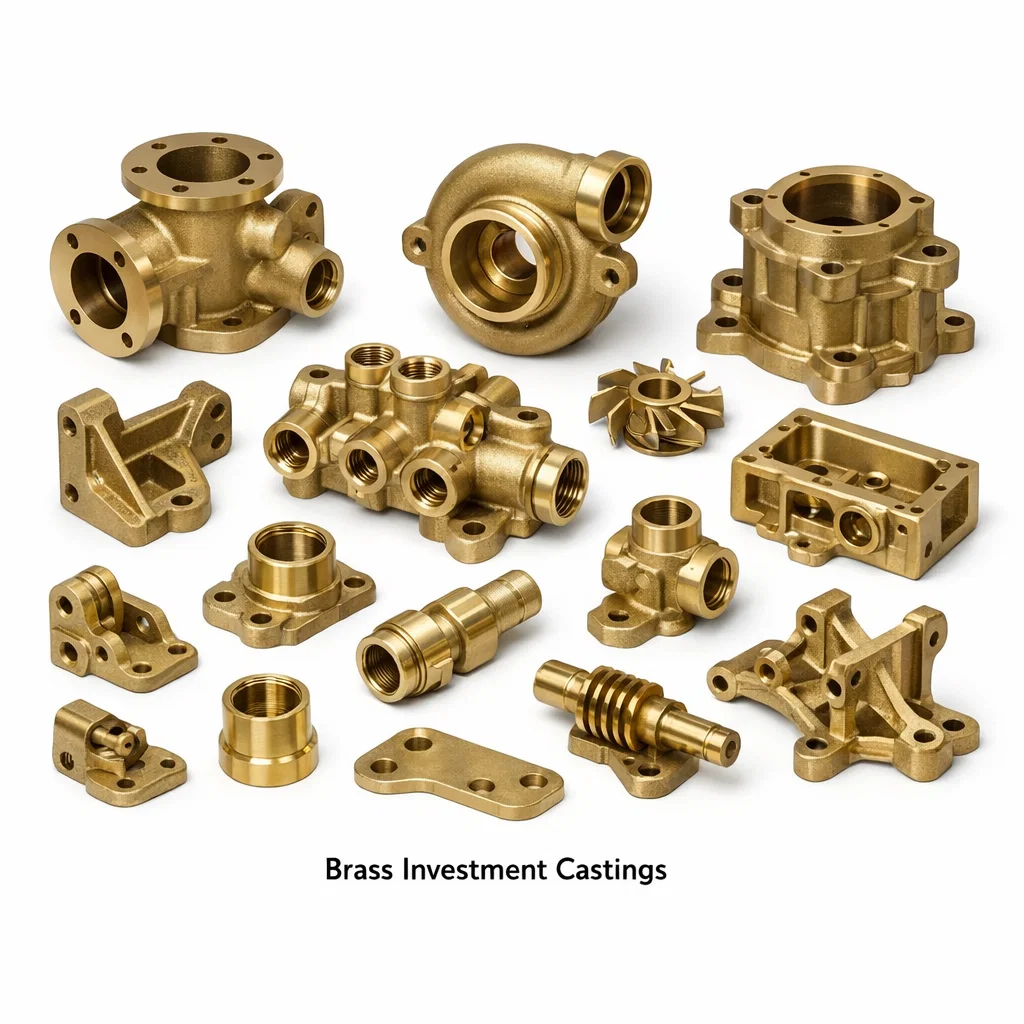
Jamnagar Brass Components manufactures brass investment castings using the precision lost wax casting process for complex-geometry brass components that require tight tolerances, excellent surface finish, and minimal post-casting machining. Investment casting is ideal for intricate designs that would be difficult or uneconomical to machine from solid bar or produce in sand casting.
The Investment Casting Process
Investment casting (lost wax casting) begins with the creation of a wax pattern — either injection-moulded in a metal die or 3D printed for prototype quantities. Wax patterns are assembled into a tree, coated with ceramic slurry in multiple layers, and fired to harden the ceramic shell and melt out the wax. Molten brass is then poured into the pre-heated ceramic shell. After cooling, the ceramic is broken away, and the castings are cut from the tree, cleaned, and inspected. The result is a near-net-shape casting with excellent surface finish (Ra 3.2-6.3 µm as-cast) and dimensional accuracy.
Brass Alloys for Investment Casting
We investment cast in CZ121 / C36000 free-machining brass for components requiring subsequent precision machining, CW617N / C37700 forging brass for higher strength applications, naval brass (CW712R / C46400) for components requiring superior corrosion resistance, and manganese brass for high-strength architectural and marine castings.
Products We Manufacture
Brass investment castings we produce include valve bodies and valve trim components, pump impellers and housings, architectural hardware and door furniture, decorative fixtures and fittings, instrument components and sensor housings, electrical connector bodies and terminal blocks, fluid system manifolds and junction blocks, and complex engineering parts from customer drawings. We handle prototype quantities (as few as 10 pieces) through to production runs of thousands.
Tolerances and Quality
Investment castings typically achieve dimensional tolerances of ±0.1 mm to ±0.2 mm depending on casting size and geometry. Critical dimensions are finish-machined to ±0.01 mm where required. Our quality management system is certified to ISO 9001:2015. Each batch is inspected dimensionally and visually, with pressure testing available for hydraulic components.
Why Choose Jamnagar Brass Components?
Our investment casting facility, combined with in-house CNC machining, allows us to supply complete, finished brass castings in a single supply chain step. Our India-based manufacturing provides significant cost advantages compared to UK, EU, or North American investment casting suppliers. Contact us with your drawing or CAD model for a competitive quotation.
Frequently Asked Questions — Brass Investment Castings
Q1: What is brass investment casting (lost wax casting)?
Brass investment casting (lost wax casting) is a precision casting process where a wax pattern of the component is coated in ceramic slurry, the wax melted out, and molten brass poured into the resulting hollow ceramic mould. The mould is broken to release the casting. Investment casting produces high-accuracy parts with excellent surface finish and complex geometry, including internal passages, thin walls, and fine external detail — impossible or uneconomical by other processes.
Q2: What tolerances are achievable with brass investment castings?
Brass investment castings achieve CT4–CT6 per ISO 8062 as-cast, equivalent to ±0.2–0.5 mm on medium-sized castings. Critical features may be machined to ±0.025 mm after casting. Wall thicknesses down to 1.5 mm are achievable. Surface finish Ra 1.6–6.3 µm as-cast (approximately N7–N9), significantly better than sand casting. Draft angles as low as 0.5 degrees are possible due to ceramic mould compliance.
Q3: What brass alloys can be investment cast?
We investment cast CZ121/C36000 free-machining brass, naval brass CW712R/C46400, silicon brass C87600 for lead-free applications, and gunmetal C83600 for pressure-containing castings. Yellow brass CW508L and DZR brass CW602N are also investment cast. For speciality applications, copper-nickel alloys and aluminium bronze can be investment cast with appropriate foundry adjustments for the different solidification behaviour.
Q4: What are the advantages of brass investment casting over sand casting?
Investment casting advantages include: higher dimensional accuracy (CT4–6 vs. CT8–10 for sand casting), better surface finish (Ra 1.6 µm vs. Ra 12 µm for sand), ability to cast thin walls (1.5 mm vs. 5 mm minimum for sand), no parting line flash, ability to cast complex internal geometries without sand cores, and closer resemblance to final machined shape (less machining required). Trade-offs: higher tooling cost and slower cycle time.
Q5: What is the wax tooling cost for brass investment castings?
Wax injection tooling for investment casting typically costs USD 1,000–5,000 for simple tools (single cavity, simple geometry) and USD 5,000–20,000 for complex multi-cavity tools with slides, lifters, and internal cores. Aluminium dies are standard for production volumes; brass or steel dies for very long-run production. Wax tooling is normally amortised over 500–2,000 pieces depending on complexity and volume.
Q6: What is the minimum wall thickness for brass investment castings?
Minimum wall thickness for brass investment castings is 1.5 mm for straightforward geometries, and 1.0 mm for thin-wall decorative or precision housings where the mould is carefully preheated before pouring. Walls below 1.5 mm risk cold shut defects if the metal cools before the mould fills. Abrupt changes from thin to thick sections should be avoided; gradual transitions improve metal flow and reduce shrinkage porosity.
Q7: Are internal passages possible in brass investment castings?
Yes, through the use of pre-formed ceramic or soluble wax cores that are built into the wax pattern before shell building. Ceramic cores maintain their shape during pouring and are leached out after casting using caustic soda or autoclave treatment. Internal passage diameters as small as 3 mm are achievable. Investment cast internal passages save significant machining cost on complex valve bodies and fuel system components.
Q8: What NDT is available for brass investment castings?
NDT options for brass investment castings include X-ray radiography (for internal porosity/shrinkage), liquid penetrant testing (LPT) for surface cracks, fluorescent penetrant inspection (FPI) for very small surface defects, and pressure testing for pressure-containing castings. Investment castings typically have fewer internal defects than sand castings due to the controlled pouring into preheated ceramic moulds, but X-ray testing is recommended for safety-critical applications.
Q9: What is the minimum order for brass investment castings?
Minimum order for brass investment castings is 10 pieces for first article/sample production (for wax tooling verification and FAIR). Production minimum is 25–50 pieces per run for economical shell building and pouring. For very small, simple parts, minimum 50 pieces. For complex large parts, minimum 10–25 pieces. Annual volumes above 500 pieces justify dedicated wax tooling with lower per-piece cost.
Q10: What is the lead time for brass investment castings?
Wax tool design and manufacture: 3–5 weeks. First investment castings from new wax tooling: 2–3 weeks. Machining of castings: add 1–3 weeks. Total first-article lead time: 6–10 weeks. Repeat production orders on existing wax tooling: 4–6 weeks for production quantities including casting, inspection, and machining. Expedited first-article production (shell building acceleration) available in 4–6 weeks at premium cost.
📧 Get a Free Quote Today
Contact Jamnagar Brass Components for your custom manufacturing requirements.
Our engineers respond within 24 hours with competitive pricing and full technical documentation.
🏭 Manufactured in Jamnagar, India · 📦 Exporting to USA, UK, Europe & Worldwide · ✅ ISO 9001:2015 Certified