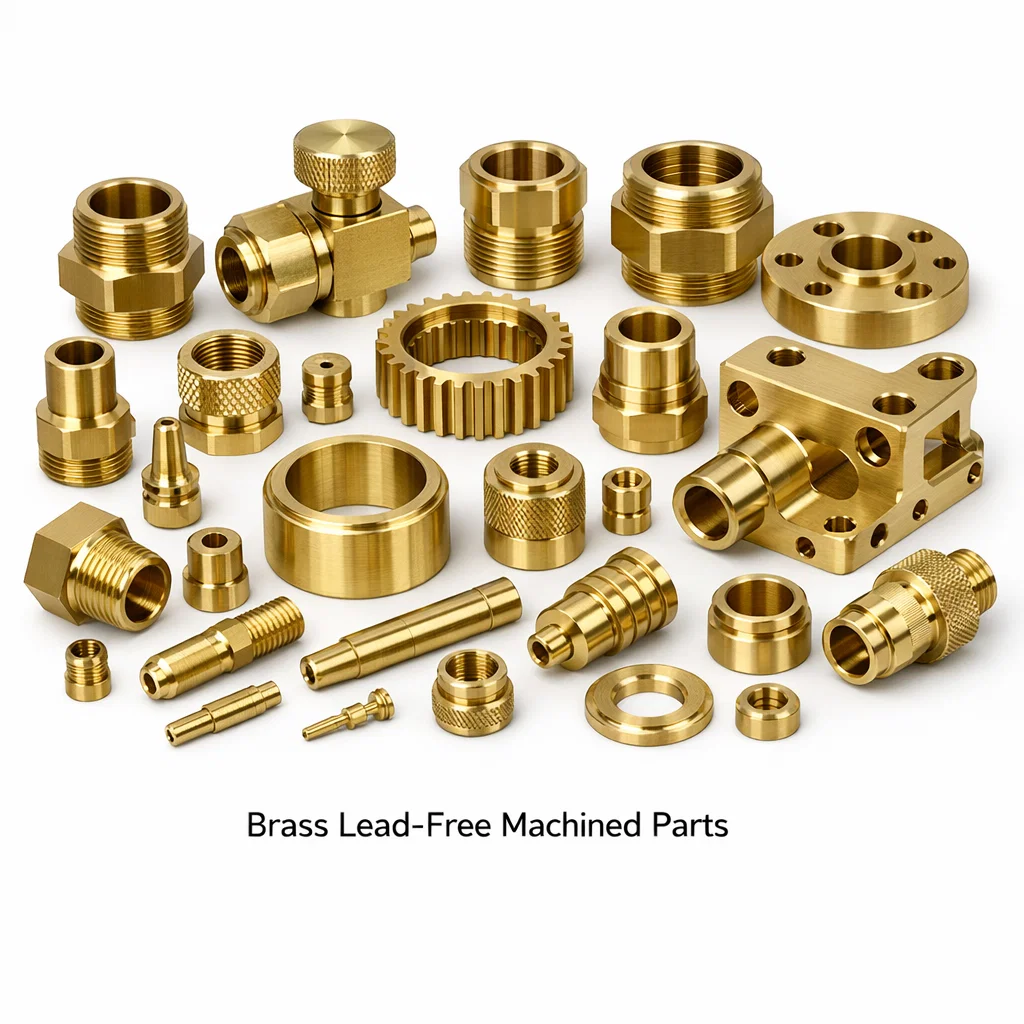
With the passage of federal and state lead-free plumbing legislation across the USA — including the revised federal Safe Drinking Water Act (SDWA) amendments, California AB1953, Vermont S.152, and the Reduction of Lead in Drinking Water Act — the demand for lead-free brass machined parts has surged dramatically. Brass & Copper Parts India is a precision manufacturer of lead-free brass machined parts in Jamnagar, India, supplying NSF/ANSI 61 and NSF/ANSI 372 compliant components to US plumbing, water treatment, and HVAC markets.
Understanding Lead-Free Brass Requirements in the USA
The US “lead-free” standard for plumbing components that contact potable water (drinking water and hot water) is defined as containing a weighted average lead content of not more than 0.25% — significantly stricter than the previous 8% threshold. This requirement applies to:
- Faucets, fittings, valves, and fixtures in contact with drinking water
- Pipe, pipe fittings, plumbing connectors and accessories
- Drinking water coolers, fountains, and dispensers
- Any other component or material intended to convey or dispense water for human consumption
Key US lead-free regulations:
- Federal Reduction of Lead in Drinking Water Act (2011): ≤0.25% weighted average lead for plumbing fixtures and fittings
- California AB1953 (Senate Bill 1420): California lead-free standard — effective January 2010
- Vermont S.152: Vermont lead-free requirement matching California standard
- NSF/ANSI 61: Health effects standard for plumbing products in contact with drinking water
- NSF/ANSI 372: Drinking water system components — lead content standard (≤0.25% weighted average)
Lead-Free Brass Alloy Options
The industry has developed several lead-free brass alloys as substitutes for traditional free-cutting brass (C36000, 3% lead). Each offers different trade-offs between machinability, cost, and specific compliance certifications:
1. Silicon Brass (Eco Brass) – C87850 / CW511L
The most widely adopted lead-free brass for US plumbing. Silicon brass replaces lead with silicon (2.7–3.4%) as the machinability-enhancing element. C87850 achieves a machinability rating of ~70% (vs. 100% for leaded C36000) and is NSF/ANSI 61/372 certified. It also offers excellent pressure tightness and DZR-class corrosion resistance. Trade names: Eco Brass, Fernco, CuZnSi.
2. Bismuth Brass – C89833 / BiMetal Brass
Bismuth (Bi) is used as a lead substitute in C89833 and similar alloys. Bismuth occupies the same grain boundary positions as lead but is non-toxic. Machinability is comparable to leaded brass. However, bismuth brass is more expensive than silicon brass due to higher bismuth metal cost.
3. Bismuth-Selenium Brass – C89510 / C89520
Bismuth-selenium brass combines bismuth with selenium for improved machinability over pure bismuth alloys. These alloys are NSF certified and widely used for faucet and valve bodies in the US market.
4. Low-Lead DZR Brass – CW511L / C69300
Some markets use phosphorus-inhibited low-lead brass (≤0.1% Pb) that combines near-zero lead with dezincification resistance. C69300 (CuZn36Mn2AlPb) is used in some European applications with low-lead compliance.
5. Tellurium Copper – C14500
For parts requiring maximum electrical conductivity with NSF compliance, tellurium copper (C14500) provides 93% IACS conductivity with 85% machinability and zero lead — suitable for electrical components in water contact environments.
Lead-Free Brass Alloy Grades – International Equivalents
| Alloy | UNS (USA) | EN (Europe) | BS (UK) | Trade Name | Pb Content | Machinability | NSF Cert. |
|---|---|---|---|---|---|---|---|
| Silicon Brass | C87850 | CW511L | — | Eco Brass | <0.1% | ~70% | NSF 61/372 ✓ |
| Bismuth Brass | C89833 | — | — | BiMetal Brass | <0.09% | ~80% | NSF 61/372 ✓ |
| Bismuth-Selenium Brass | C89510 | — | — | — | <0.09% | ~85% | NSF 61/372 ✓ |
| Low-Lead Brass | C69300 | CW511L | — | — | 0.1–0.25% | ~60% | NSF 61 ✓ |
| Yellow Brass (Wrought) | C27000 | CW507L | CZ107 | — | <0.1% | 30% | NSF 61 ✓ |
| Standard C36000 (Reference) | C36000 | CW614N | CZ121 | Free-Cutting | ~3% | 100% | Not NSF 372 |
Types of Lead-Free Brass Machined Parts We Manufacture
Lead-Free Brass Plumbing Fittings
Compression fittings, push-fit connectors, ball valves, gate valves, and service saddles machined from C87850 silicon brass (Eco Brass) to meet NSF/ANSI 61 and NSF/ANSI 372 requirements for US residential and commercial plumbing. Available in NPT, NPSM, and compression end connections.
Lead-Free Brass Faucet Components
Faucet bodies, stems, seats, cartridge housings, and mixing valves machined from bismuth brass (C89833) or silicon brass (C87850) for compliance with California AB1953, NSF/ANSI 61, and ADA/ADA-AG requirements for accessibility.
Lead-Free Brass Water Meter Components
Water meter bodies, register housings, bypass fittings, and meter connectors machined from lead-free brass alloys for municipal water metering applications. These parts meet AWWA C700 and NSF/ANSI 61 requirements for potable water metering equipment.
Lead-Free Brass Irrigation and Landscape Hardware
Drip irrigation fittings, hose bibs, garden valves, and sprinkler heads machined from lead-free brass for the US landscape and irrigation market. Lead-free compliance is increasingly required by state regulations even for outdoor landscape water systems.
Lead-Free Brass Fire Suppression Components
Sprinkler heads, deluge valve bodies, and alarm check valves machined from lead-free brass for fire suppression systems in buildings with NSF 61 water quality requirements. These parts are also tested per FM Global and UL requirements.
Our Lead-Free Compliance and Testing Capabilities
- Material verification: XRF (X-ray fluorescence) spectrometric analysis of every batch to confirm ≤0.25% Pb
- NSF/ANSI 372 weighted average calculation: Full bill-of-materials lead content analysis for NSF 372 compliance documentation
- ISO 6509 dezincification testing: For DZR-grade lead-free alloys
- Third-party NSF certification: We supply parts to NSF-certified finished goods manufacturers
- RoHS/REACH declarations: Confirming absence of restricted hazardous substances
- Material traceability: Full traceability from ingot certification to finished part shipment
Why Choose Brass & Copper Parts India for Lead-Free Brass Parts?
- Lead-free alloy expertise: Dedicated processing lines for C87850 silicon brass, C89833 bismuth brass, and C89510 bismuth-selenium brass
- NSF 372 documentation support: We provide full weighted average lead content calculations and declarations for your finished product NSF certification
- California AB1953 compliance: All our lead-free parts are certified ≤0.25% weighted average lead per California and federal standards
- No cross-contamination: Lead-free materials stored, processed, and machined separately from conventional brass
- Competitive pricing on lead-free alloys: Our silicon brass (C87850) parts are priced 20–30% lower than equivalent European sources
- Established US distribution relationships: We supply lead-free parts to major US plumbing distributors and OEMs
- ISO 9001:2015 certification: Quality management covering lead-free material qualification and ongoing controls
Frequently Asked Questions — Brass Lead Free Machined Parts
Q1: Why are lead-free brass parts required for potable water applications in the USA?
The Reduction of Lead in Drinking Water Act (2011) and NSF/ANSI Standard 372 require that all wetted surfaces of plumbing products in potable water systems contain no more than 0.25 percent lead by weighted average. This supersedes the earlier requirement of 8 percent lead maximum. California AB 1953 (effective 2010) pioneered these requirements, and they are now federal law under the Safe Drinking Water Act amendments, affecting fittings, valves, meters, and all components in contact with drinking water.
Q2: What lead-free brass alloys are available for machined parts?
Lead-free brass alloys suitable for machined components include: C69300 (EcoSmart, 63.5% Cu, bismuth-silicon brass, NSF 61 listed), C87850 (silicon-zinc brass, 75% Cu), C89833 (BiLock, bismuth-selenium brass), CW510L (EN, low-lead phosphor bronze), and CW626N (lead-free EN brass for machining). Each alloy has different machinability, conductivity, and corrosion resistance characteristics. C69300 and C87850 are the most widely used US-market lead-free machining alloys.
Q3: How does machinability of lead-free brass compare to standard free-machining brass?
Standard free-machining brass (C36000, CZ121) with 3% lead has a machinability index of 100 (the benchmark). Lead-free alternatives are somewhat harder to machine: C69300 EcoSmart rates approximately 70 to 80 on the machinability index, C87850 silicon brass approximately 60 to 70. Machining speeds and feeds must be adjusted, carbide tooling is preferred over HSS, and chip management requires more attention. Lead-free parts typically cost 15 to 30 percent more to machine than standard leaded brass for equivalent complexity.
Q4: What is the NSF/ANSI 372 standard and how do your parts comply?
NSF/ANSI Standard 372 is the US certification for low lead content in drinking water system components, requiring maximum 0.25 percent weighted average lead content across all wetted surfaces. Compliance requires: alloy certification confirming lead content below 0.25 percent (by weight) from a certified laboratory, and product listing on the NSF or IAPMO database. We provide alloy certification (MTC from certified lab) confirming lead content for lead-free brass parts. Full NSF 372 product listing is obtained by our customer as the product manufacturer.
Q5: What is the California AB 1953 law and does it apply outside California?
California AB 1953 (Assembly Bill 1953, effective January 2010) was the pioneering US state law limiting lead in plumbing products to 0.25 percent weighted average for potable water contact surfaces. Vermont, Maryland, and Louisiana enacted similar laws simultaneously. The federal Reduction of Lead in Drinking Water Act (effective January 2014) extended this requirement nationwide, so all 50 US states now require NSF 372 compliant lead-free plumbing components regardless of the original California law.
Q6: Do you supply lead-free brass parts with NSF certification documentation?
Yes. We supply lead-free brass parts with Material Test Certificates from NABL-accredited (India) or ISO/IEC 17025-accredited laboratories confirming lead content below 0.25 percent by weight. This is the alloy certification supporting the customer’s NSF 372 product listing application. We also provide Certificate of Conformance with each production shipment confirming the alloy used and declaring compliance with the lead-free alloy specification.
Q7: Are lead-free brass parts also RoHS compliant?
Yes. Lead-free brass alloys such as C69300, C87850, and CW510L contain no lead above RoHS Directive threshold limits (0.1 percent by weight in homogeneous materials for lead). They therefore comply with both RoHS Directive 2011/65/EU and REACH regulation SVHC requirements for lead. This makes lead-free brass parts suitable for both US (NSF 372) and European (RoHS/REACH) markets without separate alloy qualification.
Q8: What machined components do you produce in lead-free brass?
We machine a wide range of lead-free brass components including: ball valve bodies and stems, gate and globe valve bodies, compression fittings (tee, elbow, straight), push-fit plumbing fittings, meter bodies, pressure regulator housings, hose bib bodies, mixing valve components, and custom fittings to customer drawings. All are suitable for US potable water plumbing systems under NSF 372 and the Safe Drinking Water Act.
Q9: What is the price premium for lead-free brass over standard brass machined parts?
Lead-free brass alloys (C69300, C87850) typically cost 20 to 35 percent more than standard free-machining brass (C36000) in raw material. Combined with slower machining speeds (adding 15 to 25 percent to machining time), the total price premium for finished lead-free machined parts is typically 25 to 40 percent over equivalent standard brass parts. For potable water applications, this premium is mandatory for US market compliance and is factored into product pricing from the outset.
Q10: Can you supply lead-free brass parts for the US hot water and boiler market?
Yes. Lead-free brass is required for all potable water applications regardless of temperature. For hot water systems, C69300 (EcoSmart) and C87850 maintain adequate dezincification resistance and mechanical properties up to 90 to 100 degrees Celsius (standard domestic hot water temperatures). For higher temperature boiler applications above 110 degrees Celsius, lead-free bronze or stainless steel may be specified. We advise on the appropriate alloy for the specific temperature and pressure range.
Q11: How do I verify that parts I receive are truly lead-free?
Verification options include: XRF (X-ray fluorescence) analysis — a portable XRF gun can measure lead content in seconds non-destructively, giving rapid in-field verification; wet chemical analysis by accredited laboratory — more accurate, suitable for regulatory compliance documentation; EDX (energy dispersive X-ray) analysis on SEM — for research-grade confirmation. We provide our own laboratory analysis certificates with each lead-free shipment and can arrange third-party verification by SGS or Bureau Veritas on request.
📩 Get a Free Quote Today
Contact Jamnagar Brass Components for your needs of
Lead-Free Brass Machined Parts (NSF/ANSI 61 & 372 Compliant)
Our expert team responds within 24 hours with competitive pricing, material certifications & lead time estimates.
🏭 Manufactured in Jamnagar, India · 📦 Exporting to USA, UK, Europe & Worldwide · ✅ ISO 9001:2015 Certified