
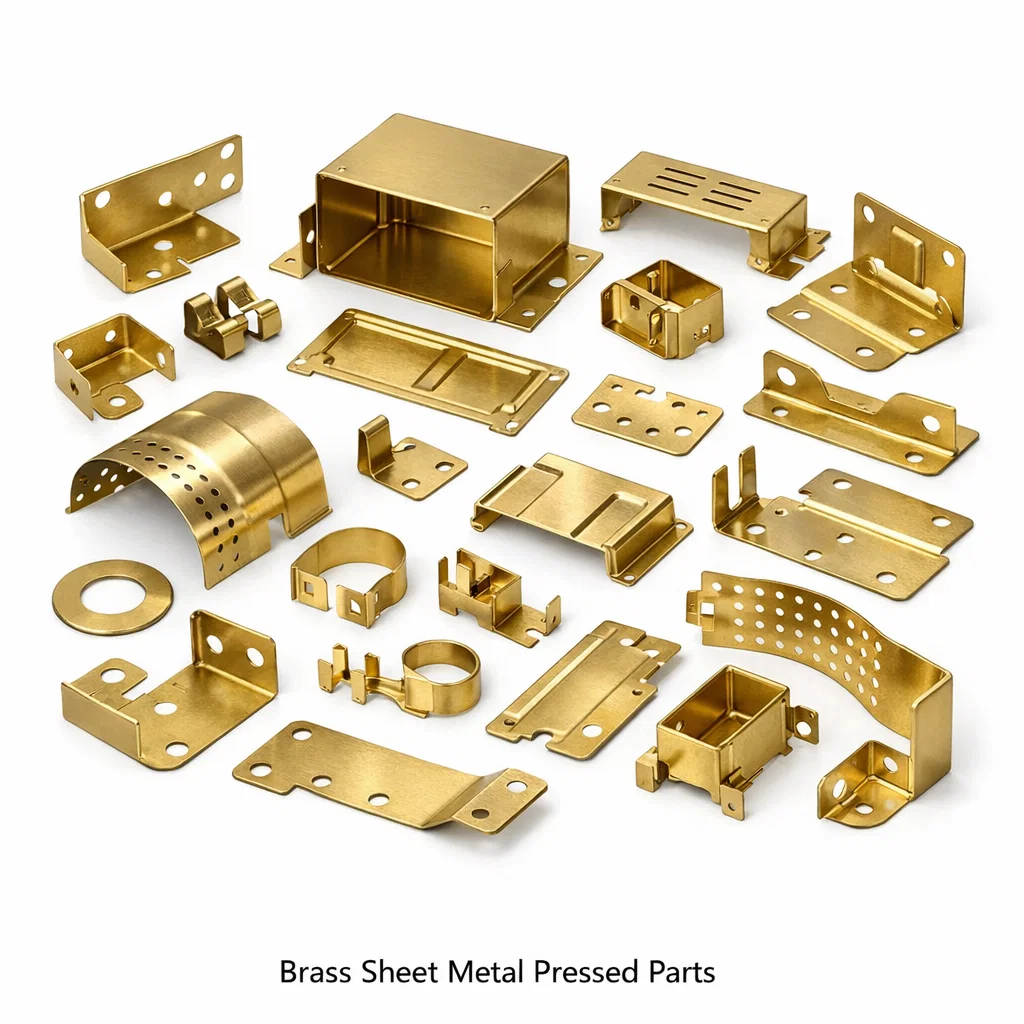
Jamnagar Brass Components is a specialist manufacturer of brass sheet metal parts and brass sheet metal components serving industrial clients in the USA, UK, Europe, and worldwide. Our brass sheet metal work encompasses blanking, piercing, bending, deep drawing, and complex multi-stage progressive stamping operations. With an in-house tool room and presses up to 300 tonnes, we can handle everything from thin 0.3 mm foil stampings to 5 mm thick brass pressings in custom geometries to your exact drawings.
Brass Alloy Grades for Sheet Metal Work — International Equivalents
| Common Name | UNS (USA) | EN (Europe) | BS (UK) | IS (India) | Composition |
|---|---|---|---|---|---|
| Cartridge Brass | C26000 | CW505L | CZ106 | Cu65Zn35 | 70% Cu, 30% Zn |
| Yellow Brass | C27000 | CW507L | CZ107 | Cu63Zn37 | 65% Cu, 35% Zn |
| Common Brass | C28000 | CW508L | CZ108 | Cu60Zn40 | 60% Cu, 40% Zn |
| Gilding Metal | C22000 | CW501L | CZ101 | Cu90Zn10 | 90% Cu, 10% Zn |
| Low Brass | C24000 | CW503L | CZ103 | Cu80Zn20 | 80% Cu, 20% Zn |
Brass Sheet Metal Components We Manufacture
Brass Stampings and Blanks
High-speed blanking and piercing of brass sheet into discs, washers, contacts, terminals, and custom blanks. Tolerances to ±0.05 mm on blanked profiles in 0.3 mm to 3 mm brass sheet.
Brass Deep-Drawn Shells and Cups
Multi-stage deep drawing of brass into cups, cartridges, cylinders, and housings. Brass (cartridge brass C26000/CZ106) is the classic deep-drawing alloy used in ammunition, fuse bodies, and instrument housings.
Brass Electrical Contacts and Terminals
Stamped and formed brass terminals, connector contacts, bus bar tabs, and spring contacts for electrical and electronics applications. Supplied bright, nickel-plated, tin-plated, or silver-plated.
Brass Brackets, Clips, and Mounting Hardware
Custom formed brass brackets, spring clips, earth clamps, P-clips, and mounting plates for panel boards, switchgear, and instrument cabinets.
Brass Enclosures and Boxes
Fabricated brass enclosures, junction boxes, and instrument housings formed from laser-cut and press-bent brass sheet, with welded or riveted seams as required.
Brass Grilles and Perforated Sheets
Decorative and functional perforated brass grilles, screens, and mesh panels for HVAC, architectural, and acoustic applications. Available in custom hole patterns and finishes.
Applications of Brass Sheet Metal Parts
- Electrical switchgear and panel boards
- Electronic connectors and PCB terminals
- Plumbing valve covers and escutcheons
- Automotive electrical and instrument systems
- Architectural decorative grilles and panels
- HVAC diffusers and ventilation components
- Ammunition and ordnance casings
- Locks, keys, and security hardware
Why Choose Jamnagar Brass Components for Brass Sheet Metal Work?
- Full in-house capability — laser cutting, CNC bending, stamping, and tooling design under one roof
- Expert in brass alloys — deep knowledge of formability, spring-back, and alloy selection
- Plating options — nickel, tin, silver, chrome, and gold plating in-house or via approved partners
- ISO 9001:2015 certified quality — full dimensional inspection with CMM
- Flexible run sizes — prototype to mass production (100,000+ pcs/month)
- Competitive India pricing — significant cost advantage for US buyers
- Technical support — alloy selection, DFM, and tolerance advice included free
- RoHS/REACH compliant materials — important for US and EU markets
Frequently Asked Questions — Brass Sheet Metal Parts
Q1: Which brass alloy is best for deep drawing?
Cartridge brass (C26000 / CZ106, 70% Cu–30% Zn) is the premier alloy for deep drawing, offering excellent cold ductility, uniform elongation of 55–65%, and consistent work-hardening that prevents tearing. It allows draw ratios up to 2.2:1 in a single stage. For less demanding forms, common brass (C28000/CZ108, 60/40) is more economical while still maintaining good formability.
Q2: What brass sheet thicknesses can you press and stamp?
We process brass sheet from 0.3 mm foil (for fine blanking and spring contacts) up to 5 mm thick strip for heavy structural brackets. The optimal range for high-speed progressive die stamping is 0.5–2.0 mm. Thicker materials (2–5 mm) are formed on hydraulic presses using compound and progressive tools with higher-clearance die sets.
Q3: Can brass stampings be supplied with electroplated finishes?
Yes. We offer bright nickel, semi-bright nickel, tin-lead, pure tin (bright or matte), silver, chrome, and gold plating on brass stampings through our approved electroplating partners. Plating thickness specifications and adhesion testing per ASTM B487/B568 are confirmed before production. Most plated parts are supplied in individual polybags to prevent contact corrosion.
Q4: What is the ASTM standard for brass sheet used in stampings?
Brass sheet and strip for stampings is supplied per ASTM B36 (brass plate, sheet, strip, and rolled bar), ASTM B19 (cartridge brass strip for drawing), and ASTM B121 (leaded brass plate, sheet, and strip). EN 1652 is the European equivalent. Material Test Certificates confirming chemical composition and mechanical properties are available with all orders.
Q5: Do you offer progressive die stamping for brass electrical terminals?
Yes. Progressive die stamping is our primary process for high-volume brass electrical terminals, connector contacts, and bus bar tabs. We achieve blanking and forming tolerances of ±0.05 mm on carrier-strip parts, with in-process inspection every 1,000 hits. Plating (tin, silver) is applied to finished parts in bulk barrel or rack configurations.
Q6: How do you prevent stress corrosion cracking (SCC) in deep-drawn brass parts?
Stress corrosion cracking in brass (also called season cracking) is caused by residual tensile stress combined with ammonia or amine environments. We prevent SCC by: annealing deep-drawn parts at 200–250 °C for 1 hour to relieve residual stress, avoiding ammonia-based cutting fluids, and specifying CZ106 (70/30 brass) which is more SCC-resistant than higher-zinc alloys. Parts for humid or chemical environments are always stress-relief annealed.
Q7: Can you manufacture brass perforated sheet and mesh panels?
Yes. We produce perforated brass sheet panels with round, square, slot, and hexagonal hole patterns in sheet thicknesses from 0.5–3 mm. Hole diameters from 1 mm upwards are standard. Custom perforation patterns for architectural, acoustic, or filtration applications are tooled from DXF files. Brass mesh can also be sourced and cut to size.
Q8: What tolerances do you hold on blanked brass washers and discs?
On blanked brass washers and discs we hold outer diameter to ±0.05 mm and inner bore to ±0.05 mm for high-speed press blanking. For close-tolerance applications, fine blanking achieves ±0.02 mm with perpendicular, burr-free edges. Thickness tolerance follows ASTM B36 strip tolerances (typically ±0.02–0.05 mm depending on nominal thickness).
Q9: Are your brass sheet metal parts RoHS compliant?
Our standard leaded brass alloys (CZ120, CZ121 with 3% lead) are exempt from RoHS Directive restrictions under Annex III exemption 6(a) for copper alloys containing up to 4% lead by weight. Lead-free brass alloys (CW510L, bismuth-brass, or silicon-brass) are available for applications where this exemption does not apply. We provide RoHS declarations with all standard orders.
Q10: What is the minimum order for custom brass stampings?
For new tooling: minimum production run of 1,000–5,000 pieces (depending on part value) to amortise tooling cost. For laser-cut brass prototypes: from 5 pieces with no tooling required, delivered in 5–7 days. For repeat orders on existing tools: minimum of 500 pieces per call-off. Blanket annual orders with monthly releases are welcomed for regular production parts.
📧 Get a Free Quote Today
Contact Jamnagar Brass Components for your needs of Brass Sheet Metal Parts and Components.
Our engineers respond within 24 hours with competitive pricing and technical data sheets.
🏭 Manufactured in Jamnagar, India · 📦 Exporting to USA, UK, Europe & Worldwide · ✅ ISO 9001:2015 Certified