
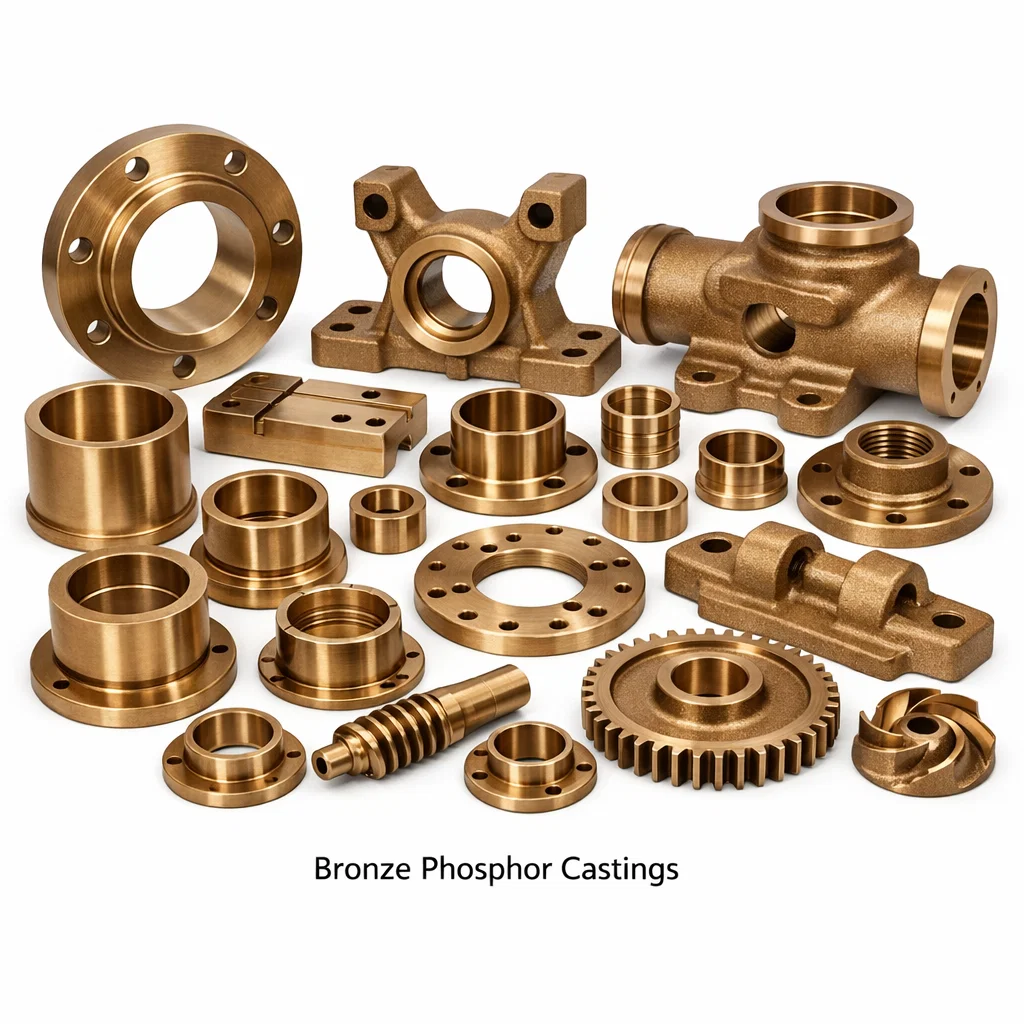
Jamnagar Brass Components manufactures phosphor bronze castings and tin bronze castings in PB1 (C90500), PB2 (C90700), and related tin bronze alloys for bearings, gears, bushings, and wear-critical components. Phosphor bronze is prized for its exceptional wear resistance, low friction coefficient, and ability to handle both static and dynamic loads in demanding industrial applications.
Phosphor Bronze Alloys We Cast
PB2 / C90700 (89% Cu, 11% Sn) is our most commonly cast tin bronze, offering the best combination of hardness (90 HB), compressive strength, and wear resistance for gears, worm wheels, and heavily loaded bearings. PB1 / C90500 (88% Cu, 10% Sn, 2% Zn) is a slightly softer alloy with improved machinability for pump parts and bushings. C91300 (naval bronze) provides very high tin content for maximum hardness in worm gear applications.
Casting Processes Available
We manufacture phosphor bronze components using three casting processes: sand casting for complex shapes and lower-volume requirements, centrifugal casting preferred for tubes, rings, and cylindrical bearing blanks producing a dense, porosity-free structure, and investment (lost wax) casting providing the best surface finish and dimensional accuracy for smaller, complex components.
Products We Manufacture
Phosphor bronze castings we produce include worm wheel blanks and machined worm wheels, spur and helical gear blanks, plain bearing bushings and flanged bushings, thrust washers and bearing plates, pump casing liners and impeller rings, hydraulic cylinder wear rings, marine propeller shaft bearings and stern tube liners, and custom wear components from customer drawings. We supply in as-cast, turned, or fully machined condition.
Standards and Quality
Our phosphor bronze castings are produced in accordance with BS 1400 PB2, ASTM B505 C90700 (continuous cast), and ASTM B271 C90700 (centrifugal cast). Chemical composition and mechanical properties are tested and certified per casting lot. Our quality management system is certified to ISO 9001:2015.
Why Choose Jamnagar Brass Components?
Our combined foundry and CNC machining capabilities allow us to supply phosphor bronze castings in fully machined-to-drawing condition, reducing your in-house processing requirements. Our India-based pricing is significantly more competitive than UK or European foundries, with the same quality certification and documentation. Contact us to discuss your phosphor bronze casting requirements.
Frequently Asked Questions — Bronze Phosphor Castings
Q1: What is phosphor bronze and what makes it special?
Phosphor bronze is a copper-tin alloy with small additions of phosphorus (0.01–0.35%), which acts as a deoxidiser during casting and produces a denser, stronger casting with improved fatigue resistance. PB2 (BS 1400) corresponds to C90700 (Navy M Bronze, 88% Cu, 10% Sn) in USA standards. The higher tin content (10% vs. 5% in LG2) gives greater hardness (90–110 HB vs. 65–85 HB), wear resistance, and tensile strength, making it ideal for gear, worm, and bearing applications.
Q2: What are the typical applications for phosphor bronze castings?
Phosphor bronze castings are used for worm gear wheels and worm wheels (where the ductile bronze meshes with hardened steel worms), gear blanks and segmental gears, bearing housings and bushings for high-load applications, cams and valve bodies for high-pressure service, and electrical contact springs and components. PB2/C90700 is specified where higher hardness and fatigue strength than LG2 are required.
Q3: How does phosphor bronze (C90700) compare to LG2 (C83600)?
C90700 phosphor bronze has higher tin content (10% vs. 5%), resulting in: higher tensile strength (280–310 MPa vs. 240–280 MPa), higher hardness (90–110 HB vs. 65–85 HB), better fatigue strength and wear resistance, and lower machinability (no lead content in C90700 vs. 5% Pb in LG2). C90700 is preferred for gear and bearing applications requiring higher load capacity; LG2 is preferred for pressure-tight valve and fitting castings requiring good machinability.
Q4: What ASTM standards apply to phosphor bronze castings?
Key ASTM standards for phosphor bronze castings are ASTM B143 (Navy M bronze, C90700 for gear and general castings), ASTM B271 (centrifugal castings of copper alloys, including C90700), and ASTM B584 (general copper alloy sand castings). For UK/European projects, BS 1400 PB2 designation applies. Material test certificates per ASTM E1086 (OES spectrometric analysis) confirm composition and mechanical properties per the applicable casting standard.
Q5: What casting processes are used for phosphor bronze?
Phosphor bronze (PB2/C90700) is cast by sand casting (most common for large and complex shapes), centrifugal casting (for tubes, rings, and bushing blanks with superior density), and gravity die casting (for medium-volume production of standardised shapes). Investment (lost-wax) casting is less common for PB2 due to its high tin content causing casting complexity but is used for precision gears and instrument components.
Q6: Why is phosphor bronze preferred for worm gear applications?
In a worm gear set, the softer bronze worm wheel mates with the harder steel (or stainless steel) worm. The bronze’s hardness (90–110 HB) and tin content provide a bearing surface that is hard enough for load carrying but soft enough to accommodate minor misalignment and run-in wear without galling the mating steel worm. Phosphor bronze also has a naturally low coefficient of friction against steel, important for efficient worm gear transmission.
Q7: What is the difference between PB2 and SAE 660 (C93200) for bearing applications?
PB2/C90700 is a harder, stronger bearing alloy (90–110 HB, 280–310 MPa) with no lead, suitable for high-load gear and journal bearings at moderate speeds where conformability is less critical. SAE 660/C93200 (7% lead) is a softer (60–70 HB), more conformable alloy with better embeddability and seizure resistance under boundary lubrication at higher sliding speeds. SAE 660 is preferred for journal bearings; PB2 for gear teeth and heavily-loaded worm wheels.
Q8: Are phosphor bronze castings available with full NDT documentation?
Yes. Available NDT for phosphor bronze castings: X-ray radiography (ASTM E94) for internal porosity in critical gear blanks and worm wheels; liquid penetrant testing (LPT, ASTM E1417) for surface cracks; ultrasonic testing for wall thickness; and hydraulic pressure testing for pressure-containing castings. All NDT reports are provided with the casting batch for quality records and compliance documentation.
Q9: What machining is available for phosphor bronze castings?
Fully machined phosphor bronze gear blanks and worm wheels are supplied to drawing, including hobbed, milled, or broached gear teeth, bored inner bore (H7 tolerance), keyway or spline bore, faced ends, and drilled/tapped mounting holes. Gear tooth profile inspection reports per DIN 3961 or AGMA 2000 are provided for precision gear applications. Final gear inspection includes lead, involute, pitch, and runout measurement.
Q10: What is the minimum order and lead time for phosphor bronze castings?
Minimum order: 1–5 pieces for new pattern sand castings (prototype pricing); 5–10 pieces for repeat orders. Centrifugal tube castings: minimum 3–5 rings or 1–3 tubes per diameter. First-article lead time: 4–6 weeks (pattern + casting + machining). Repeat production: 3–5 weeks. For gear blanks requiring gear cutting: add 2–4 weeks for tooth cutting, grinding, and inspection. Annual blanket orders with monthly delivery are available for regular worm gear supply.
📧 Get a Free Quote Today
Contact Jamnagar Brass Components for your custom manufacturing requirements.
Our engineers respond within 24 hours with competitive pricing and full technical documentation.
🏭 Manufactured in Jamnagar, India · 📦 Exporting to USA, UK, Europe & Worldwide · ✅ ISO 9001:2015 Certified