
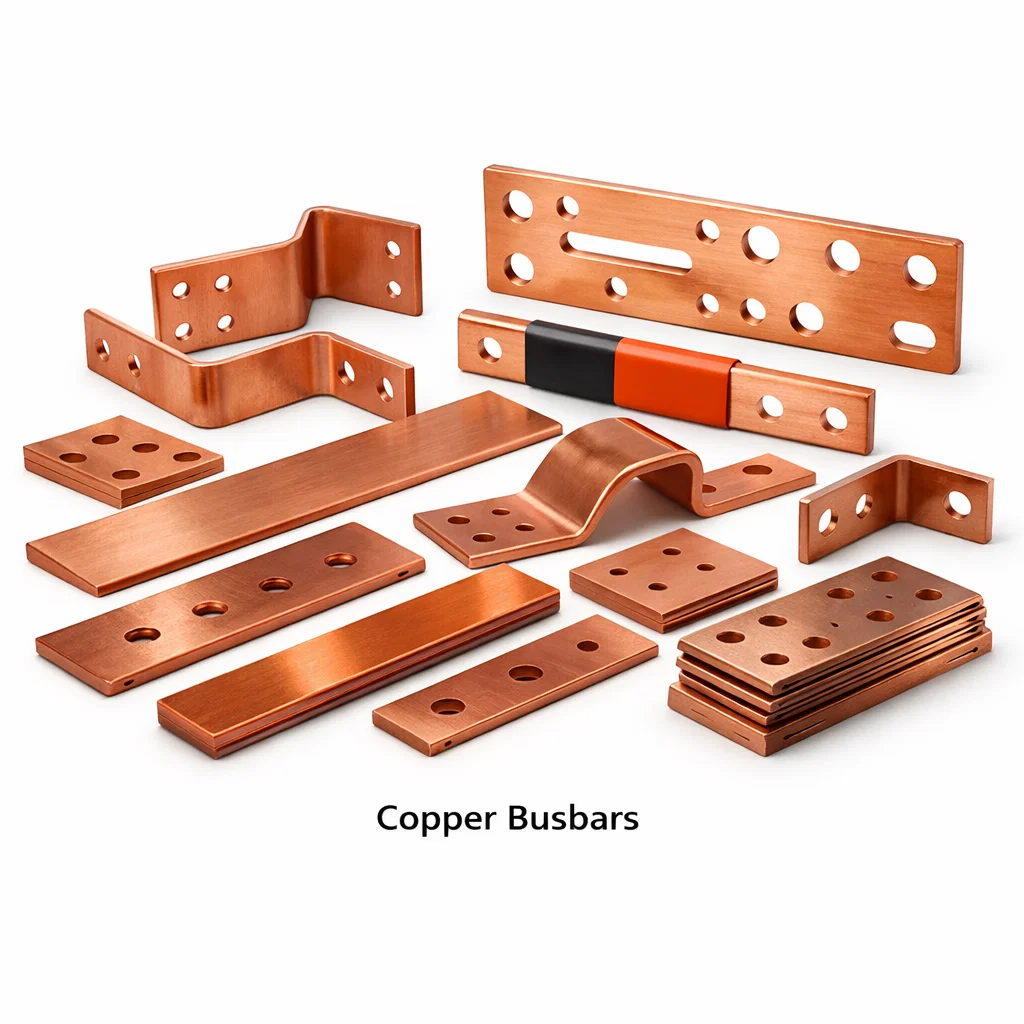
Jamnagar Brass Components supplies copper busbars in flat bar, L-section, and custom profiles for switchgear, MCCs, and distribution boards. C11000 ETP copper, ASTM B187, BS EN 13601. Tinned, silver-plated, or bare finish. Custom punching, drilling, and bending available. ISO 9001 certified, exporting to USA and Middle East.
Frequently Asked Questions — Copper Busbars
Q1: What is a copper busbar?
A copper busbar is a thick, flat conductor made from high-conductivity copper used to distribute electrical power within switchgear, distribution panels, motor control centres (MCC), and substations. Busbars carry high currents (hundreds to thousands of amperes) with low resistance and minimal heat generation. Their flat bar cross-section provides maximum surface area for heat dissipation and ease of bolted connection at tap-off points.
Q2: What copper grade is used for busbars?
Busbars are manufactured from C11000 ETP copper (Electrolytic Tough Pitch, 99.9% minimum copper, 101% minimum IACS conductivity) or C10200 OFHC copper for applications requiring highest purity. ETP copper (CW004A per EN, C11000 per ASTM) is the standard busbar material worldwide. Tinned copper busbars are produced by electroplating ETP copper bar with 5–15 µm of electrolytic tin for oxidation resistance and improved contact properties.
Q3: What standards apply to copper busbars?
Copper busbars comply with BS EN 13601 (copper rod, bar, and profiles for electrical purposes), ASTM B187 (copper bus bars), IEC 61439 (low-voltage switchgear and control gear assemblies, busbar current ratings), and IEC 62271 (high-voltage switchgear busbars). Current-carrying capacity is calculated per IEC 60298 or ANSI/IEEE C37.20 for the specific busbar cross-section, installation method, and ambient temperature.
Q4: What copper busbar sizes and profiles are available?
Flat copper busbars are available from 15×3 mm (45 mm², ~140 A) to 160×20 mm (3,200 mm², ~5,000 A). Standard cross-sections cover 25×3, 25×5, 30×5, 40×5, 50×5, 50×8, 63×6, 63×10, 80×8, 80×10, 100×10, 120×12, and 160×16 mm. DIN 43671 and BS EN 13601 standard profiles are available in 3 m and 6 m lengths. Round bar, square bar, and custom profile copper conductors are also available.
Q5: What is the current-carrying capacity of copper busbars?
Copper busbar current-carrying capacity depends on cross-section, installation (in air, touching, or in ducting), ambient temperature, and surface finish. Approximate capacities for bare copper busbars in free air at 40°C ambient: 25×5 mm (125 mm²) ≈ 400 A; 50×5 mm (250 mm²) ≈ 700 A; 100×10 mm (1,000 mm²) ≈ 2,100 A; 160×20 mm (3,200 mm²) ≈ 5,000 A. Tinned or silver-plated busbars carry 5–10% more current due to lower emissivity and contact resistance.
Q6: What is the advantage of tinned copper busbars over bare copper busbars?
Tinned copper busbars have a lower contact resistance at bolted joints (tin prevents copper oxide formation on joint surfaces), can be used with aluminium compression lugs without galvanic corrosion risk, are easier to solder for auxiliary connections, and have better corrosion resistance in humid and sulphur-containing environments. The disadvantage is higher cost and the need to re-tin surfaces if the tin layer is damaged during installation.
Q7: How are copper busbars joined and connected in switchgear?
Copper busbars are joined by: bolted lap joints with silver-plated or tin-plated mating faces (most common in LV switchgear), bolted fishplate joints for main bus connections, welded (TIG or friction stir) joints for permanent high-current connections, exothermic welding for substation earthing buses, and pressed or crimped compression connectors for tap-off connections. Bolted joints require controlled tightening torque per IEC 61439 to achieve minimum contact resistance.
Q8: Are copper busbars available in custom shapes and profiles?
Yes. Custom profile copper busbars can be produced by drawing, rolling, extrusion, or machining to any cross-section required for special switchgear designs. L-profile, T-profile, hollow rectangular (tube), comb busbars, and pre-bent busbar sets for specific switchgear layouts are manufactured to drawing. Pre-drilled, pre-tinned, and pre-insulated busbar sets for panel builder OEMs are available as a complete supply package.
Q9: What is the minimum order and lead time for copper busbars?
Standard flat copper busbars in stock sizes (25×3, 25×5, 50×5, 100×10 mm) are typically available in 1–2 weeks. Tinned copper busbars: 2–3 weeks. Non-standard profiles: 3–5 weeks. Custom profiles and pre-fabricated busbar sets: 4–8 weeks. Minimum order: 10 metres for standard stock sizes; 50 metres for non-standard. Project quantities (above 500 kg) receive volume pricing and dedicated production scheduling. Export to USA, UK, Europe, and worldwide.
Q10: Are silver-plated copper busbars available?
Yes. Silver-plated copper busbars (10–25 µm electroplated silver) are available for high-reliability MV/HV switchgear and power distribution applications where minimum contact resistance, maximum current-carrying capacity, and resistance to high-temperature oxidation are required. Silver plating on copper busbars is specified for 132 kV and above switchgear bus connections, high-current generator output busbars, and special environment applications. Silver plating certificates are provided with each batch.
📧 Get a Free Quote Today
Contact Jamnagar Brass Components for your custom manufacturing requirements.
Our engineers respond within 24 hours with competitive pricing and full technical documentation.
🏭 Manufactured in Jamnagar, India · 📦 Exporting to USA, UK, Europe & Worldwide · ✅ ISO 9001:2015 Certified