
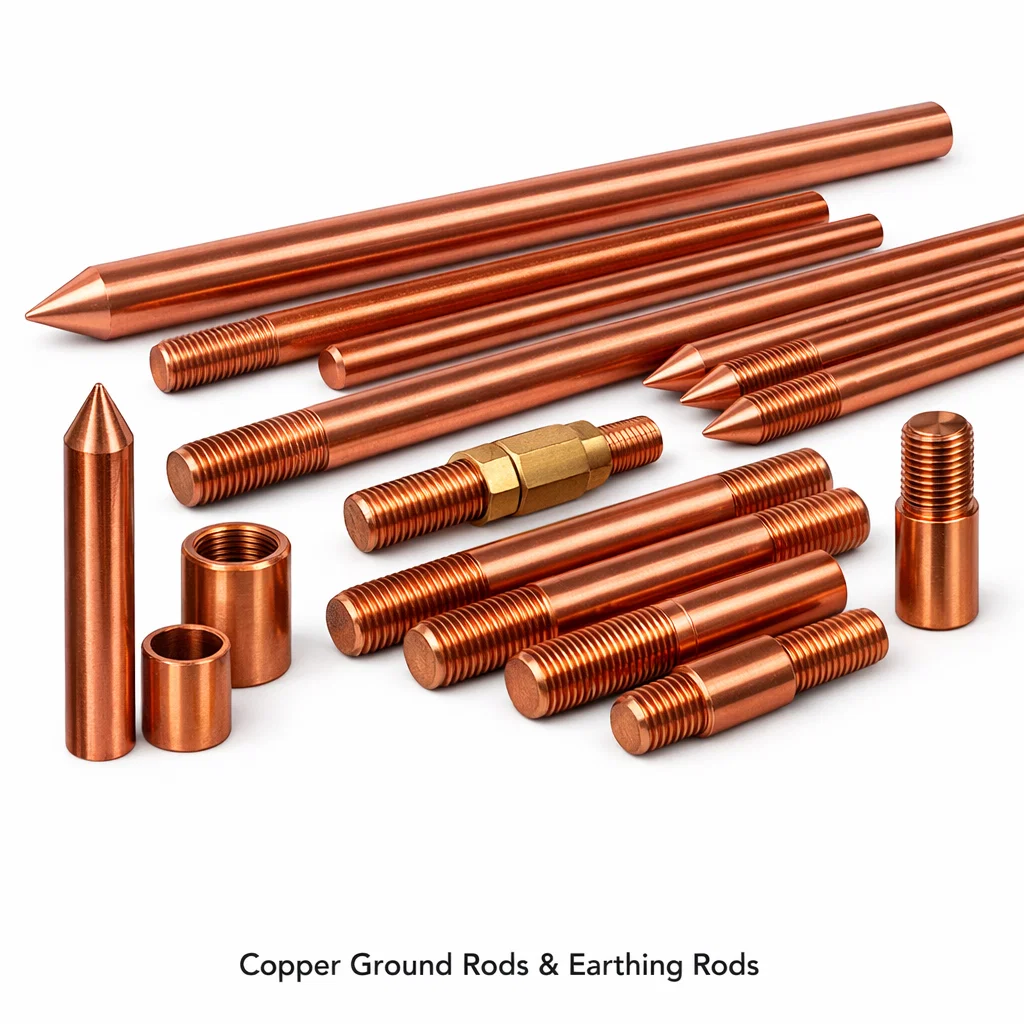
Jamnagar Brass Components manufactures and supplies copper ground rods and copper bonded steel earthing rods for lightning protection, electrical substation earthing, telecommunications earthing, and structural bonding applications. Our ground rods provide a safe, low-resistance connection between the electrical earthing system and the earth.
Types of Ground Rods We Supply
We supply solid copper ground rods manufactured from ETP copper (C11000) for the highest conductivity in applications where mechanical driving loads are low. Copper bonded steel ground rods (copper-clad steel) are electroplated with a thick copper coating (typically 250 µm) over a high-tensile steel core, providing the driving strength of steel with the corrosion resistance and conductivity of copper. Stainless steel ground rods with copper coating are available for marine and aggressive soil environments. Threaded couplers and driving studs are available to join sections for deep-driven earthing systems.
Dimensions and Specifications
We supply copper bonded steel ground rods in standard diameters of 14.2 mm (5/8″), 17.2 mm (11/16″), and 19.0 mm (3/4″) as most commonly specified in ANSI/IEEE 80 and ANSI/UL 467 standards for North American markets. For UK and European markets, we supply rods to BS EN 62305 requirements in 12.7 mm, 14.2 mm, and 16.0 mm diameters. Rod lengths range from 1.2 m (4 ft) to 3.0 m (10 ft) as standard, with longer lengths achievable by coupling.
Standards and Certifications
Our copper bonded steel ground rods are manufactured in accordance with ANSI/UL 467 (grounding and bonding equipment), IEEE 80 (guide for safety in AC substation grounding), and BS EN 62305 (protection against lightning). Material certifications confirming copper cladding thickness, steel core specification, and conductivity are provided. Our quality management system is certified to ISO 9001:2015.
Applications
Our copper ground rods and earthing rods are used in lightning protection systems for buildings and structures, electrical substation and power plant earthing grids, telecommunications tower and mast earthing, railway and road infrastructure earthing, oil and gas facility bonding and earthing, and solar power plant earthing and grounding systems.
Why Choose Jamnagar Brass Components?
We supply copper ground rods to lightning protection installers, electrical contractors, utility companies, and MRO distributors across the USA, UK, and Middle East. Our competitive India pricing, broad size range, and ISO 9001 certification make us a reliable supply partner for earthing system components. Contact us for a quotation on copper ground rods or a complete earthing system package.
Frequently Asked Questions — Copper Ground Rods & Earthing Rods
Q1: What is a copper ground rod?
A copper ground rod (also called an earth rod or grounding electrode) is a conductor driven vertically into the ground to provide a low-resistance electrical connection between an electrical system and the earth. Ground rods dissipate fault currents, lightning surges, and static charges safely into the earth, protecting electrical equipment and personnel. Copper-bonded steel rods combine the conductivity of copper with the mechanical strength of steel.
Q2: What is the difference between solid copper and copper-bonded steel ground rods?
Solid copper ground rods (pure copper, 8–14 mm diameter) offer maximum conductivity and corrosion resistance but are expensive and limited to shallow installations. Copper-bonded steel ground rods have a steel core (for driving strength and length up to 3,000 mm) with a thick copper coating (0.254 mm minimum per UL 467/IEEE 837) electrolytically applied. The copper bonding is inseparable from the steel core, providing both mechanical strength and corrosion resistance.
Q3: What standards apply to copper ground rods?
Key standards include UL 467 (USA grounding and bonding equipment), IEEE 837 (qualifying permanent connections for use in substation grounding), BS EN 62561-2 (lightning protection components), IS 3043 (India code of practice for earthing), and IEC 62305 (lightning protection). For chemical earthing systems, IS 9537 and BS 7430 provide additional guidance on electrode installation and earth resistance requirements.
Q4: What is the typical length and diameter of copper ground rods?
Standard copper-bonded steel ground rods are available in 5/8 inch (15.9 mm), 3/4 inch (19 mm), and 1 inch (25.4 mm) diameters per UL 467. Lengths are 1.2 m (4 ft), 1.5 m (5 ft), 1.8 m (6 ft), 2.4 m (8 ft), and 3.0 m (10 ft). For deep earthing applications, sectional rods with threaded couplings allow multiple sections to be driven to depths of 9 m or more using a rotary hammer or pneumatic driving tool.
Q5: What copper thickness is required on copper-bonded steel ground rods?
IEEE 837 requires a minimum copper coating thickness of 0.254 mm (254 µm, or 10 mils) for permanently bonded copper-clad ground rods. UL 467 specifies similar minimum copper thickness requirements. The copper coating must be continuous, free of holidays (uncoated spots), and adhere to the steel core without delamination after mechanical driving. We provide electroplating thickness certificates with each batch.
Q6: What is chemical earthing and how does it differ from conventional ground rods?
Chemical earthing systems use hollow copper or galvanised steel pipes filled with hygroscopic backfill compounds (bentonite, carbon, salt mixtures) that absorb moisture and maintain low-resistance earth contact in high-resistivity soils (rocky, sandy, or dry conditions) where conventional driven ground rods achieve unacceptably high earth resistance. Chemical earthing electrodes maintain stable resistance through seasonal soil moisture variations.
Q7: What is the target earth resistance for grounding systems?
Earth resistance targets vary by application: below 1 ohm for HV substation earth grids (IEEE 80), below 5 ohms for LV distribution earthing (IEEE 1100), below 10 ohms for building earthing (NEC Article 250), and below 10 ohms for lightning protection (IEC 62305). In high-resistivity soil, multiple electrodes, deep driving, or chemical treatment are used to achieve the required resistance.
Q8: How is earth resistance measured after ground rod installation?
Earth resistance is measured using the Fall of Potential (3-point) method with a dedicated earth resistance tester (Megger or equivalent), or using the Wenner 4-electrode method for large earth grids. After installation, ground rods should be tested and the resistance verified before backfilling. Test records are required for compliance with electrical regulations and insurance requirements.
Q9: Are copper ground rods available with threaded couplings for deep earthing?
Yes. Sectional copper-bonded steel ground rods with stainless steel or bronze threaded couplings (1/2 inch, 5/8 inch, or 3/4 inch thread) are available in 1.2 m and 1.5 m section lengths for deep earthing installations. Each section is driven individually and coupled to the next, allowing continuous driving to depths of 6–15 m in a single location for minimum footprint deep earthing in congested sites.
Q10: What is the lead time and minimum order for copper ground rods?
Standard sizes (5/8 inch × 1.8 m and 2.4 m copper-bonded steel rods) are typically in stock or available within 1–2 weeks. Non-standard diameters, lengths, and solid copper rods have 3–5 weeks lead time. Minimum order: 50 pieces for standard sizes; 100 pieces for non-standard configurations. Bulk quantities (above 500 pieces) are available with 4–6 weeks lead time and project-specific pricing.
📧 Get a Free Quote Today
Contact Jamnagar Brass Components for your custom manufacturing requirements.
Our engineers respond within 24 hours with competitive pricing and full technical documentation.
🏭 Manufactured in Jamnagar, India · 📦 Exporting to USA, UK, Europe & Worldwide · ✅ ISO 9001:2015 Certified