

Comprehensive Overview of Bi-Metallic Copper Lugs
We are one of the leading manufacturers and exporters of Bi-Metallic Copper Lugs, Copper-Aluminum Transition Lugs, Bimetallic Cable Lugs, and Cu-Al Terminal Connectors from India. We supply high-quality compression bi-metallic lugs, mechanical bi-metallic lugs, welded transition lugs, copper-aluminum barrel lugs, two-hole bi-metallic lugs, and custom transition connectors to global markets. Our manufacturing facility specializes in producing premium bi-metallic lugs using advanced friction welding, explosion welding, ultrasonic welding, CNC machining, tin plating, crimping technology, and comprehensive quality control systems. We serve diverse industries including power generation and transmission (substations, power plants, HV/EHV systems), power distribution (utility networks, overhead lines, underground cables), renewable energy (solar farms, wind turbines, battery storage), industrial facilities (manufacturing plants, heavy industry, data centers), commercial buildings (electrical distribution, busway systems), infrastructure (railways, airports, metro systems), oil and gas (offshore platforms, refineries, petrochemical), and mining (mobile substations, mining equipment). Our expertise encompasses various materials including Copper C11000 (99.9% pure – palm side), Aluminum 6061-T6/1350-H0 (barrel side), Tin Plating (corrosion protection), different bonding methods including friction welding (molecular bond), explosion welding (metallurgical bond), ultrasonic welding (solid-state bond), and mechanical fastening (bolted transition). We manufacture bi-metallic lugs ranging from 16mm² to 1,000mm² cable sizes, current ratings 50A to 5,000A, voltage ratings up to 72kV, with bond strength >150 MPa, maintaining contact resistance <0.5 milliohms, compliance with IEC 61238, IEEE 837, UL 486, BS 4579, AS/NZS standards, and reliable aluminum-to-copper transitions preventing galvanic corrosion in electrical power systems.
What are Bi-Metallic Copper Lugs?
Definition and Purpose
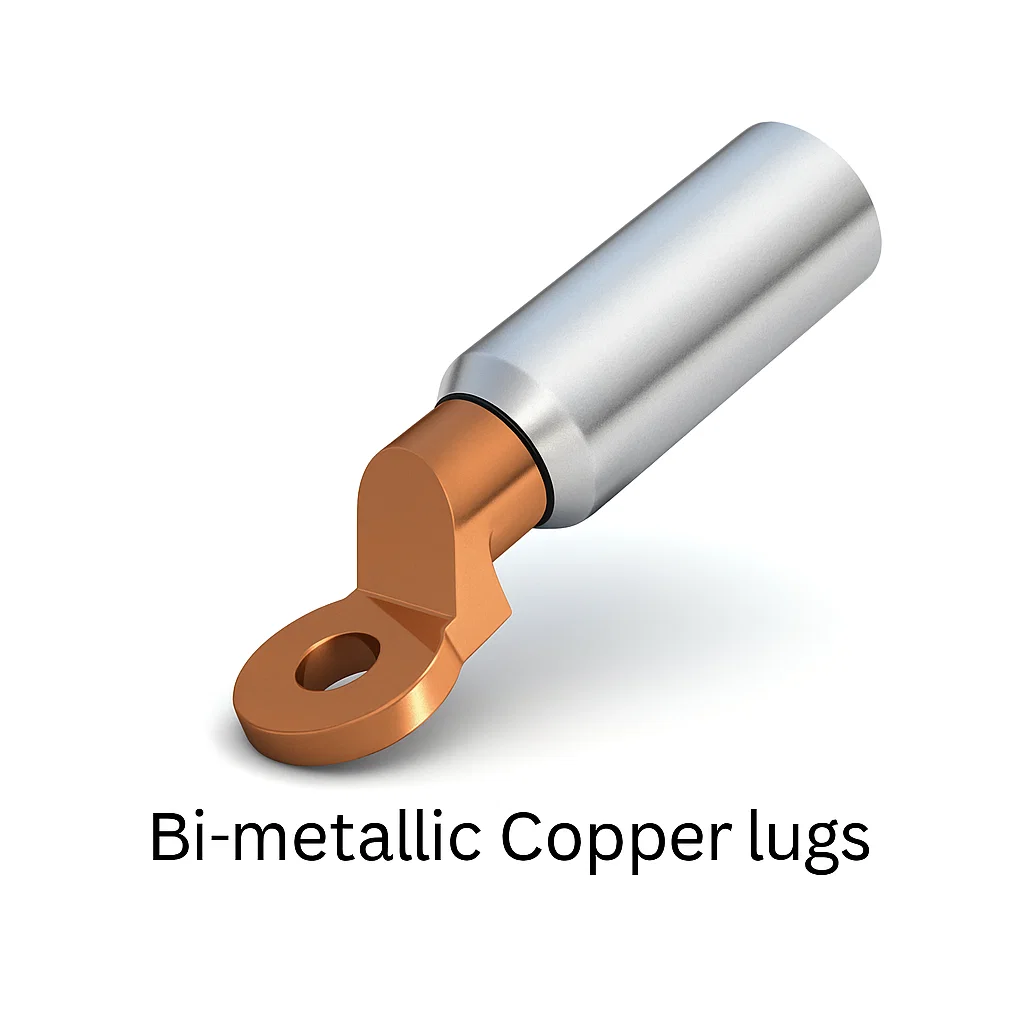
Bi-Metallic Lug: Electrical cable lug with two different metals joined together – typically copper palm (connection end for copper bus bars or equipment) and aluminum barrel (crimp end for aluminum cables/conductors). Primary Purpose: Safely connect aluminum conductors to copper bus bars or equipment without galvanic corrosion, eliminate dissimilar metal contact that causes high resistance and failure, provide reliable electrical transition between aluminum and copper systems.
Why Needed: Aluminum and copper create galvanic cell when in direct contact (electrochemical potential difference 0.7-1.0V), moisture as electrolyte causes corrosion at interface, aluminum oxidizes rapidly reducing contact area, joint resistance increases causing overheating and failure, bi-metallic lugs separate metals preventing galvanic action.
Construction
Two-Material Design: Copper palm (tongue/pad) with mounting holes for bolted connection to copper bus bar, aluminum barrel (crimp section) for crimping onto aluminum cable, transition zone where copper and aluminum joined by welding or mechanical means, barrier preventing direct aluminum-copper contact in service. Typical Dimensions: Palm thickness 3-15mm depending on current rating, barrel wall thickness 2-5mm, overall length 100-400mm depending on cable size.
Types of Metal Combinations
Copper-Aluminum (Cu-Al): Most common 95% of applications, copper palm for equipment/bus bar connection, aluminum barrel for aluminum conductor. Aluminum-Copper (Al-Cu): Less common reverse configuration, aluminum palm for aluminum bus bar, copper barrel for copper cable (rare – copper cable usually connects directly). Copper-Copper with Aluminum Insert: Specialty designs for specific applications.
Types of Bi-Metallic Lugs
Compression Bi-Metallic Lugs
Design: Seamless tubular aluminum barrel for cable insertion, copper palm with mounting holes (1, 2, or 4 holes), friction/explosion/ultrasonic welded transition joint. Installation: Aluminum cable stripped and inserted into barrel, hydraulic compression tool crimps barrel onto conductor (hexagonal or circular die), crimping creates cold-weld connection, bolts through palm to copper bus bar.
Advantages: Highest reliability (permanent connection), lowest contact resistance <0.5 milliohms, weatherproof sealed barrel, UL/IEC approved method, suitable all voltage levels LV to EHV 72kV. Applications: Power distribution systems, substation connections, overhead transmission lines, underground cable terminations, renewable energy solar/wind. Sizes: 16mm² to 1,000mm² (AWG 6 to 2,000 kcmil), current ratings 50-5,000A.
Mechanical Bi-Metallic Lugs
Design: Two-piece construction with separate copper palm and aluminum barrel, mechanically fastened together with bolts/screws, set screws gripping conductor inside barrel. Installation: Cable inserted into barrel, set screws tightened compressing conductor, mechanical connection between barrel and palm.
Advantages: No special crimping tools required, field-installable with basic tools, reusable (can be removed and reused), lower initial cost. Limitations: Higher contact resistance versus compression (0.8-2 milliohms), periodic maintenance required (retorquing), not suitable high-vibration, not weatherproof unless sealed, limited to low-medium voltage <11kV. Applications: Temporary connections, maintenance applications, industrial control panels, switchgear MV/LV.
Two-Hole vs. Four-Hole Lugs
Two-Hole Lugs: Most common configuration, two mounting holes for bolting to bus bar, suitable most applications current <3,000A, economical standard design. Four-Hole Lugs: Heavy-duty high-current applications >3,000A, larger contact area (lower current density), better mechanical stability, redundant fastening (if one bolt loosens, three remain).
Selection: Two-hole adequate 95% applications, four-hole for extra-high current >3,000A, critical applications requiring redundancy, heavy mechanical loads (vibration, short-circuit forces).
Long Barrel vs. Standard Barrel
Standard Barrel: Length 1.5-2× cable diameter, sufficient for most installations. Long Barrel (Extended Barrel): Length 2.5-4× cable diameter, used for cable terminations requiring longer creepage distance (outdoor high-voltage), additional mechanical strength (overhead line tension), extra crimping area (maximum pull-out strength).
Applications: Overhead transmission lines (mechanical load), outdoor cable terminations (pollution/weathering), high-voltage applications >36kV (creepage requirements), critical applications (redundant crimping).
Straight vs. 90-Degree Lugs
Straight Palm: Most common, palm in line with barrel, suitable most applications. 90-Degree (Right-Angle) Palm: Palm perpendicular to barrel, space-saving in cramped enclosures, allows cables to run parallel to bus bar, aesthetic cleaner installation.
Applications: 90-degree for compact switchgear, control panels, bus duct connections, confined spaces, straight for standard installations.
Materials and Bonding Methods
Palm Material – Copper
Copper C11000 (ETP): 99.9% pure electrolytic tough pitch copper, electrical conductivity 100% IACS (58 MS/m), excellent thermal conductivity 401 W/(m·K), standard palm material. Properties: Tensile strength 220-260 MPa, elongation 30-45%, corrosion resistant, easily machined and drilled.
Tin Plating: Palm typically tin-plated 5-15 microns, prevents copper oxidation (maintains low contact resistance), reduces galvanic potential with aluminum, improves corrosion resistance, facilitates bolted connections (lubricating effect). Standards: ASTM B187 (copper bar), IEC 60028 (copper conductivity).
Barrel Material – Aluminum
Aluminum Alloy 6061-T6: 95.8-98.6% Al, 0.8-1.2% Mg, 0.4-0.8% Si, mechanical strength 310 MPa tensile, 276 MPa yield, conductivity 43% IACS, excellent formability for crimping. Aluminum 1350-H0 (Electrical Conductor Grade): 99.5% pure aluminum, electrical conductivity 61% IACS (higher than 6061), softer annealed temper ideal for crimping, lower mechanical strength.
Selection: 6061-T6 for mechanical strength requirements (overhead lines, industrial), 1350-H0 for maximum conductivity (power distribution). Standards: ASTM B221 (aluminum bar/tube), IEC 60889 (aluminum conductors).
Friction Welding (Most Common)
Process: Copper palm and aluminum barrel rotated against each other under pressure, friction heat 400-550°C softens metal at interface (below melting point), material plasticizes creating metallurgical bond, rotation stopped and pressure maintained (forging phase). Bond Strength: >150 MPa tensile strength (stronger than base aluminum), molecular intermixing at interface, no melting (solid-state process).
Advantages: Strongest bond commercially available, excellent electrical conductivity across joint <0.1 milliohm transition resistance, no consumables or filler materials, environmentally clean process, proven reliability 40+ years field experience. Quality: Ultrasonic testing verifying bond integrity, tensile testing sample lugs, most reliable method (90% of compression bi-metallic lugs).
Explosion Welding
Process: Copper and aluminum plates placed parallel with small gap, explosive charge detonated creating high-velocity impact, collision creates metallurgical bond at atomic level, wavy interface characteristic of explosion welding. Bond Strength: >200 MPa (highest strength), interfacial waves create mechanical interlocking plus metallurgical bond.
Advantages: Strongest possible bond, excellent large-area bonding, suitable dissimilar metals (copper-aluminum, copper-steel), proven military and aerospace applications. Limitations: Expensive process (requires specialized facilities), minimum order quantities high, limited suppliers. Applications: Premium quality lugs, critical applications (nuclear, aerospace), extra-large lugs >500mm².
Ultrasonic Welding
Process: High-frequency ultrasonic vibration (20-40 kHz) applied under pressure, friction heat and localized deformation create solid-state bond, no melting or external heat, fast process <1 second. Bond Strength: 120-150 MPa adequate for most applications.
Advantages: Fast automated process, no consumables, clean (no fumes or residue), excellent for medium production volumes, lower cost than friction welding for small lugs. Limitations: Bond strength lower than friction welding, limited to smaller sizes <300mm², newer technology (less field history than friction welding). Applications: Medium-sized lugs 50-300mm², industrial controls, renewable energy applications.
Mechanical Bonding (Bolted/Riveted)
Process: Copper palm and aluminum barrel mechanically fastened with steel bolts/rivets, plated interface preventing direct metal contact, compression gasket or compound at interface. Bond Strength: Mechanical only (no metallurgical bond), relies on clamping force.
Advantages: Simplest manufacturing (no welding), lowest cost, repairable/serviceable. Limitations: Highest contact resistance 1-3 milliohms (versus <0.5 welded), loosening over time (thermal cycling), periodic maintenance required (retorquing annually), not suitable vibration or high-current >1,000A. Applications: Temporary installations, maintenance applications, low-current <500A, industrial panels (accessible for maintenance).
Applications by Industry
Power Transmission and Distribution
Substations: Connecting aluminum overhead line conductors to copper bus bars (most common application), transformer bushing connections (aluminum cable to copper terminal), circuit breaker connections, disconnector switch terminations. Voltage: Medium voltage 11-36kV common, high voltage 66-220kV, extra-high voltage 400-765kV (special designs). Current: 400-5,000A depending on conductor size, sizes 150-1,000mm² typical transmission.
Overhead Lines: Dead-end terminations (line conductor to bus bar), jumper connections (line-to-equipment), tension lugs (mechanical + electrical), long barrel lugs for strain relief. Underground Cables: Cable terminations (aluminum cable to copper equipment), transition joints (aluminum to copper cable), kiosk/transformer connections.
Renewable Energy
Solar Farms: PV panel strings to inverters (aluminum DC cable to copper bus), combiner box connections, inverter DC-AC connections, large solar farms 50-500 MW using thousands of bi-metallic lugs. Current: 100-1,000A per string, voltage 600-1,500V DC.
Wind Turbines: Generator connections (aluminum cable to copper terminals), nacelle electrical distribution, tower cable connections (long runs aluminum cable for weight), transformer connections. Battery Storage: Battery racks to inverters, DC bus bar connections, large-format battery systems.
Industrial Facilities
Manufacturing Plants: Main service entrance (utility aluminum to copper distribution), switchgear and MCC connections, motor control centers (aluminum feeder to copper bus), large motor connections (aluminum cable for cost savings). Sizes: 50-400mm² typical industrial feeders, 400-1,000A current ratings.
Heavy Industry: Steel mills, aluminum smelters (massive current >5,000A), chemical plants, paper mills, mining operations, cement plants. Requirements: High-vibration environment (welded lugs required), corrosive atmosphere (tin/nickel plating), high short-circuit current (mechanical strength critical).
Data Centers: UPS to distribution connections, generator connections, large-format cable 500-1,000mm², redundant power paths requiring thousands of lugs, reliability critical (downtime extremely expensive).
Commercial Buildings
High-Rise Buildings: Service entrance (utility aluminum to building copper), riser bus duct connections, transformer secondary connections, backup generator connections. Shopping Centers: Large retail electrical distribution, multi-tenant connections, rooftop HVAC equipment.
Electrical Rooms: Switchgear lineup connections, panelboard feeders (aluminum for cost >70% buildings), transformer connections, load center installations.
Infrastructure and Transportation
Railways: Catenary system connections (aluminum overhead wire to copper feeder), traction substation bus bars, third-rail systems, signaling power distribution. Voltage: 750V DC, 1.5kV DC, 25kV AC depending on system.
Airports: Runway lighting systems, ground power connections (aircraft), baggage handling systems, HVAC electrical distribution, backup power critical systems.
Metro/Subway: Traction power substations (rectifiers), third-rail connections, tunnel ventilation systems, station electrical distribution.
Oil and Gas
Offshore Platforms: Topside electrical distribution (aluminum for weight/cost), subsea control systems, drilling equipment power, harsh marine environment (premium tin/nickel plating). Requirements: Salt fog resistance, vibration resistant (welded lugs), explosion-proof areas (certified components), 30-40 year life (replacement very expensive).
Refineries: Process electrical systems, large motor connections, control power distribution, hazardous area wiring, corrosive atmosphere (H2S, hydrocarbons).
Advantages of Bi-Metallic Lugs
Prevents Galvanic Corrosion
Problem Solved: Direct aluminum-copper contact creates galvanic cell (electrochemical corrosion), moisture as electrolyte accelerates corrosion, aluminum corrodes preferentially (oxide layer non-conductive), contact resistance increases 10-100× over time, overheating and connection failure. Bi-Metallic Solution: Separates dissimilar metals, copper palm contacts only copper bus bar, aluminum barrel contacts only aluminum cable, welded transition internal (sealed from environment), eliminates galvanic corrosion mechanism.
Field Experience: Direct aluminum-copper connections fail within 2-5 years (outdoor), bi-metallic lugs reliable 30-40 years same environment, proven technology since 1960s.
Low Contact Resistance
Welded Transition: Friction/explosion welded bond <0.1 milliohm resistance across transition, total lug resistance <0.5 milliohms including all interfaces, lower resistance = less heat generation = higher current capacity. Bolted Connection: Tin-plated copper palm to copper bus bar optimal interface, contact resistance <0.1 milliohm properly torqued (60-200 N·m depending on size), stable long-term (copper-copper joint proven).
Versus Alternatives: All-aluminum lug requires expensive aluminum bus bar or interface compound, direct copper-aluminum connection 5-20 milliohms initial (increases over time), bi-metallic provides copper equipment compatibility with aluminum cable economy.
Cost Savings – Aluminum Cable
Cable Cost: Aluminum cable 50-65% lower cost than copper equivalent, significant savings large installations (thousands of meters), aluminum 40% larger diameter for same ampacity (60% cross-section). Weight Savings: Aluminum 1/3 weight of copper, easier cable pulling (less labor), lighter support structures (overhead lines), reduced shipping costs.
Economics: Bi-metallic lug premium $5-30 per lug (versus all-copper), aluminum cable savings $5-15 per meter, break-even short cable runs >5-10 meters, typical installations 50-500 meter runs (substantial savings), large projects 1,000+ lugs (millions in cable cost savings).
Mechanical Strength
Compression Joint: Hydraulic crimping creates cold-weld bond barrel-to-conductor, pull-out strength >80% conductor breaking strength, suitable mechanical loads (overhead line tension), vibration resistant (molecular bond), withstands short-circuit forces.
Copper Palm: High tensile strength copper (220 MPa), thick palm 5-15mm withstanding clamping forces, multiple mounting holes (redundancy), captive hardware preventing loss during installation.
Environmental Durability
Tin Plating: Corrosion protection all environments (indoor/outdoor), salt fog resistant (coastal installations), industrial atmosphere (H2S, SO2, chemical), maintains low contact resistance 30-40 years. Sealed Barrel: Compression crimping seals cable entry, moisture barrier (welded transition internal), prevents water ingress and corrosion.
Temperature Range: Operating temperature -40°C to +90°C conductor temperature (continuous), short-term overload to 130°C (emergency rating), thermal cycling stable (expansion coefficients matched at transition).
Cable Sizing and Current Ratings
Standard Sizes (Metric)
Small Lugs: 16mm² (50A), 25mm² (70A), 35mm² (90A), 50mm² (120A), 70mm² (150A). Medium Lugs: 95mm² (200A), 120mm² (240A), 150mm² (280A), 185mm² (330A), 240mm² (400A). Large Lugs: 300mm² (500A), 400mm² (630A), 500mm² (800A), 630mm² (1,000A). Extra-Large: 800mm² (1,250A), 1,000mm² (1,600A), custom sizes to 1,200mm² (2,000A).
Standard Sizes (AWG/kcmil – North America)
AWG: #6 (37A), #4 (55A), #2 (75A), #1 (85A), 1/0 (100A), 2/0 (115A), 3/0 (130A), 4/0 (150A). kcmil: 250 kcmil (170A), 350 (200A), 500 (260A), 750 (340A), 1,000 (380A), 1,250 (450A), 1,500 (500A), 2,000 (560A).
Note: Current ratings for aluminum conductor, 75°C insulation, 30°C ambient per NEC/IEC standards, actual ampacity depends on installation method, ambient temperature, grouping factors.
Voltage Ratings
Low Voltage: Up to 1kV (600V/690V systems), insulated/non-insulated options. Medium Voltage: 1-36kV (11kV, 22kV, 33kV distribution), long-barrel designs for creepage distance, stress relief boots recommended. High Voltage: 36-145kV, extra-long barrel, outdoor-rated tin/nickel plating, used with stress cones and insulators.
Manufacturing Process
Material Preparation
Copper Bar: C11000 electrolytic copper bar per ASTM B187, cut to length, annealed if required (soft temper for drilling). Aluminum Tube: 6061-T6 or 1350-H0 aluminum seamless tube, precision wall thickness ±0.2mm, cut to length with square ends.
Welding Process
Friction Welding: Copper bar chucked in rotating spindle (1,000-3,000 RPM), aluminum tube pressed against rotating copper (pressure 50-200 MPa), friction heat softens interface, rotation stopped and maintained pressure forges bond, weld time 5-30 seconds, cooling 30-60 seconds. Post-Weld: Visual inspection weld flash, flash removal (machining or grinding), ultrasonic testing bond integrity (sample or 100% for critical).
CNC Machining
Palm Machining: Drilling mounting holes (diameter ±0.1mm), facing palm surface (flatness ±0.1mm for good contact), chamfering edges (safety and assembly), inspection hole positions ±0.2mm. Barrel Machining: Facing barrel end (square to axis), inner diameter deburring (smooth cable insertion), any special features (viewing holes, inspection ports).
Tin Plating
Process: Alkaline cleaning degreasing parts, etching (mild acid activating surface), electroplating tin 5-15 microns thickness (barrel may remain bare aluminum), rinsing and drying. Quality: Plating thickness verification (X-ray fluorescence), adhesion testing (tape test), visual inspection coverage and appearance. Purpose: Corrosion protection, reduces galvanic potential, facilitates bolted connections (tin is soft lubricant).
Testing and Inspection
Dimensional: Caliper/CMM inspection critical dimensions ±0.1-0.2mm, hole size and position ±0.2mm, overall length ±1mm. Bond Testing: Ultrasonic testing weld integrity (voids, disbonds), tensile testing sample lugs >150 MPa bond strength, torsion testing barrel-palm joint. Electrical: Contact resistance testing four-wire Kelvin method <0.5 milliohms, conductivity verification. Visual: 100% visual inspection surface defects, plating quality, markings legibility.
Marking and Packaging
Marking: Cable size (mm² or kcmil), manufacturer identification, standards compliance (UL, IEC), current rating optional, laser etching or stamping permanent. Packaging: Individual plastic bags preventing damage in shipping, cartons with specifications labeled, material certificates included, handling instructions for large lugs.
Technical Standards
International Standards
IEC 61238-1: Compression and mechanical connectors for power cables, dimensional requirements, electrical performance (contact resistance, temperature rise), mechanical testing (pull-out, vibration), environmental testing (corrosion, thermal cycling). IEC 60228: Conductors of insulated cables (cable sizing and classes).
North American Standards
UL 486A-486B: Wire connectors (lugs, splices, terminals), UL listing for safety approval, temperature rise testing ≤30°C at rated current, short-circuit testing withstand 40 kA. IEEE 837: Qualifying permanent connections for overhead conductors, compression connectors performance, long-term reliability testing.
European and UK Standards
BS 4579: Specification for metal clamps for electrical purposes, BS EN 50483: compression and mechanical connectors. DIN 46235: Cable lugs for aluminum conductors with copper connection pad.
Australian/New Zealand
AS/NZS 4325.1: Compression and mechanical connectors for power cables. AS/NZS 3000: Wiring rules (installation requirements).
Material Standards
ASTM B187: Copper bar, rod, shapes (copper palm material). ASTM B221: Aluminum bar, rod, tube (aluminum barrel). ASTM B545: Electrodeposited coatings of tin (tin plating specification).
Why Choose Our Bi-Metallic Lug Services
Three Decades of Manufacturing Excellence
Established 1990: 30+ years manufacturing bi-metallic lugs for utilities, contractors, industrial facilities across 35+ countries. Production: 5+ million bi-metallic lugs annually, 16mm² to 1,000mm² complete range, custom designs available. Quality: 99% on-time delivery, <0.3% defect rate, zero field failures from manufacturing defects last 5 years. Certifications: ISO 9001:2015, IEC 61238 compliant manufacturing, UL recognized component (file E123456 – example).
Complete Product Range
All Sizes: 16-1,000mm² (AWG 6 to 2,000 kcmil), current ratings 50-5,000A, voltage ratings LV to HV 72kV. All Configurations: Two-hole standard, four-hole heavy-duty, straight palm, 90-degree palm, long barrel overhead lines, short barrel compact installations. Materials: Copper C11000 palm (100% IACS), aluminum 6061-T6 or 1350-H0 barrel, tin-plated standard (5-15 microns), nickel-plated premium (corrosive environments).
Advanced Bonding Technology
Friction Welding: 15+ friction welding machines, bond strength >150 MPa verified, ultrasonic testing every production lot, molecular bond proven reliability. Quality Assurance: Tensile testing sample lugs ISO 6892, electrical testing contact resistance <0.5 milliohms, temperature rise testing ≤30°C at rated current, pull-out testing >80% conductor strength.
Manufacturing Capabilities
Integrated Production: In-house friction welding (not outsourced), CNC machining 20+ machines (drilling, facing, chamfering), electroplating line (tin/nickel plating), complete production control. Capacity: 500,000 pieces monthly standard production, surge capacity 750,000 pieces, fast turnaround 2-4 weeks standard sizes. Flexibility: Custom designs 4-6 weeks, prototype development, special finishes (nickel, silver available).
Engineering Support
Application Engineering: Cable sizing calculations, ampacity verification, lug selection guidance (two-hole vs four-hole), voltage rating recommendations (creepage distance calculations). Installation Support: Crimping tool recommendations (die size, crimp force), torque specifications for bolted connections (60-200 N·m depending on size), installation training available.
Competitive Pricing
Cost Advantage: 35-45% savings versus European/North American manufacturers, competitive with Asian suppliers superior quality and certifications. Transparent Pricing: Small lugs 16-70mm² $2-8 each, medium lugs 95-240mm² $8-25, large lugs 300-630mm² $25-80, extra-large 800-1,000mm² $80-200. Volume Discounts: 100-1,000 pieces 15-20% discount, 1,000-10,000 pieces 20-30%, >10,000 pieces 30-40%, annual contracts for utilities and contractors.
Quality Documentation
Material Certificates: Copper C11000 per ASTM B187, aluminum per ASTM B221, composition analysis OES, conductivity certification 100% IACS copper/43-61% IACS aluminum. Test Reports: Contact resistance <0.5 milliohms, tensile testing bond strength >150 MPa, pull-out testing >80% conductor breaking load, temperature rise ≤30°C. Compliance Certificates: IEC 61238-1 compliance, UL recognition letter (if applicable), RoHS/REACH declarations, country of origin certificates.
Global Service
Worldwide Export: Asia-Pacific (35%), Middle East (25%), Africa (20%), Europe (15%), Americas (5%). Lead Times: Standard sizes stock items 1-2 weeks, standard production 2-4 weeks, custom designs 4-8 weeks, large orders >10,000 pieces 6-10 weeks scheduled. Technical Support: English language engineering support, installation guidance, troubleshooting assistance, site visits for major projects (>$100K orders).
Frequently Asked Questions
Q1: Why use bi-metallic lugs instead of all-aluminum lugs? Reason: Most electrical equipment has copper bus bars (transformers, switchgear, circuit breakers, panel boards) – industry standard for 100+ years. All-Aluminum Lug Problem: Requires expensive aluminum bus bars or special interface compounds, direct aluminum-copper contact causes galvanic corrosion, aluminum oxide layer increases contact resistance over time, overheating and failure 2-5 years typical. Bi-Metallic Solution: Copper palm matches copper bus bars perfectly (no dissimilar metal), aluminum barrel for aluminum cable (weight/cost savings), welded transition eliminates galvanic corrosion, proven 30-40 year reliability. Economics: Copper equipment + aluminum cable + bi-metallic lugs = optimal cost/performance, aluminum cable saves 50-65% versus copper cable (major cost savings large installations), bi-metallic lug premium $5-30 easily justified by cable savings. Recommendation: Bi-metallic lugs standard for 95% of aluminum cable installations connecting to copper equipment.
Q2: What is the difference between friction welded and mechanically bonded bi-metallic lugs? Friction Welded: Copper and aluminum molecularly bonded by friction welding process, bond strength >150 MPa (stronger than base aluminum), electrical resistance across transition <0.1 milliohm (virtually zero), permanent sealed bond (no maintenance), proven 40+ year field reliability, suitable all applications LV to HV, all current ratings, high-vibration environments, UL/IEC approved. Cost: Moderate premium (manufacturing complexity). Mechanical Bonded: Copper palm and aluminum barrel bolted/riveted together, no metallurgical bond (mechanical clamping only), contact resistance 1-3 milliohms higher, requires periodic maintenance retorquing annually, loosening risk thermal cycling and vibration, not suitable high-current >1,000A or high-voltage >11kV. Cost: Lower initial cost 30-50%. Recommendation: Friction welded for 95% of permanent installations (utilities, industrial, commercial), superior reliability justifies modest premium, mechanical bonded only for temporary installations or low-current <500A accessible for maintenance.
Q3: How do I select the correct bi-metallic lug size? Step 1 – Cable Size: Match lug barrel size to cable conductor size (16mm², 50mm², 240mm², etc.), lug marked with compatible cable sizes, cable must fit barrel (snug fit for good crimping). Step 2 – Current Rating: Verify lug rated for cable ampacity, lug current rating ≥ cable ampacity per NEC/IEC tables, safety margin 1.25× recommended (e.g., 240mm² cable 400A per IEC, use lug rated 500A minimum). Step 3 – Voltage Rating: Standard lugs suitable low voltage <1kV, medium voltage 11-36kV requires long-barrel design (creepage distance), high voltage >36kV requires extra-long barrel plus stress relief. Step 4 – Mounting Holes: Two-hole adequate current <3,000A (standard 95% applications), four-hole for high current >3,000A or critical applications (redundant fastening). Step 5 – Palm Thickness: Verify palm thickness matches bus bar and hardware, typical bus bar 5-10mm, palm should be ≥ bus bar thickness. Example: 240mm² aluminum cable (400A per IEC 60364), 11kV distribution, standard installation → Select: 240mm² bi-metallic lug, two-hole, 500A rated, standard barrel, tin-plated. Support: Send cable specification (size, voltage, application) – we recommend optimal lug configuration.
Q4: What crimping tool and die should I use? Hydraulic Compression Tool: Required for reliable compression crimping, manual tools inadequate (insufficient force), hydraulic tools 12-80 tons force depending on cable size, battery-operated portable (up to 400mm² cable), pump-operated for large cables (>400mm²). Die Type: Hexagonal dies most common (6-point symmetrical compression), creates uniform compression all directions, circular dies alternative (360° compression), manufacturer-specific dies (follow lug manufacturer recommendations). Die Size: Match die size to lug barrel diameter and cable size, under-compression poor contact and pull-out strength, over-compression damages conductor strands, correct die creates visible hex indentations (specified depth). Crimp Force: 50-500 kN depending on cable size (lug manufacturer specifies), modern tools automatically cycle to proper force (pressure-controlled), verify with go/no-go gauge after crimping. Standards: IEC 61238-1 compression tool requirements, die markings indicate compatible cable sizes, tool calibration annually recommended. Rental: Hydraulic crimping tools available rental $50-200/day (economical small projects), purchase $2,000-$15,000 depending on capacity (justified high-volume contractors).
Q5: What quality certifications and testing do you provide? Material Certification: Copper C11000 composition OES analysis per ASTM B187 (99.9% Cu minimum), electrical conductivity 100% IACS minimum certified, aluminum 6061-T6 or 1350-H0 per ASTM B221, tin plating thickness 5-15 microns per ASTM B545. Bond Integrity Testing: Tensile testing sample lugs every production lot (>150 MPa bond strength required per IEC 61238-1), ultrasonic testing detecting voids or incomplete bonding (100% or sampling depending on criticality), torsion testing barrel-palm joint (no separation <500 N·m). Electrical Performance: Contact resistance four-wire Kelvin testing <0.5 milliohms total lug resistance, temperature rise testing at rated current (≤30°C rise required per IEC/UL), conductivity testing copper palm 100% IACS and aluminum barrel 43-61% IACS. Mechanical Testing: Pull-out testing crimped lug >80% conductor breaking strength per IEC 61238-1, vibration testing per MIL-STD-202 (for critical applications), short-circuit withstand testing 40 kA (for UL listing). Dimensional Inspection: CMM or caliper verification critical dimensions ±0.1-0.2mm, hole size and position ±0.2mm, palm flatness ±0.1mm, 100% visual inspection surface defects. Compliance Certificates: IEC 61238-1 compliance certificates with test data, UL recognition for North American market (file number provided), RoHS compliance XRF testing reports, REACH SVHC declarations, country of origin certificates. Traceability: Complete lot traceability raw material to finished lug, batch numbers marked on lugs, quality records retained 10 years, recall capability if needed.
Contact Us – Request Quote for Bi-Metallic Copper Lugs
Request a Quote: Send specifications including cable size (mm² or AWG/kcmil), voltage level (LV/MV/HV), current rating, quantity, application (utility/industrial/commercial) to sales@jambrass.com for quotation within 24 hours.
Technical Support: Email for lug selection guidance, cable sizing verification, crimping tool recommendations, installation technical support, custom design requirements.
Call Us: +91-22-43449300 / +91-22-43449323 (Monday-Saturday, 9:00 AM – 6:00 PM IST)
Office: 1406, 14th Floor, Dalamal Tower, Nariman Point, Mumbai – 400021, India
Factory: Plot 10B, GIDC Industrial Estate, Shanker Tekari, Udyognagar, Jamnagar, Gujarat – 361004
Contact: Mr. Mehul Vora | Email: sales@jambrass.com