
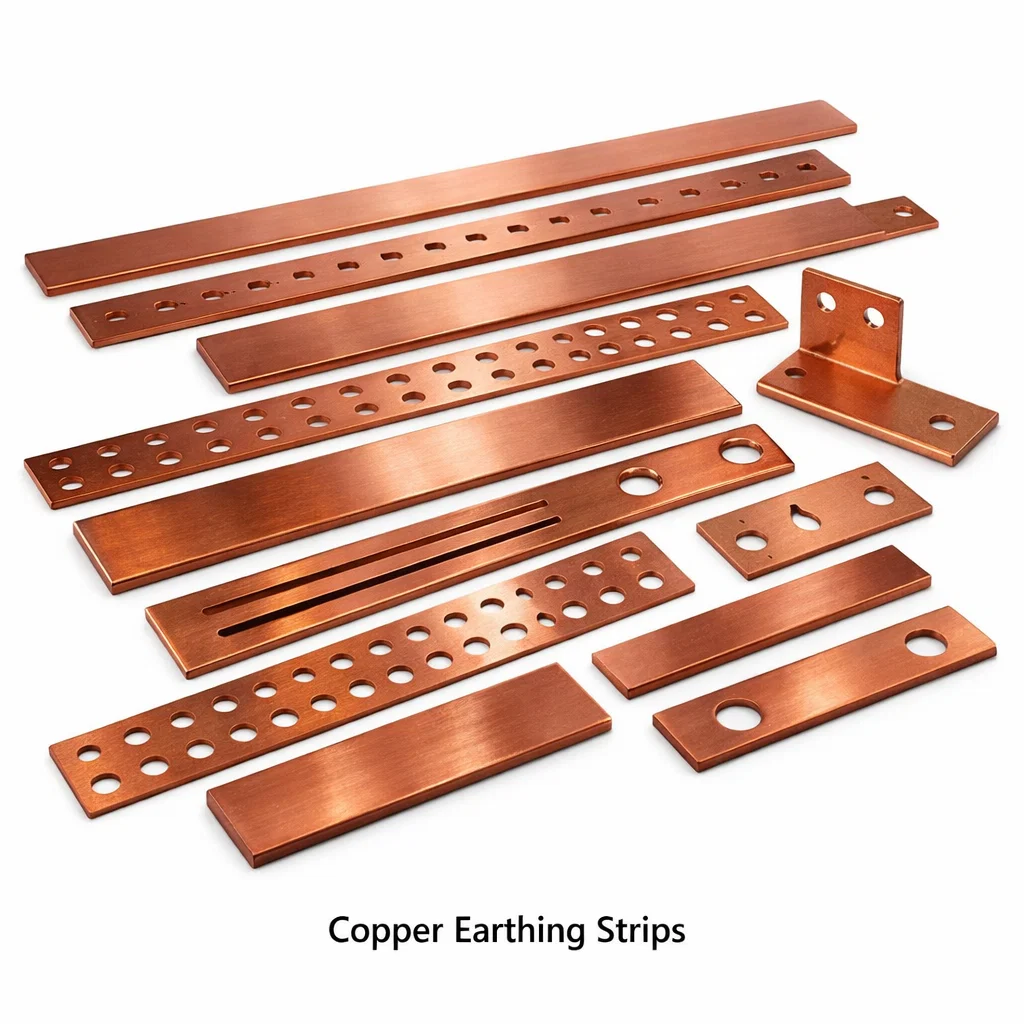
Copper earthing strips and earth bonding conductors manufactured by Jamnagar Brass Components. C11000 ETP copper to BS 951 and IEEE 80 standards. Flat strip, braided, and stranded designs. Tin-plated and bare copper variants. Custom lengths and cross-section areas. ISO 9001 certified, exporting to USA, UK, and Australia.
Frequently Asked Questions — Copper Earthing Strips & Earth Bonding
Q1: What are copper earthing strips used for?
Copper earthing strips (flat copper conductors) are used in earthing and bonding systems to connect electrical equipment, structural steelwork, cable trays, and pipework to the main earth electrode. They provide a low-resistance path for fault currents and lightning surge currents to flow safely to earth, preventing dangerous voltage differences between conductive structures. Copper earthing strips are specified in substations, industrial plants, data centres, and lightning protection systems.
Q2: What copper grades are used for earthing strips?
Earthing strips are made from C11000 ETP copper (99.9% Cu minimum, 101% IACS minimum conductivity) in the soft (annealed, H040) or hard (H080) temper. Soft copper is easier to form and bend on site; hard copper holds its shape better for straight runs. Tinned copper strips (5–10 µm electrolytic tin) are specified where enhanced corrosion resistance or compatibility with aluminium structures is required (to minimise galvanic corrosion).
Q3: What standards apply to copper earthing strips?
Copper earthing conductors comply with BS 7430 (Code of Practice for protective earthing of electrical installations), IEC 62305-3 (lightning protection — physical damage to structures), IS 3043 (Code of Practice for Earthing, India), IEEE 80 (guide for safety in AC substation grounding, USA), and NEC Article 250 (grounding and bonding, USA). Material standards: BS EN 13601 for copper rod, bar, and profiles; ASTM B187 for copper bus bars.
Q4: What sizes of copper earthing strips are available?
Copper earthing strips are available in widths from 15 mm to 100 mm and thicknesses from 2 mm to 10 mm. Standard sizes include 25×3 mm, 25×5 mm, 30×3 mm, 30×5 mm, 40×3 mm, 40×5 mm, 50×5 mm, 50×6 mm, 63×5 mm, 63×6 mm, 75×6 mm, 75×9 mm, and 100×10 mm. Custom cross-sections can be drawn or rolled to any required dimension. Standard lengths are 3 m and 6 m coils or straight lengths.
Q5: How is copper earthing strip cross-section determined?
Earthing strip cross-section is determined by fault current magnitude and duration per IEC 60949 or BS 7671. The minimum cross-section (mm²) is calculated as S = I × √(t/k), where I is fault current (A), t is fault duration (s), and k is a material constant (164 for copper). For a 10 kA fault for 1 second, minimum copper strip cross-section is approximately 60 mm². The next standard size up (typically 50×2 mm = 100 mm², or 25×5 mm = 125 mm²) would be selected.
Q6: What are the advantages of copper over aluminium for earthing conductors?
Copper has 60% higher electrical conductivity than aluminium (101% IACS vs. 61% IACS), allowing smaller cross-section for the same fault current capacity. Copper is significantly more corrosion resistant than aluminium when buried in soil or concrete. Copper earthing connectors are more reliable over decades of service in variable soil conditions. For buried earthing systems in corrosive soils, copper or copper-bonded steel is strongly preferred over bare aluminium.
Q7: How are copper earthing strips connected and joined on site?
Copper earthing strips are connected using: bolted overlapping joints with silicon bronze or stainless steel hardware (IEC 62561-1 type-tested connectors); exothermic welding (Thermit/Cadweld) for underground permanent joints with the lowest resistance and highest reliability; brazing for high-current joints; and compression connectors (parallel groove clamps, H-tap connectors) for both underground and above-ground applications. Exothermic welded joints are specified for lightning protection and primary substation earthing.
Q8: Are tinned copper earthing strips available?
Yes. Tinned copper earthing strips (electrolytic tin plating, 5–10 µm) are available in all standard sizes. Tinning provides enhanced corrosion resistance in aggressive soil environments, better compatibility with aluminium structures (reducing galvanic potential difference), and resistance to oxidation in high-humidity environments. Tinned copper strips are widely specified for earthing and bonding in coastal, chemical plant, and food processing applications.
Q9: Can copper earthing strips be supplied pre-drilled with fixing holes?
Yes. Pre-drilled copper earthing strips with fixing holes at specified centres are available as a value-added service, saving site drilling and reducing installation time. Hole diameter, hole pattern, and strip length are specified by the customer. Pre-formed (bent) earthing links for standard busbar spacings in distribution boards and switchgear are also available, ready for direct installation without site bending or drilling.
Q10: What is the minimum order and lead time for copper earthing strips?
Standard sizes (25×3, 25×5, 40×3, 50×5 mm) are typically in stock for immediate dispatch. Non-standard sizes: 2–4 weeks. Tinned copper strips: 2–3 weeks. Pre-drilled or pre-formed strips: 2–4 weeks depending on quantity and complexity. Minimum order: 10 metres for standard stock sizes; 50 metres for non-standard. Project quantities (above 500 kg) receive bulk pricing and dedicated production planning with 3–5 weeks delivery.
📧 Get a Free Quote Today
Contact Jamnagar Brass Components for your custom manufacturing requirements.
Our engineers respond within 24 hours with competitive pricing and full technical documentation.
🏭 Manufactured in Jamnagar, India · 📦 Exporting to USA, UK, Europe & Worldwide · ✅ ISO 9001:2015 Certified