
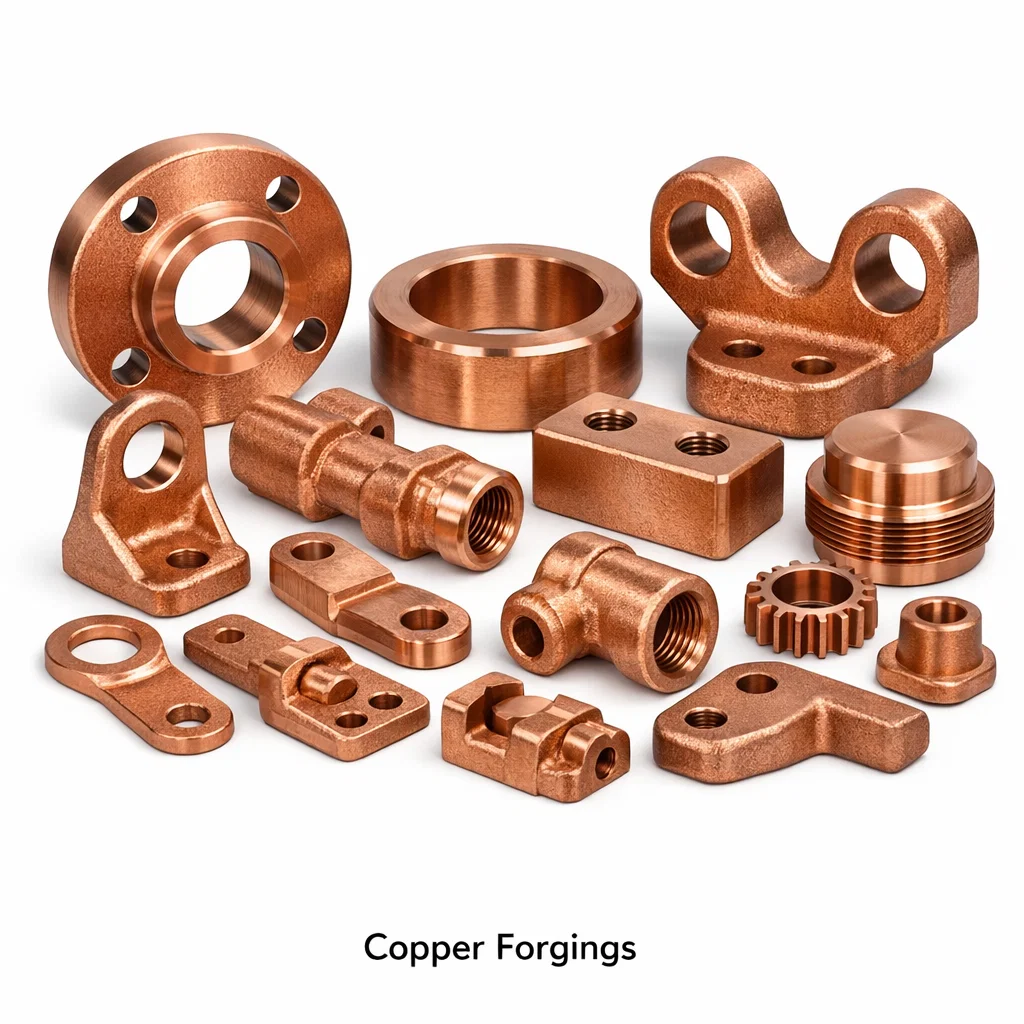
Jamnagar Brass Components manufactures copper forgings and forged copper components for the electrical, power distribution, telecommunications, and industrial sectors. Our copper forgings provide superior electrical conductivity compared to cast copper, with a dense grain structure and higher mechanical strength for demanding contact and current-carrying applications.
Copper Alloys for Forging
ETP copper (C11000 / CW004A) is our most commonly forged alloy, offering the highest electrical conductivity (100% IACS) for current-carrying components such as bus clamps, connectors, and earthing hardware. Tellurium copper (C14500 / CW118C) provides improved machinability (90% IACS conductivity) while retaining good mechanical properties for precision contacts. DHP copper (C12200 / CW024A) is used where post-forging silver brazing or welding is required. Beryllium copper (C17200) is available for spring-contact and wear-resistant connector applications.
Forging Processes
We use hot forging (at 700-900°C) for most copper components, which provides excellent formability and good grain refinement. Cold forging and cold heading is used for smaller components where tight tolerances and work-hardened surfaces are required. Our impression die forging process produces near-net-shape parts that require minimal machining, reducing material waste.
Components We Manufacture
Copper forgings we produce include bus clamps and bus bar connectors, power cable terminal lugs and connectors, earthing clamps and substation grounding connectors, switchgear contact fingers and arcing contacts, current transformer primary bars and connectors, compression connector bodies for power cables, lightning protection system components, and custom forged copper parts from customer drawings and specifications.
Quality and Standards
Our copper forgings are manufactured in accordance with ASTM B283 and BS EN 12164/12167 requirements for raw material. Electrical conductivity is verified using eddy-current conductivity testing. Chemical composition and mechanical properties are certified per lot. Our quality management system is certified to ISO 9001:2015.
Why Source Copper Forgings from Jamnagar?
We supply forged copper components to power utility contractors, switchgear manufacturers, lightning protection installers, and cable manufacturers across the USA, Middle East, and UK. Our in-house forging and CNC machining capabilities, combined with competitive India-based pricing, provide significant cost savings compared to European or North American copper forging suppliers. Contact us to discuss your copper forging requirements.
Frequently Asked Questions — Copper Forgings
Q1: What is copper forging?
Copper forging is a manufacturing process where copper is heated to its hot-working temperature (700–900°C) and shaped under high pressure in closed dies to produce dense, strong components. Forging refines the grain structure of copper, improving tensile strength (20–30% higher than cast copper), fatigue resistance, and directional mechanical properties aligned with the load direction. Hot forging produces near-net-shape parts with an oxide-free surface after descaling.
Q2: What copper alloys can be forged?
Commercially pure copper (C11000 ETP, C10200 OFHC) can be forged for electrical and thermal applications. Copper-chromium-zirconium (CuCrZr, C18150) is forged for high-strength, high-conductivity resistance welding electrodes and heat sinks. Copper-nickel (CuNi 10, CuNi 30) is forged for marine and heat exchanger components. Brass and bronze alloys (typically grouped separately) are also extensively forged.
Q3: What are the key advantages of forged copper over cast copper?
Forged copper advantages: 20–30% higher tensile strength than equivalent cast copper; no internal porosity or casting voids; refined grain structure with directional strength aligned to loading; better fatigue and impact resistance; tighter dimensional accuracy than sand casting (CT5–CT7 as-forged); superior electrical conductivity in cross-sections due to worked structure (no dendritic segregation as in castings).
Q4: What applications use forged copper components?
Key applications include electrical busbar connectors (forged for maximum conductivity and joint strength), resistance welding electrodes (CuCrZr forged for wear and thermal fatigue resistance), lightning arrester fittings, transformer connectors, heat exchanger end caps, marine propeller shaft components, compressed gas valve bodies, and aerospace electrical connectors requiring maximum conductivity and structural integrity.
Q5: What tolerances are achievable with copper hot forgings?
Hot-forged copper components achieve CT5–CT7 as-forged per ISO 8062, equivalent to ±0.3–1.0 mm on medium-sized parts. Critical features are machined after forging to ±0.025 mm. Draft angles of 3–7 degrees are required on die-closed faces. Parting line flash is trimmed to ±0.5 mm. After CNC machining of mating surfaces and bores, tolerances of ±0.025 mm or better are achievable.
Q6: What is the forging die cost for copper components?
Forging die costs for copper components: simple shape dies in steel cost USD 1,500–5,000; medium complexity closed-impression dies USD 5,000–20,000; complex multi-impression progressive dies USD 20,000–50,000. Die life for copper forging is typically 10,000–50,000 shots depending on complexity and copper alloy. Die cost is amortised over the production run and typically recovered within 200–1,000 pieces.
Q7: How does copper forging compare to copper casting for busbar connectors?
For busbar connectors and electrical fittings, forging produces higher density (no porosity), better conductivity, and stronger mechanical joint. Cast copper components may have internal voids reducing effective cross-section and conductivity. Forged connectors tested per IEC 61238-1 consistently show lower contact resistance and higher pull-out strength than equivalent cast connectors. For current-carrying applications, forging is the preferred process for safety-critical connections.
Q8: Are copper forgings available with machining?
Yes. We supply copper forgings in as-forged, rough-machined, semi-finished, and fully machined conditions. Fully machined copper forgings include CNC turned bores, drilled and tapped holes, milled faces, grooves, and any surface finish required. Complete sub-assembly supply including mechanical hardware is available for OEM panel builders and switchgear manufacturers. CMM inspection reports and dimensional certificates accompany each machined batch.
Q9: What surface treatments are available for copper forgings?
Surface treatments for copper forgings include tin plating (5–15 µm electrolytic tin) for oxidation resistance and low contact resistance, silver plating (10–25 µm) for maximum conductivity bus connections, nickel plating for corrosion and wear resistance, and chemical tin (immersion tin, 1–3 µm) for solderability. Bare machined copper (bright) with VCI anti-tarnish packaging is standard for export shipments.
Q10: What is the minimum order and lead time for copper forgings?
Minimum order for new die copper forgings: 50–100 pieces (to justify die setup). For existing dies: minimum 25 pieces. First-article lead time with new die: 4–8 weeks (die manufacture + first forgings + FAIR). Repeat production: 3–5 weeks. Fully machined copper forgings add 1–3 weeks to forging lead time. Expedited production for critical quantities available on request.
📧 Get a Free Quote Today
Contact Jamnagar Brass Components for your custom manufacturing requirements.
Our engineers respond within 24 hours with competitive pricing and full technical documentation.
🏭 Manufactured in Jamnagar, India · 📦 Exporting to USA, UK, Europe & Worldwide · ✅ ISO 9001:2015 Certified