
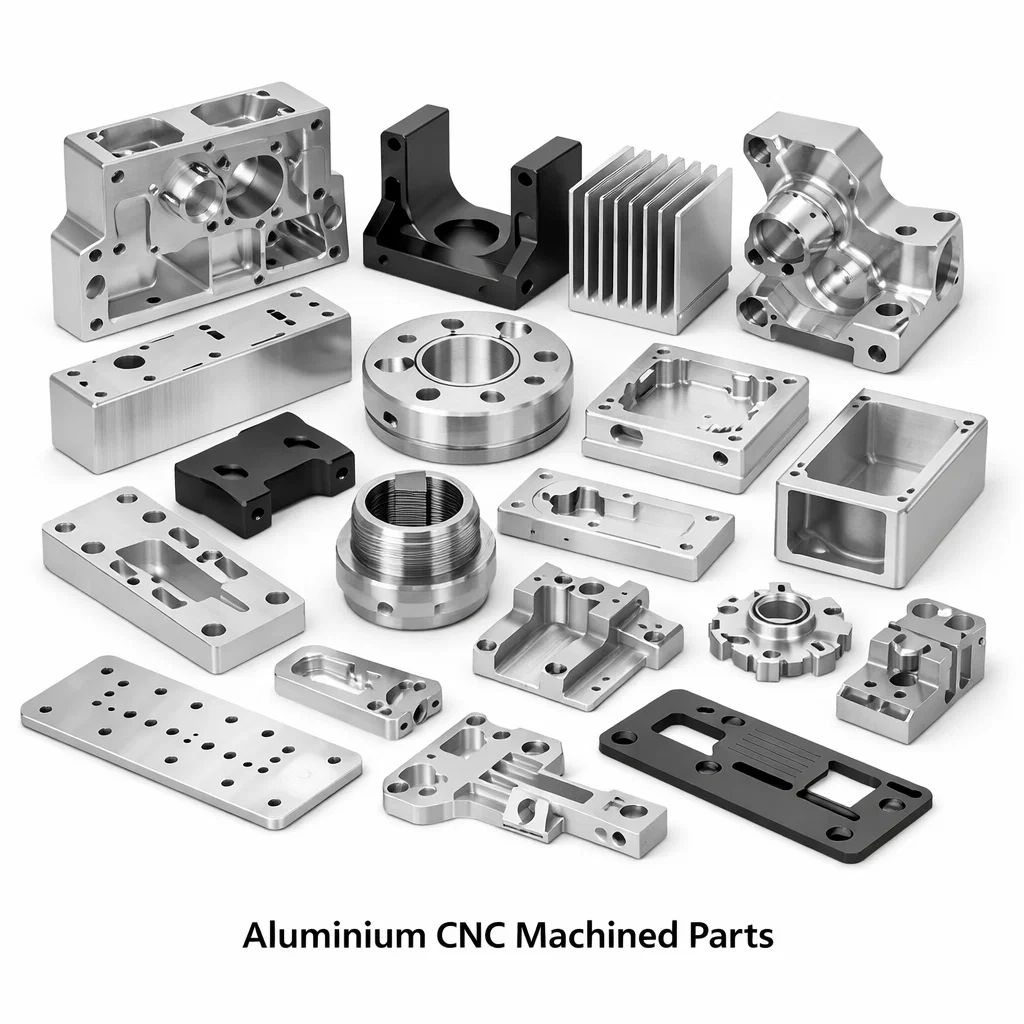
Aluminium CNC machined parts in 6061-T6, 6082-T6, and 7075-T6 alloys manufactured by Jamnagar Brass Components. Multi-axis CNC turning and milling. Anodised, powder coated, or hard-anodised finish. Aerospace brackets, heatsinks, and structural components. ISO 9001 certified, exporting to USA, Germany, and UK.
Frequently Asked Questions — Aluminium CNC Machined Parts
Q1: What aluminium alloys are best for CNC machining?
6061-T6 is the most widely used CNC machining alloy globally, offering excellent machinability, good strength (276 MPa tensile), and superior anodisability. 6082-T6 (European equivalent) is similar. 7075-T6 gives the highest strength (503 MPa tensile) for demanding structural parts. 2024-T4 is used for fatigue-critical aerospace parts. 5083 H321 is preferred for marine and cryogenic applications. Cast alloys A380/ADC12 are also CNC-machined after die casting.
Q2: What is the machinability advantage of aluminium over stainless steel?
Aluminium machines approximately 3–5× faster than SS 304 stainless steel, with cutting speeds of 600–1,500 m/min vs. 100–300 m/min for stainless. Aluminium does not work-harden during machining, allows sharper positive-rake tooling, produces cleaner chips, and allows higher depth-of-cut per pass. This results in significantly lower machining cost per piece compared to stainless steel parts of the same complexity.
Q3: What CNC processes are used for aluminium machined parts?
Aluminium components are produced on CNC turning centres (2-axis, 4-axis, 5-axis live tool), vertical and horizontal CNC machining centres (3-axis to 5-axis), Swiss-type CNC turning for small precision parts, CNC grinding for tight-tolerance bores, and EDM for very fine features. Multi-axis machining (4-axis and 5-axis) produces complex aluminium parts in a single setup, minimising datum errors and reducing cycle time.
Q4: What surface finish is achievable from CNC machined aluminium?
CNC milling achieves Ra 0.8–3.2 µm as-machined; CNC turning achieves Ra 0.4–1.6 µm; grinding achieves Ra 0.05–0.4 µm. Superfinishing and diamond turning achieve Ra below 0.025 µm for optical and precision mirror applications. Anodised surfaces (Type II, 5–25 µm) add hardness and corrosion protection with minimal dimensional change. Hard anodising (Type III, 25–75 µm) changes dimension and must be accounted for in machining allowance.
Q5: What tolerances are standard for CNC machined aluminium parts?
Standard CNC turned aluminium diameters: ±0.025 mm (±0.001 inch). Precision Swiss turned: ±0.005 mm. CNC milled pockets and bores: ±0.025 mm. Reamed bores: H7 tolerance (±0.012 mm at 25 mm). Ground bores: H5/H6 (±0.006 mm). Thread tolerances: 6H (internal), 6g (external). GD&T flatness and parallelism: 0.025 mm achievable on machined surfaces; 0.005 mm after grinding.
Q6: Can you produce aluminium parts from customer-supplied 3D CAD models?
Yes. We work directly from STEP, IGES, Parasolid, or DXF/DWG files, with our CNC programmers generating toolpaths using Mastercam or equivalent CAM software. For complex 5-axis parts, virtual simulation is run to verify collision-free tool paths before cutting. First Article Inspection (FAI) reports with GD&T measurement data are provided to confirm dimensional conformance to the 3D model and drawing.
Q7: What is the minimum order and lead time for CNC machined aluminium parts?
Prototype quantities: 5–10 pieces in 1–2 weeks for standard complexity; 2–4 weeks for complex multi-axis parts. Production quantities: minimum 25 pieces, lead time 2–4 weeks. Volume pricing breaks at 100, 500, and 1,000 pieces. Repeat orders on established programs: 1–3 weeks with pre-programmed CNC setup. Expedited prototypes (1–3 pieces) can be produced in 5–7 working days for simple parts.
Q8: What quality documentation is provided with CNC machined aluminium parts?
Standard quality documentation: Material Test Certificate (EN 10204 2.2 or 3.1) for aluminium alloy, Dimensional Inspection Report with actual measurements for critical dimensions, Certificate of Conformance (CoC), plating/anodising certificate. Additional available: First Article Inspection Report (AS9102 format for aerospace), PPAP Level 3 for automotive, material hardness test certificate, and thread gauge records.
Q9: Are you able to machine large aluminium plates and blocks?
Yes. Our CNC machining centres accommodate workpieces up to 1,200 mm × 600 mm × 500 mm. Large aluminium plates, jig tool bodies, fixture plates, and large housing components are machined with full 3-axis or 5-axis capability. Fixturing is designed to minimise deflection of large aluminium components during machining. For very large aluminium parts (above 1,200 mm), we have partner facilities with larger machining capacity.
Q10: What industries use aluminium CNC machined parts from Jamnagar?
We supply CNC machined aluminium parts to aerospace component distributors (structural brackets, instrument housings), automotive Tier 1 and Tier 2 suppliers (heat sinks, brackets, manifolds), electronics and telecoms OEMs (enclosures, heat sinks, RF connectors), medical device manufacturers (instrument handles, diagnostic equipment housings), and general industrial machinery manufacturers worldwide.
📧 Get a Free Quote Today
Contact Jamnagar Brass Components for your custom manufacturing requirements.
Our engineers respond within 24 hours with competitive pricing and full technical documentation.
🏭 Manufactured in Jamnagar, India · 📦 Exporting to USA, UK, Europe & Worldwide · ✅ ISO 9001:2015 Certified