
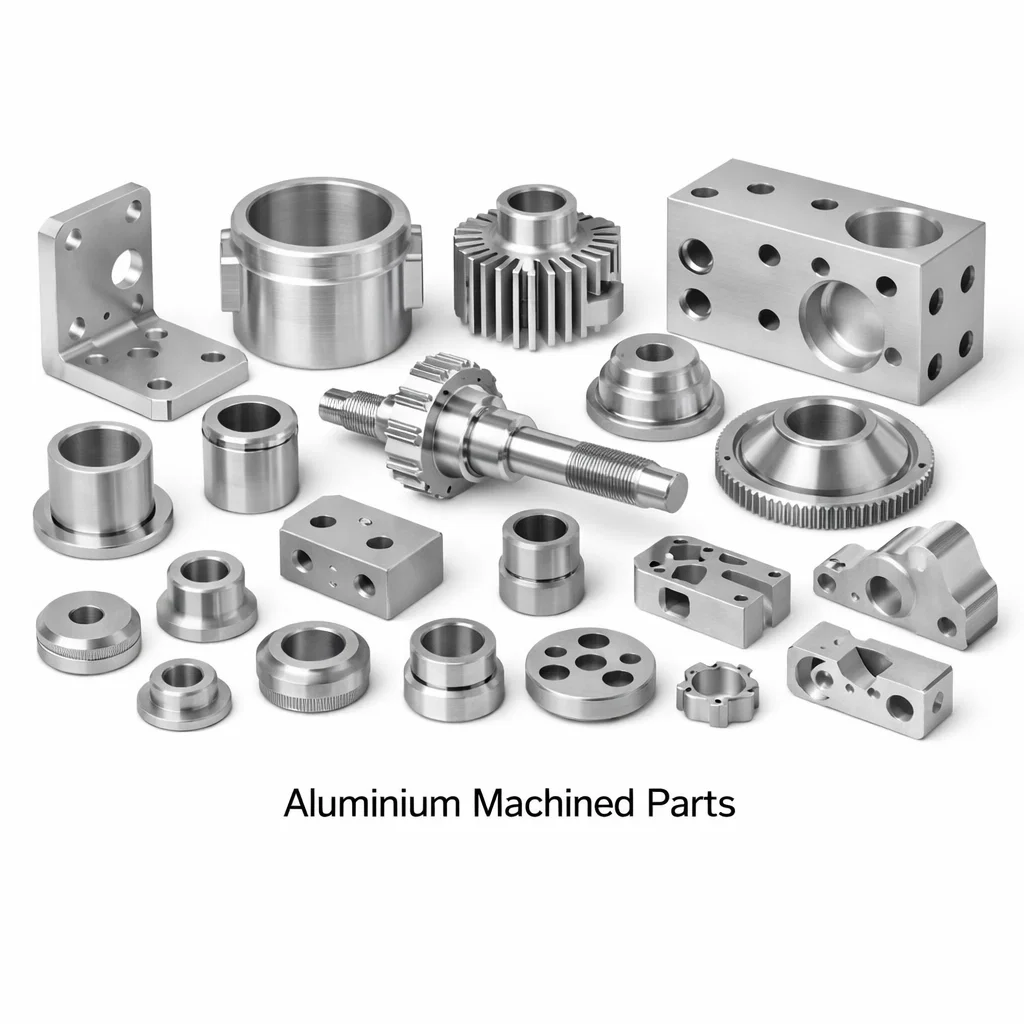
Jamnagar Brass Components manufactures precision aluminium machined parts and components for the aerospace, automotive, electronics, and medical device industries. Using 3-axis and 5-axis CNC milling centres alongside CNC turning, we produce complex aluminium components to tight tolerances from a range of aerospace and industrial alloys.
Aluminium Alloys We Machine
We regularly work with 6061-T6 (the workhorse general-purpose alloy), 6082-T6 (the European structural alloy popular in the UK and European markets), 7075-T6 (high-strength aerospace-grade aluminium), and 2024-T3/T4 (fatigue-resistant alloy for aerospace structures). We also machine 5083 marine-grade aluminium and 6063 for extrusion-profile components upon request.
Components We Manufacture
Our precision aluminium machined parts include heatsinks and thermal management components, electronic enclosures and housings, structural brackets and mounting plates, aerospace brackets and fittings, hydraulic manifold blocks, pump housings and impeller bodies, valve bodies and actuator components, and medical device components requiring anodising for sterilisation compatibility.
Surface Treatments & Finishes
Jamnagar Brass Components offers a full range of aluminium surface treatments including clear anodising (Type II) for corrosion protection, hard anodising (Type III) for wear-resistant surfaces up to 50 µm thick, chromate conversion coating (Alodine/Iridite) for electrical conductivity and paint adhesion, powder coating in any RAL colour, and precision bead blasting for a uniform matte finish.
Tolerances & Quality
We hold dimensional tolerances to ±0.01 mm on CNC turned features and ±0.02 mm on milled features as standard, with tighter tolerances achievable upon request and CMM verification. Surface roughness ranges from Ra 0.8 µm (ground finish) to Ra 3.2 µm (standard machined). All parts are inspected using calibrated Mitutoyo CMM equipment and accompanied by full dimensional inspection reports. Our quality management system is certified to ISO 9001:2015.
Why Source Aluminium Machined Parts from Jamnagar?
Our direct-from-India manufacturing model delivers significant cost savings compared to UK, EU, or US machining, while maintaining the same quality standards and documentation requirements. We export to buyers in the USA, UK, Germany, and Australia, and our experienced team understands the drawing interpretation, material certification, and packaging requirements of international buyers. Contact us for a competitive quotation on your aluminium machined components.
Frequently Asked Questions — Aluminium Machined Parts
Q1: What aluminium alloys are used for machined parts?
The most common aluminium alloys for precision machining are 6061-T6 (excellent machinability, good corrosion resistance, widely used for structural and general engineering), 6082-T6 (European standard, similar to 6061), 7075-T6 (high strength, aerospace applications), 2024-T4 (fatigue resistance), and 5083 (marine grade, seawater resistant). Alloy selection depends on strength, corrosion, and machinability requirements.
Q2: What machining processes are used for aluminium components?
Aluminium components are produced by CNC turning on multi-axis lathes, CNC milling on vertical and horizontal machining centres, Swiss-type screw turning for small precision parts, and grinding for tight-tolerance bores and surfaces. Multi-axis CNC (4-axis and 5-axis) allows complex aluminium parts to be machined in a single setup for maximum accuracy.
Q3: What tolerances are achievable with CNC machined aluminium parts?
CNC machined aluminium parts routinely achieve tolerances of ±0.05 mm (±0.002 inch) on turned diameters and ±0.025 mm on ground bores. For precision aerospace and optical components, tolerances of ±0.01 mm or better are achievable on controlled dimensions. Surface finish Ra 0.4–1.6 µm is standard from machining; Ra 0.1 µm is achievable with grinding or superfinishing.
Q4: What surface treatments are available for aluminium machined parts?
Available surface treatments for aluminium include anodising (Type II decorative, Type III hard anodising for wear resistance), chromate conversion coating (Alodine/Iridite for corrosion protection and adhesion), powder coating, electroless nickel plating, and painting. Hard anodising produces a wear-resistant ceramic surface up to 25 µm thick, ideal for sliding and wear applications.
Q5: How does aluminium compare to brass for precision machined components?
Aluminium is approximately one-third the density of brass (2.7 vs. 8.5 g/cm³), making it preferred for weight-sensitive aerospace, automotive, and electronic applications. Brass has better machinability and inherent corrosion resistance without surface treatment, but aluminium offers superior strength-to-weight ratio and is typically lower cost per kilogram of finished part.
Q6: Can aluminium parts be welded or joined?
Yes. Aluminium alloys 6061, 6082, and 5083 are readily TIG and MIG welded with appropriate filler wire. 7075 and 2024 alloys are more difficult to weld due to hot-cracking tendency and are usually joined by fastening or bonding. Friction stir welding (FSW) is used for high-integrity aluminium butt joints in aerospace and automotive applications.
Q7: What is the typical lead time for custom aluminium machined parts?
First-article lead time for custom CNC machined aluminium parts is typically 2–4 weeks from approved drawings, including CNC programming, first-piece inspection, and dimensional report. Repeat production orders typically ship in 1–3 weeks. Expedited parts can be produced in 5–7 working days for simple components where bar stock is available.
Q8: What industries use aluminium precision machined components?
Key industries include aerospace (structural brackets, housings, fittings), automotive (engine components, heat sinks, brackets), electronics (enclosures, heat sinks, connectors), medical devices (surgical instrument handles, diagnostic equipment housings), robotics (arm links, joint housings), and general machinery (pump housings, valve bodies, manifold blocks).
Q9: What quality certifications apply to aluminium machined parts?
Jamnagar Brass Components is ISO 9001:2015 certified. Aluminium machined parts are supplied with material test certificates (EN 10204 3.1 or 2.2) confirming alloy composition and mechanical properties. Dimensional inspection reports, first article inspection (FAIR) per AS9102 for aerospace, and PPAP documentation for automotive supply are available on request.
Q10: What is the minimum order quantity for custom aluminium machined parts?
Minimum order quantity is 10 pieces for standard CNC turned or milled aluminium parts. For very complex 5-axis machined parts, minimum is 5 pieces for first article. Prototype quantities of 1–3 pieces are available at prototype pricing. Regular production orders typically start from 25–50 pieces, with price breaks at 100, 500, and 1,000 pieces.
📧 Get a Free Quote Today
Contact Jamnagar Brass Components for your custom manufacturing requirements.
Our engineers respond within 24 hours with competitive pricing and full technical documentation.
🏭 Manufactured in Jamnagar, India · 📦 Exporting to USA, UK, Europe & Worldwide · ✅ ISO 9001:2015 Certified