
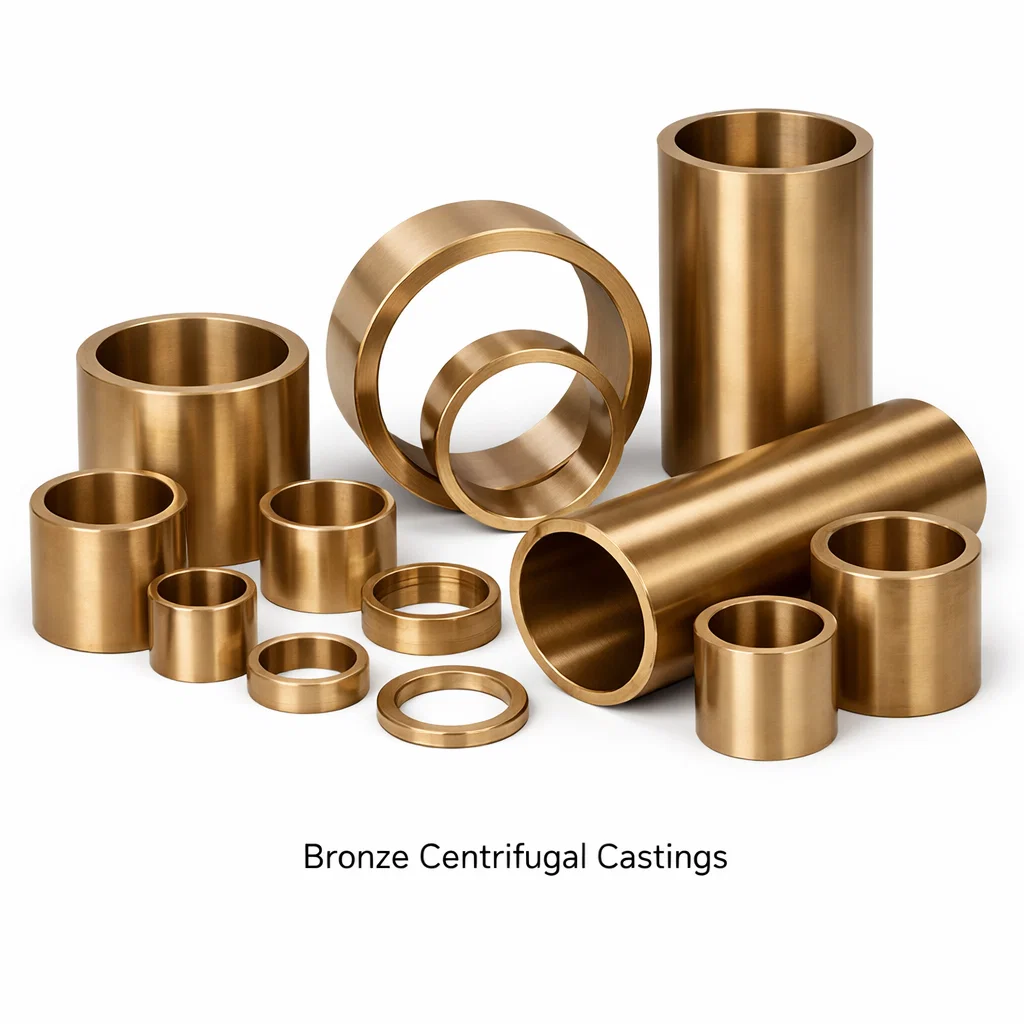
Jamnagar Brass Components manufactures bronze centrifugal castings including tubes, rings, cylinder liners, and bushings for heavy engineering, marine, power generation, and industrial machinery. Centrifugal casting produces a fine, dense grain structure free from porosity, making it the preferred process for high-performance bearing and wear components.
Bronze Alloys for Centrifugal Casting
We centrifugally cast in phosphor bronze (PB1/C90500, PB2/C90700) for bearings and bushings with excellent load-bearing capacity and wear resistance, aluminium bronze (AB1/C95200, AB2/C95500) for higher strength and corrosion resistance in marine and chemical plant applications, manganese bronze (C86300) for heavily loaded gears and worm wheels, and leaded gunmetal (LG2/C83600) for general bearing and pump applications requiring good machinability.
Products We Manufacture
Our centrifugal bronze castings include plain bushings and sleeve bearings, flanged bushings and bearing inserts, centrifugally cast tubes for machining into bearings, large-diameter rings for slewing rings, cylinder liners for hydraulic and pneumatic cylinders, worm gear blanks and worm wheel rim castings, pump casing liners and wear rings, and marine propulsion shaft bearings. We supply castings as-cast or fully machined to finished dimensions.
Centrifugal Casting Process
In centrifugal casting, molten bronze is poured into a rapidly rotating mould. Centrifugal force distributes the metal uniformly against the mould wall, producing castings with a dense, fine grain structure and minimal porosity. This results in superior mechanical properties compared to static sand casting, with higher tensile strength, better fatigue resistance, and improved density uniformity. Our horizontal centrifugal casting machines handle diameters from 25 mm to 600 mm and lengths up to 1200 mm.
Standards and Quality
Our centrifugal bronze castings are produced in accordance with ASTM B271 and BS 1400. Mechanical testing, chemical analysis, and dimensional inspection are performed on each production lot, with full material test certificates provided. Our quality management system is certified to ISO 9001:2015.
Why Source from Jamnagar Brass Components?
With experienced foundry and machining teams under one roof, we offer a complete service from casting to finished bearing dimensions. Our competitive India-based pricing and established export experience to industrial buyers in the USA, UK, and Europe make us a reliable centrifugal bronze casting partner. Contact us with your drawing or specification for a competitive quotation.
Frequently Asked Questions — Bronze Centrifugal Castings
Q1: What is centrifugal casting of bronze?
Centrifugal casting is a process where molten bronze is poured into a rotating cylindrical mould. Centrifugal force distributes the molten metal against the mould wall, producing dense, homogeneous castings with excellent mechanical properties and virtually no internal porosity. It is ideal for tubes, rings, bushings, and cylindrical components.
Q2: What bronze alloys are available for centrifugal casting?
Common bronze alloys for centrifugal casting include LG2/C83600 gunmetal for general purpose bushings and valves, SAE 660/C93200 bearing bronze for journal bearings, phosphor bronze C90700 for gear blanks and worm wheels, aluminium bronze C95400/C95800 for high-strength marine and pump applications, and manganese bronze C86300 for maximum strength requirements.
Q3: What shapes can be produced by centrifugal casting?
True centrifugal casting produces hollow cylinders: tubes, rings, flanged bushes, and liner blanks. The inner bore is formed by the centrifugal force (no core required), while the outer diameter is formed by the mould. Typical dimensions range from 50 mm to 1,500 mm outer diameter and lengths up to 3,000 mm. Wall thickness from 10 mm to 150 mm is achievable.
Q4: How does centrifugal casting compare to sand casting for bronze bushings?
Centrifugal castings have superior mechanical properties to sand castings in the same alloy: tensile strength 10–20% higher, better elongation, and finer grain structure due to faster solidification under centrifugal pressure. Porosity is significantly lower, resulting in better pressure tightness and longer service life in bearing and bushing applications.
Q5: What tolerances are achievable with bronze centrifugal castings?
As-cast dimensional tolerances for centrifugal castings are CT8–CT10 on outer diameter and CT10–CT12 on inner bore (the inner surface is rough and requires machining). After CNC turning, inner bores achieve H7 tolerance (±0.025 mm on 50 mm bore) and outer diameters achieve h6. Surfaces are typically finish-turned to Ra 1.6 µm.
Q6: What is the typical wall thickness range for bronze centrifugal tube castings?
Bronze centrifugal tube castings are produced with wall thicknesses from 10 mm minimum to 150 mm maximum. Very thin walls (below 8 mm) may show cold shuts or incomplete fill; very thick sections (above 150 mm) may have longer solidification times and require controlled cooling. Most industrial bushing applications fall in the 15–80 mm wall thickness range.
Q7: Are NDT tests available for bronze centrifugal castings?
Yes. Available NDT for bronze centrifugal castings includes ultrasonic testing (UT) for internal porosity and inclusions, radiographic testing (X-ray) for pressure-critical applications, liquid penetrant testing (LPT) for surface cracks, and hydraulic pressure testing for liner and bushing applications. Material test certificates per ASTM B271 or EN 1982 are provided.
Q8: What industries use bronze centrifugal castings?
Bronze centrifugal castings are used in heavy engineering (crane and hoist bushings), marine (propeller shaft bearings, stern tube liners), hydraulic machinery (pump cylinder liners), power generation (turbine bearing housings), offshore oil and gas (subsea equipment wear rings), paper and pulp industry (dryer roll bearings), and general industrial machinery (journal bearing liners).
Q9: What is the minimum order quantity and lead time for centrifugal bronze castings?
Minimum order is typically 1 piece for large special castings and 5–10 pieces for standard tube sizes. Lead time for first production: 2–4 weeks for standard alloys in available mould sizes; 4–6 weeks if special mould tooling is required. Repeat orders on existing mould sizes ship in 1–3 weeks. Machined and finished castings add 1–3 weeks to production time.
Q10: Can centrifugal bronze castings be supplied fully machined?
Yes. Jamnagar Brass Components supplies bronze centrifugal castings in as-cast, rough-machined, semi-finished, or fully-machined condition. Fully machined bushings and liners are supplied to customer drawing, including bored inner diameter, turned outer diameter, faced ends, keyways, oil grooves, and threaded holes. CMM inspection reports and dimensional certificates are provided with fully machined supplies.
📧 Get a Free Quote Today
Contact Jamnagar Brass Components for your custom manufacturing requirements.
Our engineers respond within 24 hours with competitive pricing and full technical documentation.
🏭 Manufactured in Jamnagar, India · 📦 Exporting to USA, UK, Europe & Worldwide · ✅ ISO 9001:2015 Certified