
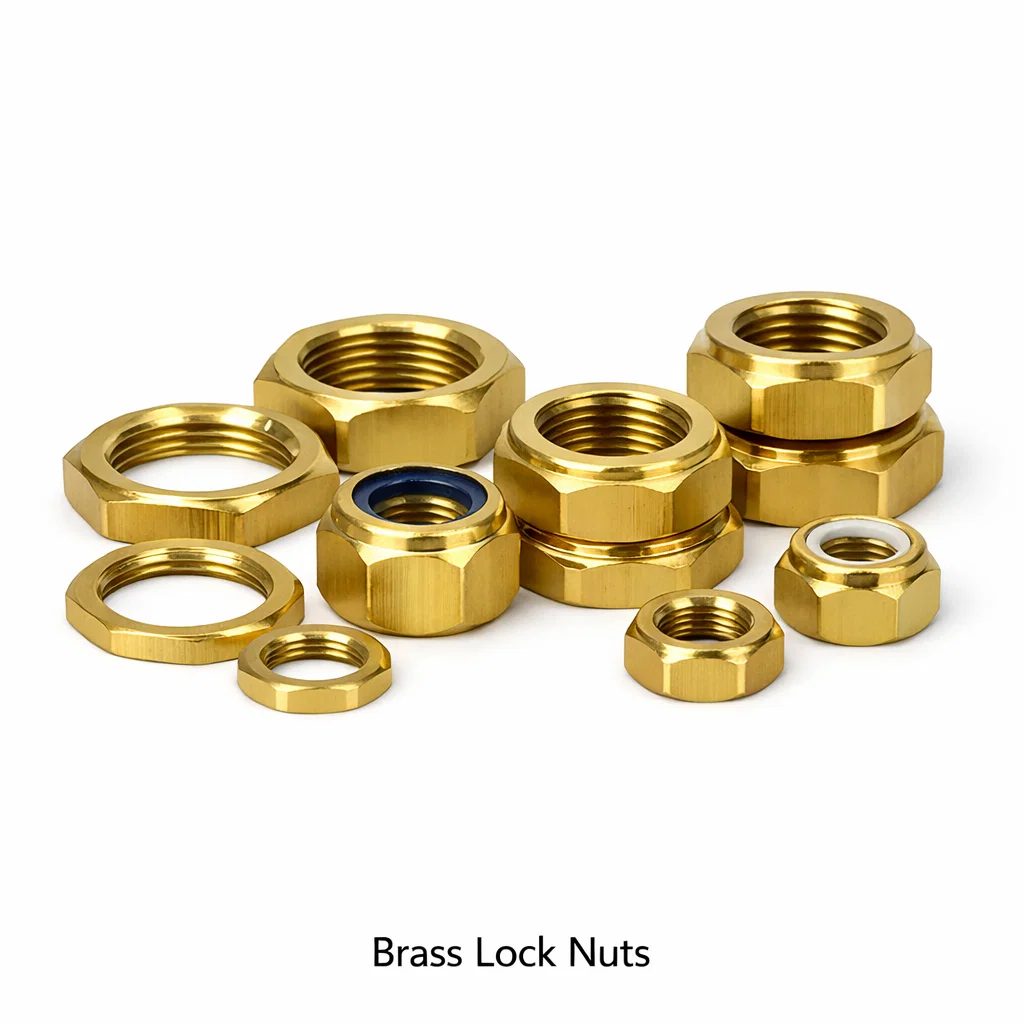
Jamnagar Brass Components manufactures a comprehensive range of brass lock nuts — from standard thin hex jam nuts and DIN 439 half-nuts to specialised cable gland lock nuts, conduit lock nuts, and prevailing torque all-metal lock nuts. Our brass lock nuts are CNC-machined from free-machining brass (CZ121 / C36000) and are supplied to electrical OEMs, cable management manufacturers, panel builders, plumbing equipment producers, and industrial fastener distributors across the USA, UK, and worldwide.
Types of Brass Lock Nuts
The term “lock nut” covers a broad family of fasteners designed to resist loosening under vibration, dynamic loads, or thermal cycling. The different types available in brass include:
Brass Thin Hex Jam Nuts (DIN 439 / ISO 4035)
The simplest form of lock nut — a reduced-height hex nut (approximately 40–50% of standard nut height) tightened against a standard nut to create a preload. The friction between the two nuts resists self-loosening. DIN 439 thin hex jam nuts are available M4 to M36 in CZ121 brass, tolerance class 6H thread. Used extensively in instrument and valve adjustment mechanisms.
Brass Cable Gland Lock Nuts
Cable gland lock nuts (also called backplate nuts or gland locknuts) secure cable glands to electrical enclosure walls and panels. Available in metric thread (M12×1.5, M16×1.5, M20×1.5, M25×1.5, M32×1.5, M40×1.5, M50×1.5, M63×1.5) to match standard cable gland sizes per EN 50262. Also available in PG thread (PG7, PG9, PG11, PG13.5, PG16, PG21, PG29) and NPT thread (1/2″, 3/4″, 1″, 1¼”, 1½”, 2″) for US market enclosures. Bright or nickel-plated finish.
Brass Conduit Lock Nuts
Brass conduit lock nuts secure rigid conduit, flexible conduit, and EMT (electrical metallic tubing) connectors to electrical enclosures and junction boxes. Available in trade sizes 1/2 inch to 4 inch with NPT or metric conduit thread per ANSI C80.1 (US) or EN 50262 (European). The conduit lock nut’s large-diameter thin profile provides maximum panel wall contact area for rigid, low-resistance grounding connections.
Brass Pipe Fitting Lock Nuts
BSP or NPT threaded lock nuts for securing pipe fittings, tank connectors, and bulkhead fittings through panels and walls. The lock nut is threaded onto the fitting from the back of the panel and tightened to clamp the fitting flange against the panel face. Available 1/4 inch to 2 inch BSP/NPT in standard and extra-thin body profiles.
Brass All-Metal Prevailing Torque Lock Nuts (Stiff Nuts)
All-metal prevailing torque lock nuts maintain a consistent locking torque over multiple reuse cycles without a nylon insert — making them suitable for temperatures above 120°C where nyloc nuts fail. Brass versions use distorted-thread or top-profile deformation to create prevailing torque. Per ISO 2320 / DIN 980 requirements. Used in automotive engine components, heater elements, and any brass assembly exposed to elevated temperatures.
Brass Hex Slotted Nuts (Castle Nuts)
Castellated (slotted) hex nuts with split-pin slots for positive mechanical locking — the most positive locking method available, used in safety-critical applications like wheel bearings and steering rod ends where self-loosening could be catastrophic. Available DIN 935 (ISO 7042 equivalent) M6 to M36 and 1/4 inch to 1.5 inch.
Brass Alloy Grades for Lock Nuts — International Equivalents
| Grade | UNS (USA) | EN (Europe) | BS (UK) | IS (India) | Best Use |
|---|---|---|---|---|---|
| Free-Machining Brass CZ121 | C36000 | CW603N | CZ121 | IS 319 | General purpose, high volume |
| DZR Brass | C35330 | CW602N | CW602N | — | Hot water, plumbing |
| Low-Lead NSF 372 | C69300 | CW724R | — | — | Potable water USA |
| Naval Brass | C46400 | CW712R | CZ112 | IS 291 NB | Marine, seawater |
Applications of Brass Lock Nuts
- Electrical enclosure cable entry glands
- Conduit to panel connections (NPT conduit lock nuts)
- Plumbing tank connectors and bulkhead fittings
- Valve packing gland lock nuts
- Instrument and sensor body retention
- Industrial machine tool coolant fittings
- HVAC and refrigeration pipe entry panels
- Automotive accessory and electrical system connections
Why Choose Jamnagar Brass Components for Brass Lock Nuts?
- Complete lock nut range — jam nuts, cable gland nuts, conduit nuts, castle nuts, prevailing torque
- All thread standards — DIN/ISO metric, ANSI inch (UNC/UNF), BSP, NPT, PG thread
- 100% thread gauging — go/no-go gauge verification on all threaded lock nuts
- Free-machining brass CZ121 — fastest production, best thread accuracy
- ISO 9001:2015 certified — dimensional inspection reports on request
- Large size range — M4 to M64 metric; 1/4 inch to 4 inch imperial
- Plating available — bright, nickel, tin, chrome per customer requirement
- Competitive export pricing — 40–60% cost advantage for US and European buyers
Frequently Asked Questions — Brass Lock Nuts
Q1: What is the difference between a lock nut and a jam nut?
A jam nut is a thin hex nut used in pairs with a standard nut to lock the assembly by friction preload. A lock nut is a broader term covering any nut with an integral locking mechanism — nyloc insert, prevailing torque deformation, or castellations for split pin retention. All jam nuts are lock nuts, but not all lock nuts are jam nuts.
Q2: What thread do cable gland lock nuts use?
Cable gland lock nuts use metric cable gland thread (M thread, typically M12×1.5 to M63×1.5), PG thread (Panzergewinde, e.g. PG7 to PG48) for older European cable glands, or NPT thread (1/2 inch to 2 inch) for US-standard electrical enclosures. The thread standard depends on the cable gland manufacturer and enclosure standard. We supply all three forms.
Q3: What size brass conduit lock nut is used with 3/4 inch NPT conduit?
A 3/4 inch NPT conduit lock nut has a nominal 3/4 inch NPT internal thread to match the conduit connector, with an outside diameter of approximately 1.375 inch (34.9 mm) and a knurled or wrench-flat hex periphery for tightening with a conduit tool or pliers. We supply 1/2 inch to 4 inch NPT conduit lock nuts from stock.
Q4: Can brass lock nuts be used in outdoor weatherproof electrical installations?
Yes. Brass conduit and cable gland lock nuts are excellent for outdoor and weatherproof (IP66/IP67) electrical installations, especially in coastal or industrial environments where steel lock nuts would corrode rapidly. Nickel-plated brass lock nuts provide additional corrosion protection. For marine and very aggressive outdoor environments, stainless steel lock nuts may be preferred over brass.
Q5: What is a PG thread lock nut and is it still used?
PG thread (Panzergewinde, or armoured cable thread) is a legacy European cable gland thread standard, with sizes PG7, PG9, PG11, PG13.5, PG16, PG21, PG29, PG36, PG42, and PG48. While EN 50262 metric cable gland threads have largely replaced PG in new designs, millions of existing electrical cabinets with PG holes require PG thread fittings for maintenance and retrofit. We manufacture PG thread brass lock nuts for the retrofit and replacement market.
Q6: What torque should brass lock nuts be tightened to?
Cable gland brass lock nuts: typically 2 to 5 N·m depending on thread size (M12 to M63). Conduit lock nuts: hand-tight plus 1/4 turn with a conduit tool. Pipe fitting lock nuts (BSP/NPT): 15 to 25 N·m for 1/2 inch to 1 inch sizes. Jam nuts against standard nut: tighten the jam nut first finger-tight, then torque to approximately 50% of the standard nut torque while holding the standard nut with a second spanner. Over-tightening brass lock nuts can strip threads — always use appropriate tooling.
Q7: Do you supply brass lock nuts with O-ring or sealing washer?
Yes. For watertight cable entry applications (IP68 / NEMA 4X ratings), brass cable gland lock nuts are supplied with a bonded EPDM or NBR sealing washer on the back face. The washer compresses between the lock nut and the enclosure wall when tightened, providing a watertight seal independent of the cable gland seal. This dual-seal arrangement is common in outdoor, underground, and submerged electrical enclosure applications.
Q8: What is the difference between a standard hex lock nut and a conduit lock nut?
A conduit lock nut has a large-diameter thin body (typically less than 4 mm thick) with a large OD to span the enclosure hole, providing maximum bearing area on the wall. The periphery is usually knurled or has small wrench lugs rather than a hex — because conduit tools, not spanners, are used for installation. Standard hex lock nuts have a smaller OD and conventional hexagonal body for spanner tightening.
Q9: Can you manufacture brass lock nuts with a non-standard thread form?
Yes. Custom thread forms — proprietary thread pitch, non-standard diameter-pitch combinations, ACME threads, and Whitworth (BSW) threads for legacy equipment — are all machinable. We require a thread form drawing or a sample nut for reverse engineering. Lead time for custom thread tooling is typically 1 to 2 weeks additional above standard production lead time.
Q10: Are brass lock nuts suitable for high-temperature applications?
Brass (CZ121 / C36000) retains adequate mechanical properties up to approximately 200°C, so brass all-metal lock nuts (castle nuts, prevailing torque types) are suitable for moderate elevated temperature service. Nyloc (nylon insert) brass lock nuts are limited to 120°C due to the nylon softening temperature. Above 200°C, silicon bronze or stainless steel lock nuts should be specified.
Q11: Do you supply brass lock nuts for the US electrical code (NEC) compliant conduit installations?
Yes. We supply NPT conduit lock nuts conforming to the National Electrical Code (NEC) and NEMA enclosure standards for rigid metal conduit (RMC), intermediate metal conduit (IMC), and electrical metallic tubing (EMT) installations. Our NPT conduit lock nuts conform to UL 514B connector standard dimensions and are supplied in 1/2 inch through 4 inch trade sizes.
Q12: What is the minimum order for brass lock nuts?
For standard metric cable gland nuts (M20 to M40) and NPT conduit nuts (1/2 to 1 inch): minimum 500 pieces per size. For larger sizes (M50 and above, 1.5 inch NPT and above): minimum 200 pieces. For custom thread forms, non-standard body profiles, or special alloys: minimum 500 pieces. Sample packs of 10 to 50 pieces in standard sizes are available within 5 to 7 working days.
📧 Get a Free Quote Today
Contact Jamnagar Brass Components for your needs of Brass Lock Nuts in Metric, NPT, BSP, and PG Thread Forms.
Our engineers respond within 24 hours with competitive pricing and full technical documentation.
🏭 Manufactured in Jamnagar, India · 📦 Exporting to USA, UK, Europe & Worldwide · ✅ ISO 9001:2015 Certified