
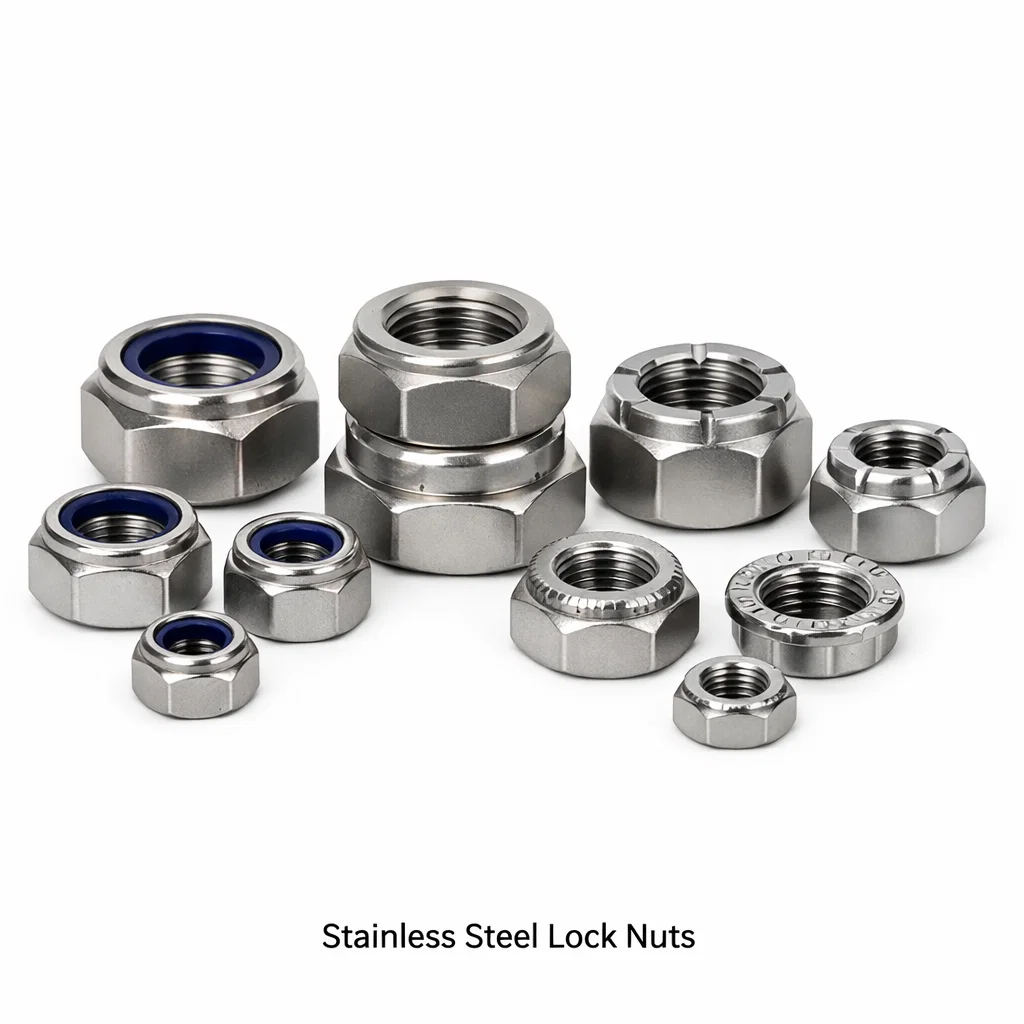
Jamnagar Brass Components manufactures stainless steel lock nuts by CNC machining from solid bar stock — not cold-formed or stamped. This bar-machining approach produces stainless lock nuts with superior dimensional accuracy, tighter thread tolerances, better surface finish, and greater dimensional consistency than cold-formed pressed nuts, making them the preferred choice for precision engineering, pharmaceutical, marine, chemical, and food processing applications. We produce SS 304 and SS 316/316L lock nuts in metric, UNC/UNF, BSP, NPT, and custom thread forms for USA, UK, and global customers.
Why Machine Stainless Steel Lock Nuts from Bar?
Cold-formed stainless steel nuts are made by cold upsetting — pressing the nut shape from wire or rod. This process works well for standard metric sizes in high volumes, but has limitations: close-tolerance threads require secondary tapping, grain flow is disrupted in the thread area, size range is limited to the dies available, and custom body profiles are impractical. Bar-machined stainless lock nuts are turned and threaded on CNC lathes from certified SS 304 or SS 316 bar, giving: any thread form and tolerance, any body shape (flanged, spigot, knurled), any OD and height combination, and full grain continuity in the thread root.
Stainless Steel Grades for Lock Nuts — International Equivalents
| Grade | UNS (USA) | EN/DIN (Europe) | BS (UK) | JIS (Japan) | Key Properties |
|---|---|---|---|---|---|
| SS 304 | S30400 | 1.4301 | 304 S31 | SUS 304 | General purpose, food, architectural |
| SS 304L | S30403 | 1.4307 | 304 S11 | SUS 304L | Low carbon, welded assemblies |
| SS 316 | S31600 | 1.4401 | 316 S31 | SUS 316 | Marine, chemical, chloride environments |
| SS 316L | S31603 | 1.4404 | 316 S13 | SUS 316L | Low carbon 316, pharma/food grade |
| SS 303 | S30300 | 1.4305 | 303 S31 | SUS 303 | Free-machining SS, highest machinability |
Types of Stainless Steel Lock Nuts We Manufacture
SS Thin Hex Jam Nuts (DIN 439 / ISO 4035)
Bar-machined thin hex jam nuts in SS 304 and SS 316 to DIN 439 / ISO 4035 dimensions, M4 to M64, tolerance class 6H thread. Superior to cold-formed pressed SS jam nuts in thread accuracy and surface finish. Used in chemical and pharmaceutical plant equipment where brass would corrode.
SS Cable Gland Lock Nuts
Stainless steel cable gland lock nuts in SS 316 for electrical enclosures in outdoor, marine, offshore, and food processing environments. Available in metric cable gland thread (M12×1.5 to M63×1.5), PG thread, and NPT thread. Bar-machined SS 316 cable gland nuts provide long service life in salt air and corrosive wash-down environments where brass eventually dezincifies.
SS Conduit Lock Nuts (NPT and Metric)
Bar-machined SS 304 and SS 316 conduit lock nuts in 1/2 inch to 4 inch NPT and metric conduit sizes for offshore platform electrical installations, chemical plant wiring, and marine electrical systems where NEC stainless conduit systems are specified for maximum corrosion resistance.
SS Hex Slotted (Castle) Lock Nuts
Bar-machined SS 316 castle nuts with split pin slots for positive mechanical locking in marine winch gear assemblies, underwater equipment, and food equipment where nyloc nuts are not food-safe approved. Available M8 to M48 and 5/16 inch to 2 inch.
SS Flanged Lock Nuts
Bar-machined SS lock nuts with an integral flange beneath the hex, distributing bearing load over a larger area — eliminating the need for a separate washer. The flange face is machined perpendicular to the thread axis for reliable sealing against O-ring or soft washer faces. Available M6 to M30 in SS 304 and SS 316.
SS Spanner (Spanner-Drive) Lock Nuts
Large-diameter thin lock nuts with spanner holes (pin-spanner drive) rather than hex flats, used on bearing lock nuts (shaft lock nuts) in precision spindles, rotating assemblies, and bearing housings. Available in SS 304 and 316, inner threads from M20 to M250 (metric) or 3/4 inch to 10 inch, per ISO 2982-1 (spanner hole type).
Applications of Stainless Steel Lock Nuts
- Offshore and marine electrical installations (ATEX and IP-rated enclosures)
- Chemical and petrochemical plant electrical wiring
- Food processing and dairy equipment electrical panels
- Pharmaceutical clean room electrical and instrument installations
- Subsea and underwater equipment assemblies
- Coastal and corrosive environment outdoor electrical enclosures
- Medical instrument and device assembly
- High-purity semiconductor and cleanroom equipment
Why Choose Jamnagar Brass Components for SS Lock Nuts?
- Bar-machined quality — superior to cold-formed in thread accuracy and dimensional consistency
- SS 304 and SS 316/316L — certified bar with ASTM A276 / EN 10088-3 MTC
- Custom body profiles — flanged, spigot, knurled, spanner-drive designs to drawing
- All thread standards — metric coarse/fine, UNC/UNF, BSP, NPT, PG, and custom
- 100% thread gauging — go/no-go gauges on all threaded lock nuts
- Passivation available — ASTM A967 passivation for maximum corrosion resistance
- ISO 9001:2015 certified — full traceability from bar heat to final inspection
- Competitive pricing — 40–55% savings vs. US and European machined SS lock nuts
Frequently Asked Questions — Stainless Steel Lock Nuts
Q1: Why specify bar-machined SS lock nuts over cold-formed?
Bar-machined SS lock nuts offer tighter thread tolerances (5H/6H vs. 6H nominal for cold-formed), better surface finish on thread flanks reducing galling risk, any body shape or profile not achievable by cold-forming, full dimensional traceability to the turned bar, and availability in custom sizes and alloys without die tooling limitations. For precision, pharmaceutical, and safety-critical applications, bar-machined is the preferred method.
Q2: What is galling and how do SS lock nuts prevent it?
Galling (also called cold welding or seizure) occurs when two stainless steel threaded surfaces weld together under friction during tightening — tearing material from one surface and bonding it to the other. It is a common problem with SS bolts and nuts. Prevention: lubricate threads with anti-galling lubricant (Molykote, Loctite anti-seize, or copper paste), use slow tightening speeds, and consider specifying a dissimilar grade pair (e.g. SS 304 nut with SS 316 bolt) to reduce galling tendency.
Q3: What is the difference between SS 304 and SS 316 lock nuts?
SS 316 contains 2–3% molybdenum in addition to the 18% chromium and 10% nickel of SS 304, significantly improving resistance to chloride pitting and crevice corrosion. For outdoor, marine, chemical, and coastal installations, SS 316 lock nuts are mandatory. For indoor, food contact, and architectural applications, SS 304 is adequate and costs approximately 15–20% less.
Q4: Can you machine SS lock nuts with NPT conduit thread for US marine installations?
Yes. SS 316 conduit lock nuts with NPT thread (1/2 inch to 4 inch trade sizes) are a standard product. US marine and offshore installations increasingly require SS conduit systems per ABYC (American Boat and Yacht Council), USCG, and offshore platform ATEX/NEC standards. We machine NPT conduit lock nuts in SS 316 to ANSI C80.1 conduit thread specifications.
Q5: What passivation standard do you apply to SS lock nuts?
We passivate SS lock nuts per ASTM A967 using citric acid (preferred, environmentally safe) or nitric acid processes. Passivation removes free iron from the machined surface, restoring the protective chromium oxide layer and maximising corrosion resistance. Passivation certificates confirming the process parameters are supplied. This is especially important for medical, pharmaceutical, and food processing SS hardware.
Q6: Are SS 316 cable gland lock nuts suitable for ATEX Zone 1 and Zone 2 environments?
SS 316 cable gland lock nuts do not themselves carry ATEX certification — the ATEX rating applies to the complete cable gland assembly. However, SS 316 lock nuts are widely specified in ATEX and NEC Class I Div. 1 and Div. 2 installations because stainless steel is non-sparking in most conditions and provides the long service life required in hazardous area electrical installations. The lock nut must match the thread and dimensions of the ATEX-certified cable gland body.
Q7: Can you supply SS lock nuts to ASME B18.2.2 for US inch-thread applications?
Yes. We bar-machine SS 304 and SS 316 hex jam nuts and thin lock nuts to ANSI/ASME B18.2.2 inch thread sizes (1/4 inch to 2 inch UNC and UNF), to tolerance class 2B per ASME B1.1. These are specified by US OEMs who require SS lock nuts in inch sizes for existing equipment with inch-threaded studs and bolts where metric SS lock nuts are not compatible.
Q8: What is SS 303 and is it suitable for machined lock nuts?
SS 303 (UNS S30300, EN 1.4305) is the free-machining grade of 304 stainless, containing added sulphur (0.15% minimum) to promote short chip formation and improve machinability. It machines at approximately 45–55% the speed of free-machining brass. SS 303 is used for lock nuts where high machining throughput is needed and slightly lower corrosion resistance compared to 304 is acceptable. Not recommended for welding or highly corrosive environments.
Q9: Do you supply SS nyloc (nylon insert) lock nuts?
Yes. Bar-machined SS 304 and SS 316 nyloc nuts per DIN 985 / ISO 7042, with a nylon or polyamide insert, are available in M4 to M30. The insert provides vibration-resistant locking without separate hardware. Note: standard nylon inserts are limited to 120°C. For higher temperatures, specify an all-metal prevailing torque lock nut or castle nut with split pin. For food-grade applications, specify a white FDA-compliant polyamide insert (PA6/PA66).
Q10: What is the lead time for bar-machined SS lock nuts?
Prototype and sample orders (10–25 pieces): 7 to 10 working days. Standard production orders (500–5,000 pieces): 3 to 4 weeks. Complex body profiles or non-standard thread forms: 4 to 6 weeks. Air freight to USA: 3 to 5 business days. Passivated parts add 3 to 5 working days for processing and certificate issuance.
Q11: What certifications do you provide with SS lock nuts?
Standard documentation: Material Test Certificate (MTC) per ASTM A276 or EN 10088-3 confirming chemistry and mechanical properties of the bar used, Certificate of Conformance (CoC) per ISO 9001:2015, dimensional inspection report on critical dimensions, and passivation certificate if passivation is ordered. Third-party inspection (SGS, BV, TÜV) available on request for orders with specific third-party inspection requirements.
Q12: What is the minimum order for bar-machined SS lock nuts?
For standard metric (M12 to M32) and NPT conduit (1/2 to 1.5 inch) lock nuts: minimum 100 pieces. For small metric sizes (M4 to M10): minimum 200 pieces. For custom body profiles, special thread forms, or non-standard alloys: minimum 250 pieces. Prototype/sample orders of 10 to 25 pieces are accepted at prototype pricing — full documentation included. No minimum for emergency engineering samples.
📧 Get a Free Quote Today
Contact Jamnagar Brass Components for your needs of Stainless Steel Lock Nuts Machined from Bar in SS 304 and SS 316.
Our engineers respond within 24 hours with competitive pricing and full technical documentation.
🏭 Manufactured in Jamnagar, India · 📦 Exporting to USA, UK, Europe & Worldwide · ✅ ISO 9001:2015 Certified