
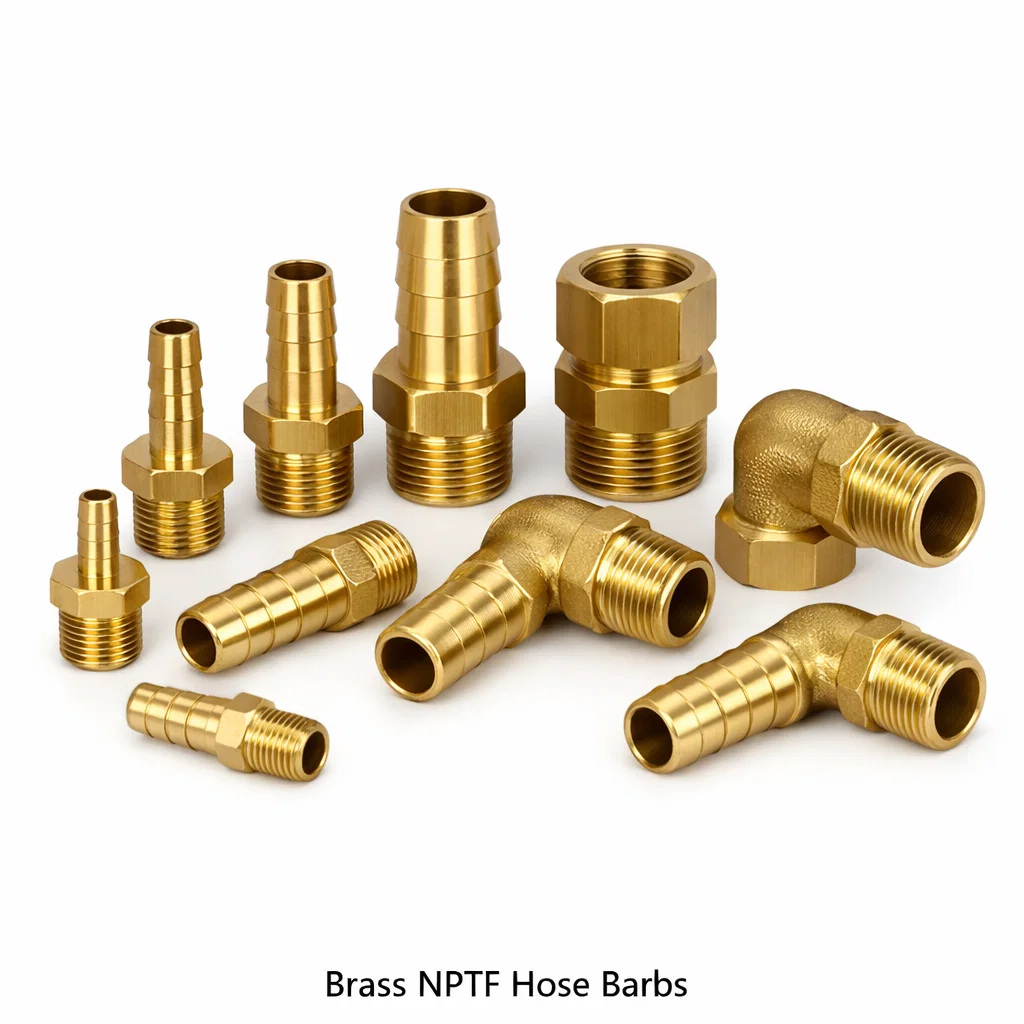
Jamnagar Brass Components manufactures precision brass NPTF hose barbs — Dryseal tapered pipe thread hose barb fittings conforming to ASME B1.20.3 — for the demanding requirements of the US fuel handling, hydraulic, pneumatic, and automotive fluid system markets. NPTF (National Pipe Taper Fuel, Dryseal) is the high-integrity US pipe thread standard that achieves a leak-free metal-to-metal seal without thread sealant compounds, making it mandatory wherever contamination of the fluid by sealant is unacceptable. Our brass NPTF hose barbs are CNC-machined from free-machining brass C36000 (CZ121) bar, with 100% gauge verification using ASME B1.20.3-compliant NPTF gauges.
What Makes NPTF (Dryseal) Different from NPT?
The critical difference between NPT and NPTF lies in the thread form precision at the crest and root. An NPT thread has clearance between the crest of the male thread and the root of the female thread — this gap is filled by PTFE tape or pipe compound to achieve a seal. An NPTF thread is machined to tighter tolerances on thread height so that when the male NPTF is engaged in a female NPTF port, the crests crush into the roots in a controlled “Dryseal” action — creating a metal-to-metal pressure-tight joint without any sealant. NPTF is specified wherever:
- Sealant compound cannot be tolerated (fuel, oxygen, food, pharmaceutical systems)
- Very high pressures require a positive metal seal rather than relying on compound
- Repeated assembly/disassembly is required without adding fresh sealant each time
- Automated assembly equipment cannot apply thread sealant consistently
Brass Alloy Grades for NPTF Hose Barbs — International Equivalents
| Grade Name | UNS (USA) | EN (Europe) | BS (UK) | IS (India) | Composition |
|---|---|---|---|---|---|
| Free-Machining Brass (Primary) | C36000 | CW603N / CW614N | CZ121 | IS 319 Gr.1 | 61.5Cu–35.5Zn–3Pb |
| Low-Lead NSF 372 | C69300 | CW724R | — | — | 63.5Cu–Zn–0.09Pb–Si |
| Naval Brass | C46400 | CW712R | CZ112 | IS 291 NB | 60Cu–39Zn–1Sn |
| DZR Brass | C35330 | CW602N | CW602N | — | 61Cu–37Zn–2Pb–0.07As |
Types of Brass NPTF Hose Barbs We Manufacture
Straight Male NPTF Brass Hose Barbs
Straight configuration with hex body, male NPTF thread (1/8 NPTF to 2 NPTF), and smooth or ribbed barb tail in hose ID sizes from 3/16 inch to 2 inch. This is the highest-volume configuration for US fuel, hydraulic, and pneumatic hose assemblies. All NPTF threads 100% gauged with L1 and L3 NPTF gauge set per ASME B1.20.3.
Female NPTF Swivel Hose Barbs
Female NPTF swivel hose barbs with a rotating captive hex nut providing female NPTF thread entry and a barb tail exit — for screwing onto a fixed male NPTF stud without rotating the hose assembly. Used in diesel fuel system connections and agricultural equipment where hose routing prevents turning the complete fitting.
90-Degree Elbow Brass NPTF Hose Barbs
Right-angle elbow brass NPTF hose barbs for fuel tank ports, carburetor connections, and hydraulic valve bodies where straight hose routing would interfere with adjacent components. Male NPTF thread entry, smooth barb exit. Available 1/8 NPTF to 3/4 NPTF with barb sizes matched to hose ID.
45-Degree Brass NPTF Hose Barbs
45-degree angled NPTF brass hose barbs for gentle hose bend routing at fuel pump outlets, generator set fuel connections, and power equipment where the hose minimum bend radius must be maintained for maximum hose life.
Brass NPTF Hose Barb Tees (T-Piece)
T-shaped NPTF hose barb fittings with one NPTF thread end and two barb tails, or three barb tails — for fuel return lines, coolant bypass circuits, and vacuum manifolds where a single line splits into two directions. Available with all-equal or unequal barb diameters for reducing tee configurations.
Push-In NPTF Barb Adapters
Brass NPTF male thread to metric or imperial compression-fit or push-in tube end adapters, for connecting rigid tube assemblies to NPTF-ported components — common in automotive fuel injection systems and industrial pneumatic panels with mixed connection standards.
NPTF Thread Size Reference — Hose Barb Combinations
| NPTF Thread Size | TPI | Pitch Diameter (L1) | Typical Hose ID | Common Application |
|---|---|---|---|---|
| 1/8 NPTF | 27 | 0.37360 in | 3/16″ – 1/4″ | Instrument, vacuum, small fuel lines |
| 1/4 NPTF | 18 | 0.47739 in | 5/16″ – 3/8″ | Pneumatic, fuel, brake vacuum |
| 3/8 NPTF | 18 | 0.62701 in | 3/8″ – 1/2″ | Hydraulic return, fuel supply |
| 1/2 NPTF | 14 | 0.77843 in | 1/2″ – 5/8″ | High-flow fuel, coolant, air |
| 3/4 NPTF | 14 | 1.02938 in | 3/4″ – 7/8″ | Main fuel feed, large coolant |
| 1 NPTF | 11.5 | 1.28750 in | 1″ – 1¼” | High-volume fluid transfer |
Applications of Brass NPTF Hose Barbs
- Diesel and gasoline engine fuel supply and return lines
- Hydraulic power unit hose connections (low-pressure return)
- Automotive cooling system and heater core hose connections
- Industrial compressed air distribution hose assemblies
- Agricultural equipment fuel, hydraulic, and spray system hoses
- Generator set, engine, and power equipment fluid connections
- Marine engine room fuel and coolant hose connections
- Construction and off-road equipment hydraulic hoses
Why Choose Jamnagar Brass Components for Brass NPTF Hose Barbs?
- ASME B1.20.3 NPTF gauging — both L1 and L3 gauge verification on 100% of NPTF threads
- CNC machined from CZ121/C36000 bar — consistent thread form, tightest NPTF tolerance
- Full size range — 1/8 NPTF to 2 NPTF, barb sizes 3/16 to 2 inch
- US market expertise — familiar with SAE J514, SAE J516, and US OEM fitting standards
- Custom configurations — straight, elbow, tee, reducing in any thread-barb combination
- Lead-free (NSF 372) alloy — available for potable water and food-grade systems
- ISO 9001:2015 certified quality — NPTF gauge records available for each production lot
- Competitive US export pricing — 40–60% cost savings vs. US domestic brass hose fittings
Frequently Asked Questions — Brass NPTF Hose Barbs
Q1: Can NPTF threads be used in NPT ports?
Yes — with an important caveat. A male NPTF fitting can be installed in a female NPT port (and vice versa), and with PTFE tape will seal functionally. However, the Dryseal metal-to-metal seal that NPTF is designed to achieve requires both mating parts to be NPTF-gauged (L1 and L3). Mixing NPTF with standard NPT achieves at best an NPT-quality sealant seal, not a Dryseal. For critical applications (fuel, oxygen), both fitting and port should be NPTF.
Q2: What NPTF gauge set do you use for thread verification?
We use ASME B1.20.3-compliant NPTF gauge sets consisting of: L1 gauge (measures thread engagement — same function as NPT gauge), and L3 gauge (ring/plug gauge measuring crest truncation for the Dryseal crest-root crush). Only parts passing both L1 and L3 checks are certified as NPTF. Gauge records are maintained per ISO 9001:2015 and are available to customers on request for quality audit purposes.
Q3: What is the maximum pressure for brass NPTF hose barb connections?
The NPTF brass fitting body (C36000, machined wall ≥ 2 mm) is rated to at least 150 psi (10 bar) for standard hose barb applications. The threaded NPTF joint itself — when properly engaged with a mating NPTF port — is rated to the full working pressure of the system, limited by the hose or tube rating. Hydraulic applications using brass NPTF fittings in low-pressure return circuits typically operate at 50 to 300 psi.
Q4: How many threads of engagement are required for an NPTF Dryseal joint?
Per ASME B1.20.3, the L1 hand-tight engagement for NPTF is 3 to 6 threads depending on size (more for larger threads). The Dryseal is achieved in the final wrench-tight turns (typically 2 to 4 turns past hand-tight) when crest truncation occurs. Insufficient engagement leaves unsealed threads; over-engagement risks splitting cast or thin-wall ports. Always verify engagement using L1 gauge measurement at final installation.
Q5: Are brass NPTF hose barbs compatible with SAE J514 hydraulic fittings?
SAE J514 (Hydraulic Tube Fittings) covers JIC 37-degree flare and O-ring fittings — a different connection type from NPTF hose barbs. Brass NPTF hose barbs connect to NPTF-threaded ports per ASME B1.20.3 and are used for push-on hose connections rather than the compression-type tube fittings covered by SAE J514. Both types are common in hydraulic systems; the choice depends on whether hose or rigid tube is used on each leg of the circuit.
Q6: Can I use brass NPTF hose barbs with gasoline and diesel fuel?
Yes. Brass NPTF hose barbs in C36000 are compatible with gasoline, diesel, biodiesel (B20), lubricating oil, and most petroleum fuels. Brass does not corrode in petroleum products and the NPTF Dryseal eliminates any concern about PTFE tape fragments entering the fuel stream. For ethanol-blended fuels above E15 or alternative fuels like methanol, verify compatibility with both the brass fitting and the flexible hose material before specifying.
Q7: What barb profile options are available (ribbed, smooth, double-barb)?
Available barb profiles: smooth (for push-on applications with hose clamp), single rib (one machined groove/ridge), double rib (two ribs for high pull-out resistance), and full barb profile (tapered entry rib with sharp retention edge). The choice depends on hose type (reinforced vs. soft wall), operating pressure, and whether hose clamps are used. We machine any barb profile to customer drawing or SAE/MIL-specification barb geometry.
Q8: Do you supply NPTF fittings to MIL-spec or SAE standards for US defense and aerospace ground support?
Yes. We supply NPTF hose barb fittings referencing MS (Military Standard) and AN (Air Force-Navy Aeronautical Standard) drawings for ground support equipment (GSE), aviation fuel vehicles, and defence logistics vehicles. MIL-DTL-25579 (swaged hose fittings) dimensional references and ASME B1.20.3 NPTF gauging are standard on military-referenced orders. DFARS compliance for US DoD supply is available on request.
Q9: What is the difference between a hose barb and a hose nipple?
The terms overlap significantly in the US market. “Hose barb” typically emphasises the barbed retention feature of the hose-end tail. “Hose nipple” (or hose tail in UK usage) is the more general term for the complete fitting with thread one end and barb the other. In practice both terms describe the same family of fittings — a threaded male entry with a barbed hose tail. We use both terms on product drawings and specifications.
Q10: Can you supply brass NPTF hose barbs in NSF 372 lead-free alloy for potable water?
Yes. For US potable water applications, we supply NPTF hose barbs in C69300 (EcoSmart, lead content 0.09%) or C87850 low-lead brass, both complying with NSF/ANSI 372 (maximum 0.25% weighted average lead). Material Test Certificates confirming lead content are provided. Potable water hose assemblies using lead-free NPTF brass barbs with NSF 61-listed hose are common in RV fresh water systems, water dispensing equipment, and low-pressure drinking water appliances.
Q11: What nickel plating is available on brass NPTF hose barbs?
Electrolytic bright nickel plating (5 to 10 µm) is available on brass NPTF hose barbs for corrosion protection in humid outdoor and marine environments, and for aesthetic matching with nickel-plated panel hardware. Plating is applied after NPTF thread gauging — post-plating dimensional check ensures NPTF thread remains within gauge tolerance after plating thickness is added. Chrome and tin plating are also available.
Q12: What is the minimum order and lead time for brass NPTF hose barbs?
Minimum order: 100 pieces for standard thread-barb combinations from 1/8 NPTF to 3/4 NPTF; 200 pieces for 1 NPTF and larger. For NSF 372 lead-free alloy: minimum 250 pieces. For prototype and first-article samples: 10 to 25 pieces in 7 to 10 working days. Production lead time: 2 to 3 weeks for standard configurations; 3 to 5 weeks for custom elbow, tee, or reducing designs. Air freight to USA: 3 to 5 business days.
📧 Get a Free Quote Today
Contact Jamnagar Brass Components for your needs of Brass NPTF Hose Barbs and Dryseal Brass Hose Fittings.
Our engineers respond within 24 hours with competitive pricing and full technical documentation.
🏭 Manufactured in Jamnagar, India · 📦 Exporting to USA, UK, Europe & Worldwide · ✅ ISO 9001:2015 Certified