
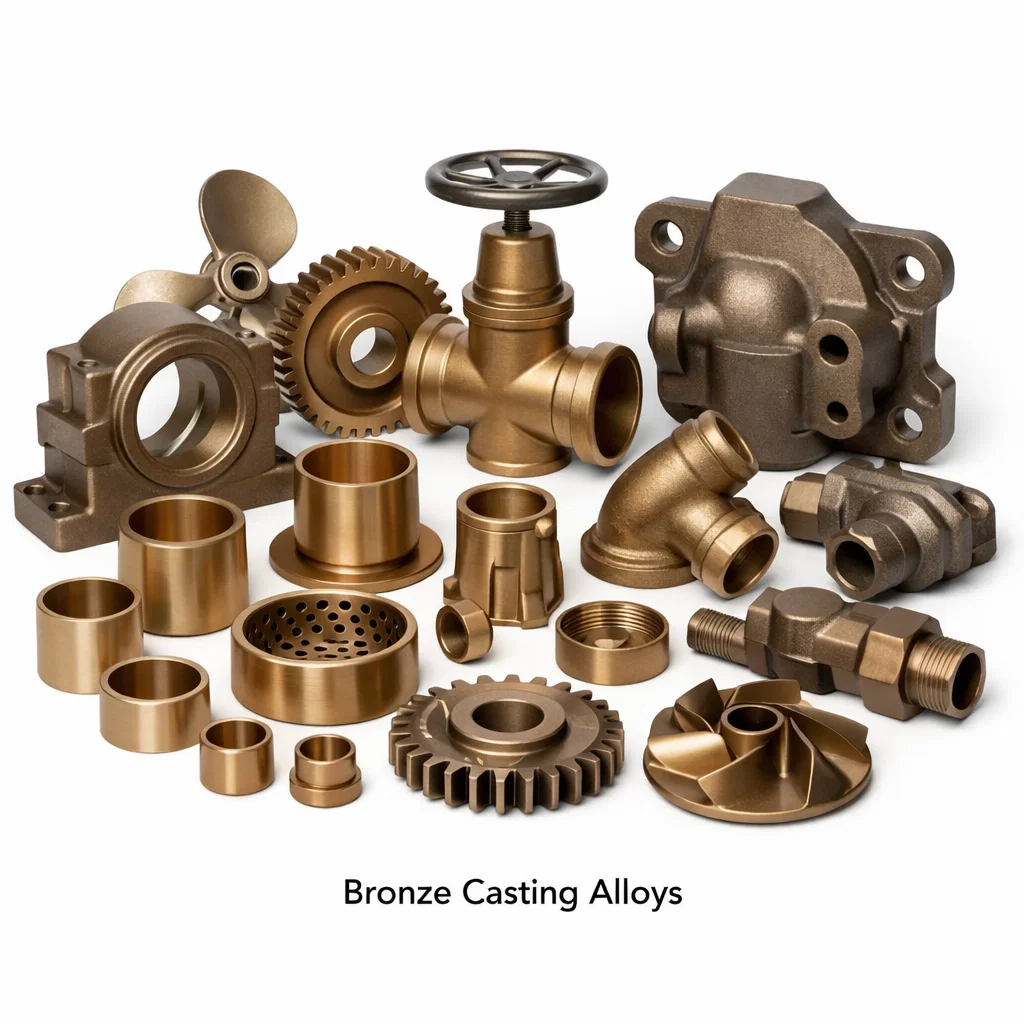
Selecting the right bronze casting alloy is one of the most consequential decisions in product design and procurement. The wrong alloy can lead to premature failure, excessive cost, or non-compliance with regulatory requirements. The right alloy delivers decades of reliable service with optimal mechanical properties, corrosion resistance, and machinability. Jamnagar Brass Components has been casting and machining bronze components for over 25 years, serving clients in the USA, UK, Europe, and worldwide. This comprehensive guide covers every major bronze casting alloy — their composition, mechanical properties, corrosion resistance, casting characteristics, machinability, and ideal applications — to help engineers, procurement professionals, and product designers make the best choice for their application.
What is Bronze? Bronze vs. Brass vs. Copper
Bronze is a copper-base alloy in which the primary alloying element is anything other than zinc. The most traditional bronzes use tin as the primary alloying element, but modern engineering bronzes include silicon bronze (silicon as primary alloying element), aluminium bronze (aluminium), manganese bronze (manganese), and lead-tin bronze. Brass, by contrast, uses zinc as the primary alloying element. The distinction matters for specification: a component specified as “bronze” should be a true copper-tin alloy, not a high-zinc copper alloy (brass).
All Major Bronze Casting Alloys — Properties and Equivalents
1. LG2 Bronze (Gunmetal 85-5-5-5)
| Property | Value |
|---|---|
| UNS (USA) | C83600 |
| EN / DIN (Europe) | CC491K |
| BS (UK) | LG2 (BS 1400) |
| IS (India) | LTB-2 |
| Nominal composition | 85% Cu, 5% Sn, 5% Pb, 5% Zn |
| Tensile strength | 240–280 MPa (35–40 ksi) |
| Yield strength | 110–140 MPa |
| Elongation | 13–18% |
| Hardness | 65–85 HB |
| Electrical conductivity | ~15% IACS |
| ASTM casting standard | ASTM B62 |
Best for: Valves, pump bodies, pipe fittings, marine hardware, bearing bushes, and general industrial castings. The most widely used bronze casting alloy worldwide due to its excellent castability, pressure tightness, and corrosion resistance in fresh water, seawater (moderate velocity), and industrial atmospheres. The lead content provides good machinability and pressure tightness by filling micro-shrinkage porosity during solidification.
2. Phosphor Bronze — High-Tin Casting Alloys (Navy M, C90700)
| Property | Value |
|---|---|
| UNS (USA) | C90700 (Navy M, 88-10-0-2) |
| EN / DIN (Europe) | CC480K |
| BS (UK) | PB1 (BS 1400) |
| Nominal composition | 88% Cu, 10% Sn, 0% Pb, 2% Zn |
| Tensile strength | 280–310 MPa |
| Hardness | 90–110 HB |
| Electrical conductivity | ~12% IACS |
| ASTM casting standard | ASTM B143 / B271 |
Best for: Gear blanks, worm wheels, bushings, bearing housings, and heavy-load wearing components. High tin content (10%) produces a harder, more wear-resistant alloy than LG2. The low lead content means reduced machinability compared to LG2, but the higher hardness and fatigue strength justify specification for gear and bearing applications. Not suitable for pressure-tight casting as readily as LG2 — requires careful feeding.
3. Leaded Tin Bronze (LTB1 / SAE 660 / C93200)
| Property | Value |
|---|---|
| UNS (USA) | C93200 (SAE 660) |
| EN / DIN (Europe) | CC493K |
| BS (UK) | LTB1 (BS 1400) |
| Nominal composition | 83% Cu, 7% Sn, 7% Pb, 3% Zn |
| Tensile strength | 240 MPa |
| Hardness | 60–70 HB |
| ASTM casting standard | ASTM B584 |
Best for: Bearing bushes, journal bearings, thrust washers, and sleeve bearings carrying moderate loads at moderate speeds. SAE 660 (C93200) is the most widely used bearing bronze in the USA, offering a balance of strength, conformability (lead embeds dirt particles), and machinability. The lead content acts as a solid lubricant and helps the bearing conform to slight misalignment without seizing.
4. Aluminium Bronze (AB1 / AB2 — C95400, C95800)
| Property | Value |
|---|---|
| UNS (USA) | C95400 (AB1) / C95800 (AB2 nickel-aluminium bronze) |
| EN / DIN (Europe) | CC331G (AB1) / CC333G (AB2) |
| BS (UK) | AB1 / AB2 (BS 1400) |
| IS (India) | AB1 / AB2 |
| Nominal composition | AB1: 88% Cu, 10.5% Al, 1.5% Fe; AB2: 81% Cu, 9% Al, 5% Ni, 4% Fe, 1% Mn |
| Tensile strength | AB1: 550–620 MPa; AB2: 680–750 MPa |
| Hardness | AB1: 150–180 HB; AB2: 180–220 HB |
| Electrical conductivity | ~8–10% IACS |
| ASTM casting standard | ASTM B148 |
Best for: Marine propellers, propeller hubs, pump impellers for seawater, valve seats, offshore structural components, and heavy-duty wear parts. AB2 (nickel-aluminium bronze) is the premier alloy for seawater pump casings and propellers due to its outstanding resistance to cavitation erosion and impingement attack. Much harder and stronger than LG2 — requires carbide tooling and slower machining speeds. Can be heat treated (solution anneal + age) for maximum strength.
5. Silicon Bronze (SC1 / C87600 / C65500)
| Property | Value |
|---|---|
| UNS (USA) | C87600 (casting) / C65500 (wrought) |
| EN / DIN (Europe) | CC766S |
| BS (UK) | SC1 (BS 1400) |
| Nominal composition | 91–96% Cu, 3–5% Si, trace Mn/Zn |
| Tensile strength | 380–480 MPa |
| Hardness | 95–120 HB |
| Electrical conductivity | ~7% IACS |
| ASTM casting standard | ASTM B198 / B584 |
Best for: Architectural castings, pump shafts, marine hardware (decorative and structural), substation connector bodies, hardware bolts and fasteners, and any application requiring both good corrosion resistance and weldability. Silicon bronze is the only standard bronze alloy that can be readily TIG and MIG welded without sensitisation, making it ideal for cast-and-fabricated hybrid assemblies. Lead-free by nature — suitable for NSF 61 potable water applications in some jurisdictions.
6. Manganese Bronze (High-Tensile Brass / HTB1 / C86300)
| Property | Value |
|---|---|
| UNS (USA) | C86300 |
| EN / DIN (Europe) | CC765S |
| BS (UK) | HTB1 (BS 1400) |
| Nominal composition | 60–66% Cu, 22–28% Zn, 3–7% Mn, 2–4% Fe, 3% Al |
| Tensile strength | 640–760 MPa (93–110 ksi) |
| Hardness | 175–230 HB |
| Electrical conductivity | ~7% IACS |
| ASTM casting standard | ASTM B584 (C86300) |
Best for: Propeller shafts, marine hardware under high stress, bridge plates, large bushings and wear plates, heavy gear blanks, valve bodies in high-pressure service, and any application requiring the highest tensile strength available from a cast copper alloy. HTB1/C86300 is the strongest standard copper alloy casting, but is more difficult to cast than LG2 or silicon bronze due to its narrow freezing range and tendency to hot-crack. Requires careful pattern design and feeding system.
7. Copper-Nickel (CuNi 90/10 and 70/30 — Casting Grades)
| Property | Value |
|---|---|
| UNS (USA) | C96200 (90/10) / C96400 (70/30) |
| EN / DIN (Europe) | CC382H (90/10) |
| Nominal composition | 90% Cu, 10% Ni, Fe, Mn (90/10); 70% Cu, 30% Ni (70/30) |
| Tensile strength | 280–340 MPa |
| Hardness | 90–110 HB |
| Electrical conductivity | ~5% IACS |
| ASTM casting standard | ASTM B369 |
Best for: Marine heat exchanger end plates, ship sea chests and hull fittings, desalination plant components, and offshore oil and gas fluid handling where resistance to impingement and biofouling in seawater is required. Copper-nickel alloys are highly resistant to biofouling (barnacle and algae attachment), making them uniquely suited for submerged marine applications. Not widely cast but extremely valuable in niche marine applications.
8. Tin Bronze — High-Lead Bearing Alloys (C94300)
| Property | Value |
|---|---|
| UNS (USA) | C94300 |
| EN / DIN (Europe) | CC496K |
| Nominal composition | 70% Cu, 5% Sn, 25% Pb |
| Tensile strength | 170 MPa |
| Hardness | 40–55 HB |
| ASTM casting standard | ASTM B271 / B584 |
Best for: Very-low-speed, high-load plain bearings (diesel engine main bearings, hydraulic cylinder pivot pins, heavy press bearings) where the high lead content (25%) provides maximum conformability and seizure resistance under boundary lubrication conditions. The soft lead matrix embeds abrasive particles and provides self-lubrication when oil film breaks down. Not suitable for structural castings — strength is very low.
Bronze Casting Alloy Comparison Table
| Alloy | UNS | UTS (MPa) | Hardness (HB) | Castability | Machinability | Corrosion Resistance | Best Application |
|---|---|---|---|---|---|---|---|
| LG2 / Gunmetal | C83600 | 240–280 | 65–85 | Excellent | Good | Very Good | Valves, general castings |
| Navy M Bronze | C90700 | 280–310 | 90–110 | Good | Moderate | Very Good | Gears, worm wheels |
| SAE 660 Bearing | C93200 | 240 | 60–70 | Good | Very Good | Good | Journal bearings |
| Aluminium Bronze AB1 | C95400 | 550–620 | 150–180 | Moderate | Difficult | Excellent | Marine pumps, propellers |
| Aluminium Bronze AB2 | C95800 | 680–750 | 180–220 | Moderate | Difficult | Outstanding | Offshore, seawater pumps |
| Silicon Bronze SC1 | C87600 | 380–480 | 95–120 | Good | Moderate | Excellent + weldable | Architectural, electrical |
| Manganese Bronze HTB1 | C86300 | 640–760 | 175–230 | Moderate | Difficult | Good | High-strength marine parts |
| Copper-Nickel 90/10 | C96200 | 280–340 | 90–110 | Moderate | Moderate | Exceptional seawater | Marine heat exchangers |
| High-Lead Bearing | C94300 | 170 | 40–55 | Good | Excellent | Good | Heavy-load plain bearings |
How to Choose the Right Bronze Casting Alloy
Use this decision framework to select the optimal bronze casting alloy for your application:
- General purpose valves, fittings, and marine hardware: LG2 / C83600 — the default choice for 80% of bronze casting applications
- Bearings and bushings (moderate load/speed): SAE 660 / C93200 (leaded tin bronze) for best conformability
- Gears, worm wheels, high-wear surfaces: Navy M / C90700 or Phosphor Bronze for higher hardness and fatigue strength
- High-strength structural parts, seawater pumps: Aluminium Bronze AB1 (C95400) or AB2 (C95800) for maximum tensile strength and cavitation resistance
- Weldable architectural or electrical connector bodies: Silicon Bronze SC1 / C87600
- Highest tensile strength, propeller shafts: Manganese Bronze HTB1 / C86300
- Submerged marine heat exchangers, anti-fouling: Copper-Nickel 90/10 / C96200
- Heavy-load, low-speed plain bearings: High-lead tin bronze C94300
- Potable water compliance (NSF 61/372): Silicon bronze C87600 or specified NSF-listed alloys
Bronze Casting Processes Available at Jamnagar Brass Components
- Sand casting: Complex shapes, wide alloy range, CT8–CT10 accuracy, 50 g to 500 kg. Ideal for prototypes and low-volume production in LG2, aluminium bronze, and silicon bronze.
- Gravity die casting: Tighter tolerances (CT5–CT7), better surface finish, higher productivity for medium volumes in LG2 and silicon bronze.
- Investment (lost wax) casting: Highest precision (CT4–CT6), excellent surface finish, complex geometry with thin walls. For LG2, silicon bronze, and aluminium bronze precision parts.
- Continuous casting: Bronze bar, tube, and rod in LG2, bearing bronze, and phosphor bronze for machining blanks.
Why Choose Jamnagar Brass Components for Bronze Castings?
- All major bronze alloys in-house — LG2, aluminium bronze, silicon bronze, phosphor bronze, bearing bronze
- Full casting-to-machined-component capability — pattern → casting → machining → NDT → despatch
- ASTM and EN certified raw material — MTC per ASTM B62, B148, B584 on all castings
- ISO 9001:2015 certified — full traceability and NDT options (LPT, X-ray, pressure test)
- 25+ years of bronze casting experience — serving US, UK, European, and global clients
- NSF 61/372 compliant alloys — available for US potable water market requirements
- Competitive India pricing — 40–60% cost savings vs. US and European bronze castings
- Fast prototype turnaround — first castings in 3 to 5 weeks from approved drawing
Frequently Asked Questions — Bronze Casting Alloys
Q1: What is the most commonly used bronze casting alloy?
LG2 bronze (C83600 / CC491K / gunmetal 85-5-5-5) is the most widely used bronze casting alloy globally, specified for the majority of valves, fittings, pump bodies, and marine hardware castings. Its combination of castability, corrosion resistance, machinability, and reasonable cost makes it the first choice for most general bronze casting applications. It is the “default” bronze — consider alternatives only when LG2 cannot meet specific strength, hardness, or regulatory requirements.
Q2: When should I use aluminium bronze instead of LG2?
Specify aluminium bronze (C95400 AB1 or C95800 AB2) when: tensile strength above 450 MPa is required (LG2 max is ~280 MPa); the component operates in high-velocity seawater (above 3 m/s) where LG2 would suffer erosion; the environment contains sulphuric acid, hydrofluoric acid, or other media aggressive to leaded tin bronzes; or operating temperatures above 250°C are encountered in steam valve service. The higher cost and machining difficulty of aluminium bronze are justified by its performance in these demanding conditions.
Q3: What is the difference between LG2 and SAE 660 (C93200) bearing bronze?
LG2 (C83600) has 5% lead and is optimised for pressure-tight castings (valves, fittings). SAE 660 (C93200) has 7% lead and 7% tin, optimised for bearing and bushing applications where the higher lead provides better conformability, embeddability of abrasive particles, and seizure resistance under boundary lubrication. SAE 660 castings are not typically pressure-tested — they are used as solid bearing liners rather than pressure-containing housings.
Q4: Is silicon bronze suitable for potable water applications (NSF 61)?
Silicon bronze (C87600) is inherently lead-free (typically less than 0.02% lead) and has been used for potable water hardware globally. However, full NSF 61 and NSF 372 product listing requires the finished product to be tested and listed by an accredited certification organisation. We supply castings in C87600 with the alloy certification supporting the customer’s NSF listing application. California AB 1953 low-lead compliance is met by silicon bronze’s natural lead-free composition.
Q5: What is manganese bronze and when is it used?
Manganese bronze (HTB1, C86300) is technically a high-zinc brass (60% Cu, 26% Zn) with manganese, iron, and aluminium additions that dramatically increase strength to 640–760 MPa — the highest of any standard copper alloy. It is the alloy of choice for marine propeller blades (1 to 10 tonne castings), large propeller shafts, worm gear wheels for heavy machinery, and structural underwater hardware. Its high strength comes at the cost of greater casting complexity and susceptibility to dezincification in certain environments.
Q6: Can bronze castings be welded for repair?
Weldability varies significantly by alloy. Silicon bronze (C87600) is the most readily weldable using TIG with silicon bronze filler wire and preheat to 100°C. LG2 bronze can be TIG or gas welded for repair with C83600 or C86100 filler, but leaded alloys produce porosity in weld metal if excessive heat is applied. Aluminium bronze (C95400) requires careful pre-heat (150–200°C) and is welded with aluminium bronze filler (ERCuAl-A2). Phosphor bronze and bearing alloys are not recommended for welding.
Q7: What NDT tests are available for bronze pressure castings?
Available NDT for bronze castings: liquid penetrant testing (LPT) per ASTM E1417 for surface cracks; radiographic testing (X-ray) per ASTM E94 for internal porosity and inclusions in critical castings; ultrasonic testing (UT) for thick-section pressure vessel castings; hydraulic pressure testing at 1.5× to 2.0× working pressure for valve bodies and pump casings; and helium leak testing for high-integrity sealing applications. Test certificates are provided with each tested casting.
Q8: What ASTM standards apply to bronze castings?
Key ASTM casting standards: B62 (leaded tin bronze — C83600 LG2), B148 (aluminium bronze castings — C95400, C95800), B584 (copper alloy sand castings, general), B271 (copper alloy centrifugal castings), B369 (copper-nickel alloy castings), and B198 (silicon bronze castings). For UK and European projects, BS EN 1982 covers all copper alloy castings with CC-series grade designations. We supply MTC per the applicable standard with all production castings.
Q9: What is the difference between sand casting and gravity die casting for bronze?
Sand casting uses expendable sand moulds — low tooling cost (USD 500 to 3000 per pattern), any complexity including internal passages and undercuts, CT8–CT10 accuracy, Ra 12–25 µm surface finish. Gravity die casting uses permanent metal dies — higher tooling cost (USD 3000 to 15,000 per die), limited to simple geometries without undercuts, CT5–CT7 accuracy, Ra 5–10 µm surface finish, lower unit cost for medium-to-high volumes (above 500 pieces per year). For most valve bodies and pump housings, sand casting is used for prototypes and low volumes, transitioning to gravity die casting for established products in regular production.
Q10: How is dezincification relevant to bronze casting alloys?
Dezincification (selective removal of zinc from the alloy by corrosion) affects copper alloys with zinc content above approximately 15–20% in soft or slightly acidic water. True bronzes (LG2, aluminium bronze, silicon bronze, phosphor bronze) contain less than 10% zinc in most cases and are not significantly affected by dezincification. Manganese bronze (26% Zn) and some “commercial bronzes” with high zinc content are susceptible and should not be specified for hot water plumbing or submerged applications without dezincification resistance testing.
Q11: What is the typical lead time for bronze sand castings from Jamnagar?
New pattern manufacture: 2 to 4 weeks. First sand castings (rough): 1 to 2 weeks after pattern approval. Machining of castings: add 1 to 3 weeks. Total first-article lead time for machined and inspected castings: 5 to 8 weeks. Repeat orders on existing patterns: rough castings in 1 to 2 weeks; fully machined in 2 to 4 weeks. Gravity die casting tooling: additional 4 to 6 weeks for die manufacture before first parts.
Q12: What minimum order quantity applies to custom bronze castings?
Sand castings: minimum 1 to 5 pieces for new pattern development (prototype/first-article pricing). Repeat orders on existing patterns: minimum 10 pieces. Gravity die castings: minimum 25 to 50 pieces for first run on new die; minimum 100 pieces repeat. Investment castings: minimum 10 pieces for wax tooling development; minimum 25 pieces repeat. For emergency requirements, 1 to 2 sample castings can be produced on an expedited basis at premium pricing.
📧 Get a Free Quote Today
Contact Jamnagar Brass Components for your needs of Bronze Castings in LG2, Aluminium Bronze, Silicon Bronze and All Major Bronze Alloys.
Our engineers respond within 24 hours with competitive pricing and full technical documentation.
🏭 Manufactured in Jamnagar, India · 📦 Exporting to USA, UK, Europe & Worldwide · ✅ ISO 9001:2015 Certified