
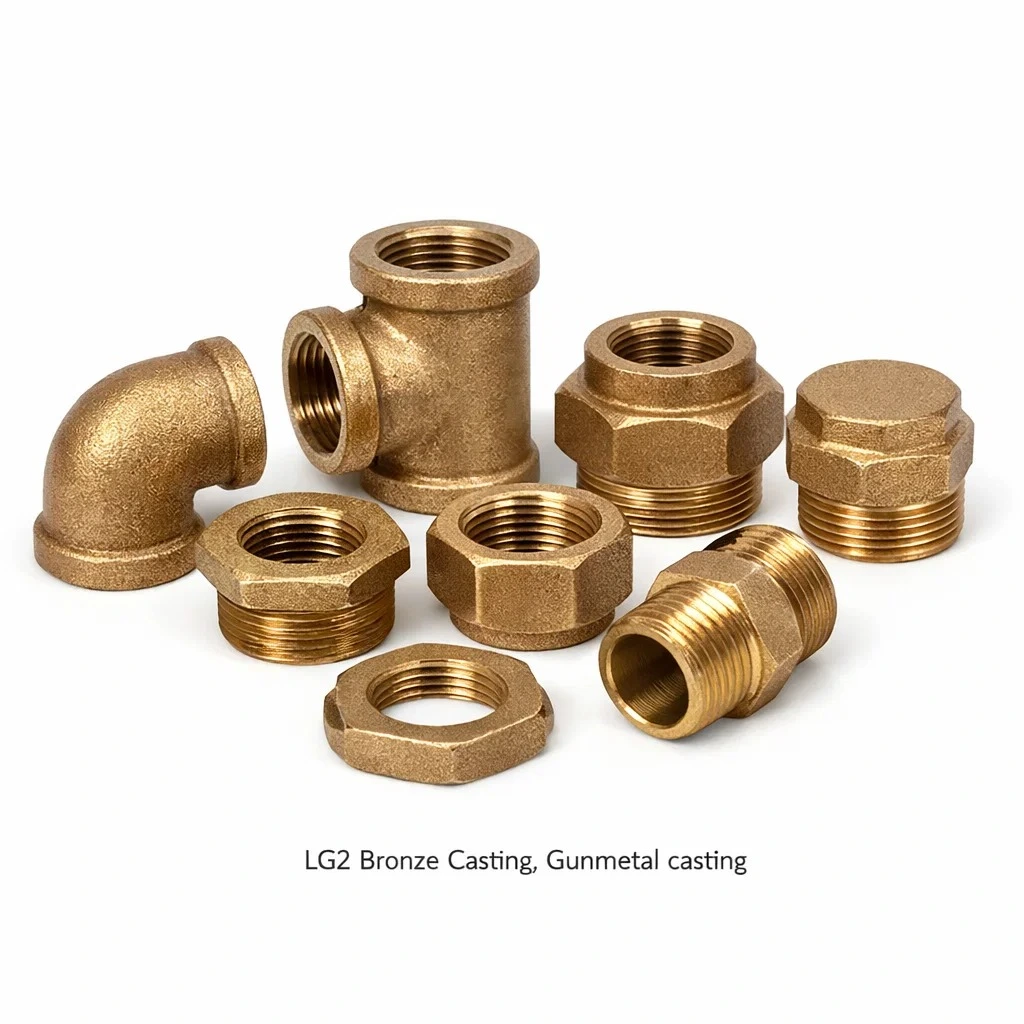
Jamnagar Brass Components manufactures bronze sand castings in LG2 gunmetal, aluminium bronze, and other copper-base alloys for the valve, pump, marine, oil and gas, and general engineering industries. Our bronze sand castings combine complex geometry capability with the excellent corrosion resistance and mechanical properties of copper-base alloys.
Bronze Alloys We Sand Cast
LG2 Gunmetal (C83600, 85-5-5-5 bronze) is our most commonly cast alloy, a lead-tin-zinc bronze offering good machinability, pressure tightness, and excellent corrosion resistance for valve bodies, pump casings, and pipe fittings. Aluminium Bronze (AB1/C95200, AB2/C95500) provides superior strength and corrosion resistance for marine, offshore, and chemical plant components. Nickel Aluminium Bronze (C95500, C95800) offers maximum corrosion resistance for seawater-exposed components in propellers, pump impellers, and valve bodies. Manganese Bronze (C86300) provides very high strength for heavily loaded structural and gear applications.
Casting Processes and Capabilities
We use both green sand casting (for standard geometries and higher production volumes) and resin sand / no-bake casting (for better surface finish, improved dimensional accuracy, and more complex internal geometries). Casting weights range from 0.5 kg to 200 kg. After casting, components are shot-blasted, inspected, and then CNC machined to final dimensions where required. Surface finishes include as-cast, machined, and polished.
Products We Manufacture
Bronze sand castings we produce include LG2 gunmetal valve bodies (gate, globe, ball, check valves), pump housings and impeller casings, pipe fittings and manifolds, marine hardware and propeller components, offshore platform and subsea connectors, industrial bearing housings and bracket castings, and custom engineering components from customer drawings and patterns.
Standards and Quality
Our bronze sand castings are produced in accordance with ASTM B62 (composition bronze), ASTM B148 (aluminium bronze), and BS 1400 (copper alloy castings). Chemical composition and mechanical properties are tested and certified per heat. Radiographic and pressure testing is available for critical hydraulic and pneumatic castings. Our quality management system is certified to ISO 9001:2015.
Why Choose Jamnagar Brass Components?
Our experienced bronze foundry team, combined with in-house CNC machining, allows us to supply complete, machined bronze castings at competitive India-based pricing. We have established export experience to valve OEMs, pump manufacturers, and marine hardware companies in the USA, UK, and Europe. Contact us for a quotation on LG2 gunmetal, aluminium bronze, or custom bronze sand castings.
Frequently Asked Questions — Bronze Sand Castings
Q1: What bronze alloys are available for sand casting?
We sand cast LG2/C83600 gunmetal (the most common), SAE 660/C93200 bearing bronze, aluminium bronze AB1/C95400 and AB2/C95800, silicon bronze SC1/C87600, phosphor bronze C90700, manganese bronze HTB1/C86300, and copper-nickel 90/10 C96200. Alloy selection depends on strength, corrosion resistance, and the intended application environment.
Q2: What is the most common bronze alloy for sand castings?
LG2 gunmetal (C83600, 85-5-5-5 composition) is by far the most widely used bronze sand casting alloy, accounting for the majority of valve bodies, pump housings, pipe fittings, and marine hardware castings worldwide. Its combination of excellent castability, good machinability, pressure tightness, and corrosion resistance in seawater and industrial atmospheres makes it the default choice for most applications.
Q3: What ASTM standards apply to bronze sand castings?
Key ASTM standards for bronze sand castings include ASTM B62 (leaded tin bronze, C83600 LG2), ASTM B148 (aluminium bronze, C95400/C95800), ASTM B584 (general copper alloy sand castings), ASTM B271 (centrifugal copper alloy castings), and ASTM B369 (copper-nickel alloy castings). Material Test Certificates per ASTM E1086 (spectrometric analysis) and mechanical property testing per ASTM B208 are provided.
Q4: What dimensional tolerances are achievable with bronze sand castings?
Bronze sand castings achieve CT8–CT10 per ISO 8062 as-cast, equivalent to ±1.5–3 mm on medium-size castings. Resin-bonded sand gives better accuracy than green sand. After CNC machining of critical bores and faces, tolerances of ±0.025 mm are achievable. Draft angles of 1–3 degrees are required on vertical surfaces for pattern withdrawal.
Q5: Can you supply bronze sand castings for pressure-containing applications?
Yes. Bronze sand castings for valves, pump bodies, manifold blocks, and pressure vessels are pressure tested per customer specification at 1.5× to 2× working pressure. LG2 and silicon bronze have good pressure tightness properties. Impregnation (vacuum resin impregnation) is available to seal minor micro-porosity in castings that show minor leakage during pressure testing.
Q6: What is the weight range for bronze sand castings?
Bronze sand castings range from 50 grams (small valve components) to 500 kg (large pump housings, propeller hubs, marine hardware). Green sand casting is optimal for smaller pieces (up to 50 kg). Resin-bonded (no-bake) sand is used for larger castings (50–500 kg) requiring better dimensional accuracy and surface finish. Shell moulding is used for medium-volume production of medium-sized castings.
Q7: What NDT options are available for bronze sand castings?
Available NDT for bronze sand castings includes: liquid penetrant testing (LPT) for surface and near-surface defects per ASTM E1417; radiographic testing (X-ray) for internal porosity, inclusions, and shrinkage per ASTM E94; ultrasonic testing for wall thickness and internal integrity on thick sections; and hydraulic pressure testing for pressure-containing castings. Test reports are provided with certified castings.
Q8: What is the tooling cost for bronze sand casting patterns?
Sand casting pattern costs typically range from USD 500–1,500 for simple patterns (split pattern, single cavity), USD 1,500–5,000 for medium-complexity patterns with cores, and USD 5,000–15,000 for multi-cavity match plate or complex cored patterns. Patterns are made from wood, aluminium, or resin depending on production volume. Pattern cost is amortised over the production run and typically recouped within 50–200 castings.
Q9: What surface finish is achievable from bronze sand castings?
As-cast surface finish for bronze sand castings is Ra 6–25 µm (250–1000 µin). Resin-bonded sand and shell moulding give better finish than green sand. Shot blasting after casting improves surface appearance and removes loose sand. Machined surfaces achieve Ra 0.4–3.2 µm, and polished decorative surfaces (for architectural fittings) achieve Ra 0.1–0.4 µm.
Q10: What is the typical lead time for bronze sand castings?
New pattern design and manufacture: 2–4 weeks. First sand castings from new pattern: 1–2 weeks. Machining: add 1–3 weeks. Total first-article lead time: 4–8 weeks. Repeat orders on existing patterns: rough castings in 1–2 weeks; fully machined in 3–5 weeks. Expedited prototype castings in 7–10 working days at premium pricing.
📧 Get a Free Quote Today
Contact Jamnagar Brass Components for your custom manufacturing requirements.
Our engineers respond within 24 hours with competitive pricing and full technical documentation.
🏭 Manufactured in Jamnagar, India · 📦 Exporting to USA, UK, Europe & Worldwide · ✅ ISO 9001:2015 Certified