
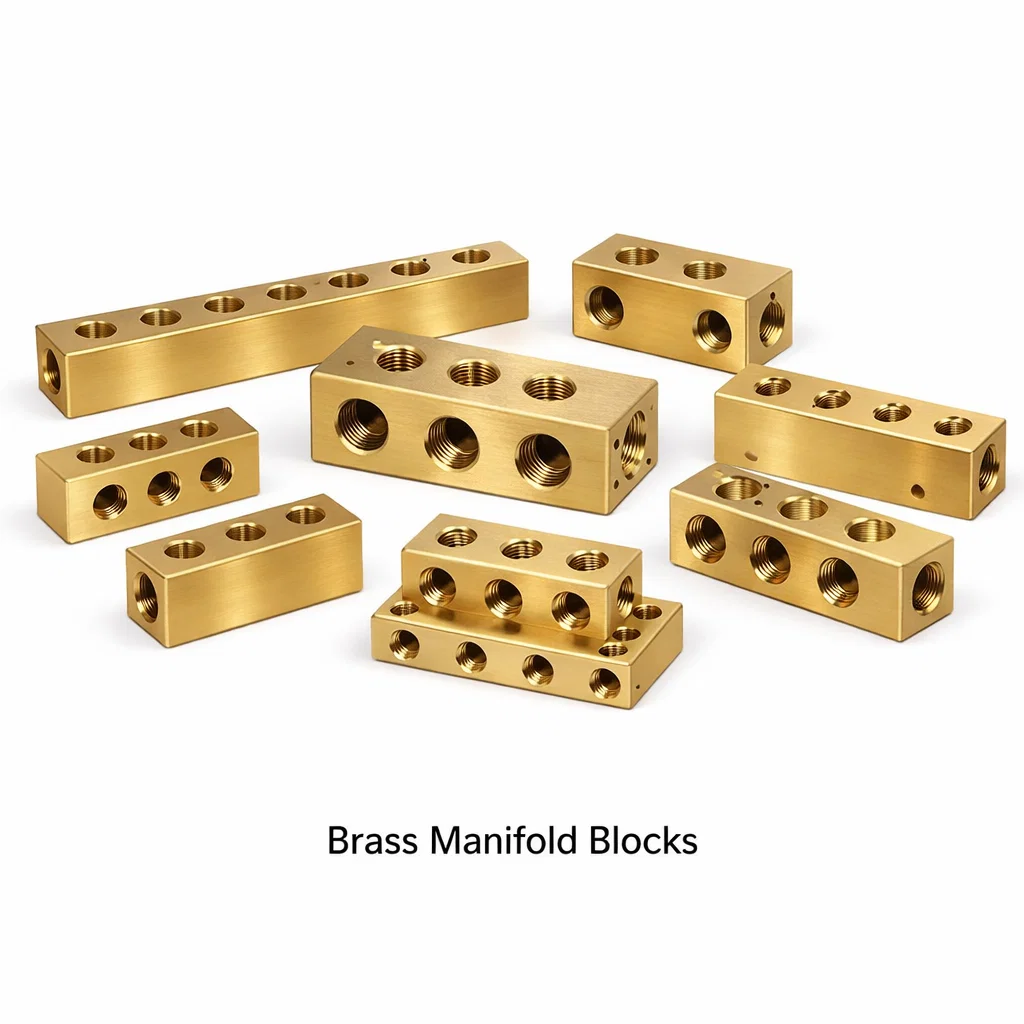
Jamnagar Brass Components manufactures custom brass manifold blocks for hydraulic, pneumatic, and fluid power systems. CNC machined from forged or extruded brass bar, our manifold blocks integrate multiple valves, ports, and flow paths into a single compact unit, replacing complex plumbing assemblies and reducing potential leak points.
What We Manufacture
We produce hydraulic manifold blocks for valve banks and directional control, pneumatic distribution manifolds for multi-zone air systems, fuel distribution manifolds for engine and industrial burner systems, modular manifolds with DIN or ISO standard porting for solenoid valve mounting, sandwich manifolds for stacking valve configurations, and custom fluid distribution blocks for OEM machinery. We work from customer drawings, P&ID diagrams, or functional specifications.
Materials and Thread Standards
Our manifold blocks are machined from CZ121 / C36000 free-machining brass for standard applications. For higher-pressure or corrosive service, we offer CW617N naval brass and CW602N DZR brass alternatives. Port connections are machined to BSP (BSPP/BSPT) to BS EN ISO 228 and BS 21, NPT/NPTF to ASME B1.20.1 and B1.20.3, SAE straight thread (UNF) to SAE J1926, JIC 37 flare to SAE J514, and metric M thread to ISO 6149.
Pressure Testing
All brass manifold blocks are hydrostatically pressure tested after machining. Standard manifolds are tested to 1.5x the maximum rated working pressure, with our brass manifolds rated for working pressures up to 600 bar depending on design and wall thickness. Pneumatic manifolds are submersion tested for leaks.
Quality and Documentation
Our quality management system is certified to ISO 9001:2015. We provide dimensional inspection reports, pressure test certificates, material test certificates, and compliance declarations with each manifold shipment.
Why Choose Jamnagar Brass Components?
Our combined in-house CNC machining, drilling, threading, and pressure testing capabilities allow us to produce complete, tested manifold assemblies ready for installation. Our India-based manufacturing delivers significant cost savings compared to European or US manifold suppliers, with the same quality standards and documentation. Contact us to discuss your hydraulic or pneumatic manifold block requirements.
Frequently Asked Questions — Brass Manifold Blocks
Q1: What is a brass manifold block?
A brass manifold block is a precision-machined component with multiple internal passages, ports, and thread connections that distribute or combine fluid flows from a single inlet to multiple outlets (or vice versa). Manifold blocks replace multiple individual fittings and hoses, reducing potential leak points, saving assembly time, and improving system reliability in hydraulic, pneumatic, and fluid control systems.
Q2: What thread standards are available on brass manifold blocks?
We machine ports to all standard thread forms: BSP (BSPP and BSPT) to ISO 228 and BS 21, NPT and NPTF to ASME B1.20.1/B1.20.3, UNC/UNF and metric M-threads for mounting and instrument ports, JIC 37-degree flare per SAE J514, and O-ring face seal (ORFS) per SAE J1453. Mixed thread standards on a single manifold block are available to match system requirements.
Q3: What brass alloy is used for manifold blocks?
Most brass manifold blocks are machined from CZ121/C36000 free-machining brass bar, which provides excellent machinability for the complex cross-drilling and port machining required. For higher pressure applications (above 200 bar), forging brass CW617N/C37700 or naval brass C46400 is used. DZR brass (CW602N) is specified for hot water and potable water manifold applications.
Q4: What pressure ratings apply to brass manifold blocks?
Brass manifold blocks machined from CZ121 bar are typically rated to 100–200 bar (1,450–2,900 psi) working pressure for hydraulic applications, depending on port geometry, wall thickness, and thread type. Pneumatic manifolds operate at 10–20 bar. Pressure test certificates at 1.5× working pressure are available on request. For pressures above 200 bar, steel or stainless steel manifold material is recommended.
Q5: Can you manufacture custom brass manifold blocks to drawing?
Yes. All brass manifold blocks are manufactured to customer drawings or specifications. We require 2D CAD drawings (PDF, DWG, DXF) or 3D STEP/IGES models showing port positions, thread specifications, passage diameters, and tolerance requirements. Our engineers review drawings for manufacturability and confirm cross-drilling feasibility before production. DFM advice is included at no charge.
Q6: How are internal passages checked in brass manifold blocks?
Internal passage integrity is verified by hydraulic pressure testing at 1.5× to 2× rated working pressure, with all unused ports plugged. Flow testing at rated flow rate confirms passage sizing. Ball-plugged cross-drillings are leak-tested at system pressure. Dimensional inspection of all ports and external features is conducted using CMM or air gauging. Inspection reports are supplied with each batch.
Q7: What is the typical size range for brass manifold blocks?
Brass manifold blocks range from small instrument manifolds (25×25×50 mm, 2–4 ports) to large distribution manifolds (200×100×150 mm, 12–24 ports). We machine from solid bar up to 150 mm diameter and 600 mm length. For larger manifolds, we start from forged brass billets. Machined manifolds up to 15 kg are within standard CNC machining centre capacity.
Q8: What is the difference between a brass manifold block and a brass valve block?
A manifold block distributes fluid passively without flow control — it simply routes fluid between ports through drilled passages. A valve block incorporates threaded cavities for cartridge valves, solenoid valves, or check valves that actively control flow direction, pressure, and volume. We manufacture both types, with valve block cavities machined to standard Cetop/ISO or cartridge valve cavity dimensions.
Q9: Are brass manifold blocks available with surface treatment?
Yes. Surface treatment options for brass manifold blocks include natural brass (bright machined, lacquered), nickel plating (5–15 µm electrolytic nickel for corrosion protection), chrome plating (decorative), and zinc/chromate plating. Nickel-plated brass manifold blocks are commonly specified for hydraulic systems exposed to moisture, salt spray, or outdoor environments.
Q10: What is the lead time and minimum order for custom brass manifold blocks?
First article lead time for custom brass manifold blocks: 2–4 weeks from approved drawings for standard-complexity designs; 4–6 weeks for complex multi-circuit manifolds requiring special fixturing. Minimum order: 5–10 pieces for first articles; 25–50 pieces for production orders. Repeat orders on established programs: 2–3 weeks production lead time.
📧 Get a Free Quote Today
Contact Jamnagar Brass Components for your custom manufacturing requirements.
Our engineers respond within 24 hours with competitive pricing and full technical documentation.
🏭 Manufactured in Jamnagar, India · 📦 Exporting to USA, UK, Europe & Worldwide · ✅ ISO 9001:2015 Certified