
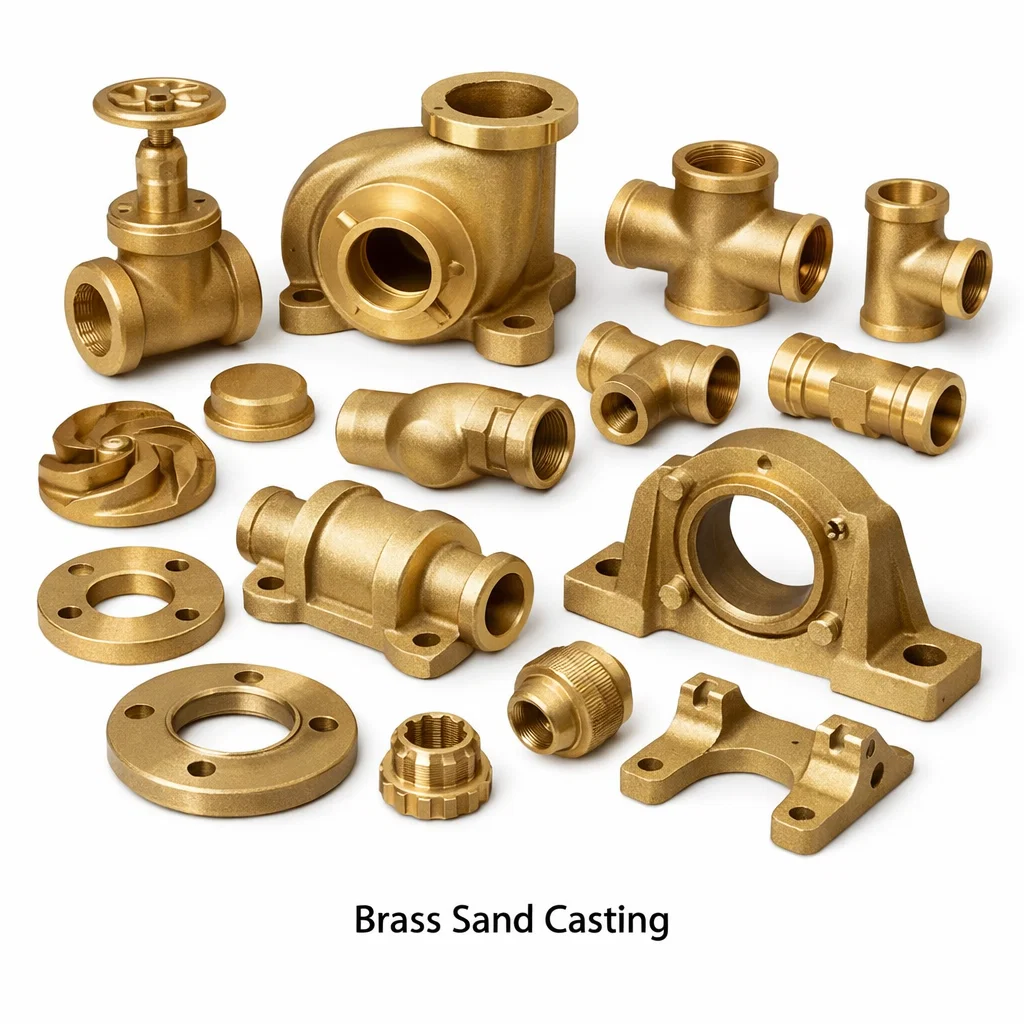
Jamnagar Brass Components manufactures sand cast brass parts and components for the valve, pump, plumbing, architectural, and general engineering industries. Using both green sand and resin-bonded sand casting processes, we produce complex shapes that would be difficult or uneconomical to machine from solid bar, delivering near-net-shape castings with excellent dimensional repeatability.
Brass Alloys Available for Sand Casting
We cast a range of copper-zinc alloys to international standards. CZ121 / C36000 leaded brass is used for general engineering castings where good machinability is required. CW617N / C37700 forging brass provides higher strength for pressure-bearing applications. Naval brass (CW712R / C46400) offers superior corrosion resistance for marine and offshore components. Manganese brass delivers high strength and corrosion resistance for heavy engineering. We can also cast to customer-specified alloy compositions with full material test certificates.
Products We Manufacture
Our brass sand castings include valve bodies and bonnets, pump housings and impeller casings, pipe fittings and manifolds, architectural hardware and decorative fixtures, plumbing components and tap bodies, electrical housing and enclosure components, and custom industrial components from customer drawings. We handle prototype quantities through to medium-volume production runs.
Process & Capabilities
Our sand casting facility uses both green sand (for standard castings) and resin sand / no-bake processes (for improved surface finish and dimensional accuracy on more complex geometries). Typical casting weights range from 0.1 kg to 50 kg. After casting, components are shot-blasted and then machined to final dimensions on our CNC turning and milling centres. Surface finishes available include as-cast, machined, polished, nickel-plated, and chrome-plated.
Standards & Quality
Our brass sand castings are produced in accordance with ASTM B584 (copper alloy sand castings for general applications) and BS 1400 (copper alloy ingots and castings). Each casting is visually inspected and dimensionally checked, with pressure testing available for hydraulic and pneumatic applications. Material test certificates confirming chemical composition and mechanical properties are provided with each shipment. Our quality management system is certified to ISO 9001:2015.
Why Choose Jamnagar Brass Components?
Based in Jamnagar — India’s recognised centre for brass manufacturing — we combine traditional foundry expertise with modern CNC finishing capabilities. Our competitive India-based pricing, combined with proven export experience to the USA, UK, and Europe, makes us a reliable and cost-effective casting partner. Contact us to discuss your brass sand casting requirements and receive a competitive quotation.
Frequently Asked Questions — Brass Sand Casting
Q1: What is brass sand casting?
Brass sand casting is a manufacturing process where molten brass alloy is poured into a sand mould cavity to produce shaped components. It is ideal for complex geometries, valve bodies, pump housings, architectural fittings, and custom engineering parts that are difficult to machine from solid bar stock.
Q2: What brass alloys are used in sand casting?
Common brass alloys for sand casting include CZ121/C36000 (free-machining brass), CW617N/C37700 (forging brass), naval brass CW712R/C46400 for marine applications, and manganese brass for high-strength requirements. The choice depends on the required mechanical properties, corrosion resistance, and application environment.
Q3: What tolerances are achievable with brass sand casting?
Brass sand casting typically achieves CT8 to CT10 tolerances per ISO 8062, equivalent to ±1.5 to ±3 mm on medium-sized castings. For tighter tolerances, machining allowance is added and the casting is finish-machined to CT5 or better. Critical dimensions can achieve ±0.25 mm after CNC machining.
Q4: What is the minimum and maximum casting weight for brass sand castings?
Brass sand castings range from as small as 50 grams (small valve components) to over 200 kilograms (large pump housings and manifold blocks). Green sand casting is suited for smaller pieces, while resin-bonded sand (no-bake) is preferred for larger, heavier castings requiring higher dimensional accuracy.
Q5: How does brass sand casting compare to die casting?
Sand casting has lower tooling costs (USD 500–3,000 for a pattern vs. USD 5,000–30,000 for a die), handles larger and more complex shapes, and suits low-to-medium production volumes. Die casting offers tighter tolerances, better surface finish, and lower per-piece cost at high volumes (above 1,000 pieces per year).
Q6: What surface finish is achievable from brass sand castings?
As-cast surface finish for brass sand castings is typically Ra 6–25 µm (250–1000 µin), depending on sand type and mould quality. Resin-bonded sand gives better finish than green sand. Post-casting machining, polishing, or electroplating can achieve any required surface finish including mirror polish for decorative applications.
Q7: What lead time can I expect for new brass sand castings?
For new patterns, brass sand casting lead time is typically 3–5 weeks from approved drawings: 2–3 weeks for pattern manufacture, followed by 1–2 weeks for first casting, shot blasting, and inspection. Repeat orders on existing patterns ship in 2–4 weeks. Expedited prototype castings can be produced in 7–10 working days at premium pricing.
Q8: Can brass sand castings be pressure tested?
Yes. Pressure testing of brass sand castings (valve bodies, pump housings, manifold blocks) is a standard quality procedure at Jamnagar Brass Components. Hydraulic pressure tests at 1.5× to 2× working pressure are conducted per customer specification. Test certificates are provided with each batch of castings for quality records.
Q9: What is the minimum order quantity for brass sand castings?
Minimum order quantity is 1–5 pieces for new pattern development (prototype/first-article pricing). Repeat production orders typically have a minimum of 10–25 pieces per run to achieve economical batch pricing. For established patterns with regular demand, minimum orders can be as low as 5 pieces with appropriate pricing adjustment.
Q10: Are brass sand castings suitable for potable water applications?
Yes, when the correct alloy is selected. DZR brass (CW602N), silicon brass, or NSF 372 low-lead alloys (max 0.25% weighted average lead) are specified for potable water valves, fittings, and pump components in the USA and UK. We provide material test certificates confirming alloy composition and lead content compliance with applicable standards.
📧 Get a Free Quote Today
Contact Jamnagar Brass Components for your custom manufacturing requirements.
Our engineers respond within 24 hours with competitive pricing and full technical documentation.
🏭 Manufactured in Jamnagar, India · 📦 Exporting to USA, UK, Europe & Worldwide · ✅ ISO 9001:2015 Certified